Indoor air quality modeling depends on one thing first: good data.
Indoor environments change constantly. Occupancy, outdoor pollution, weather, room usage, and HVAC system behavior all affect indoor air quality throughout the day. That is why reliable IAQ insights do not start with AI or dashboards. They start with clean, structured, and usable data.
Many buildings already collect large amounts of information from sensors and building systems. But raw data alone is not enough. It is often noisy, incomplete, inconsistent, or poorly aligned across systems. If the data quality is weak, the results will also be weak. Poor input leads to poor predictions, poor analysis, and poor building decisions.
Why Indoor Air Quality Modeling Needs Better Data
To improve indoor air quality modeling, data from several sources often needs to be combined. This can include indoor air quality monitoring data, outdoor pollution levels, weather conditions, ventilation or HVAC runtime data, and building-specific information such as room use or layout. Some of this is dynamic and changes every minute, while some remains relatively stable. The challenge is making all of it work together.
How IAQ Data Is Prepared for Analysis
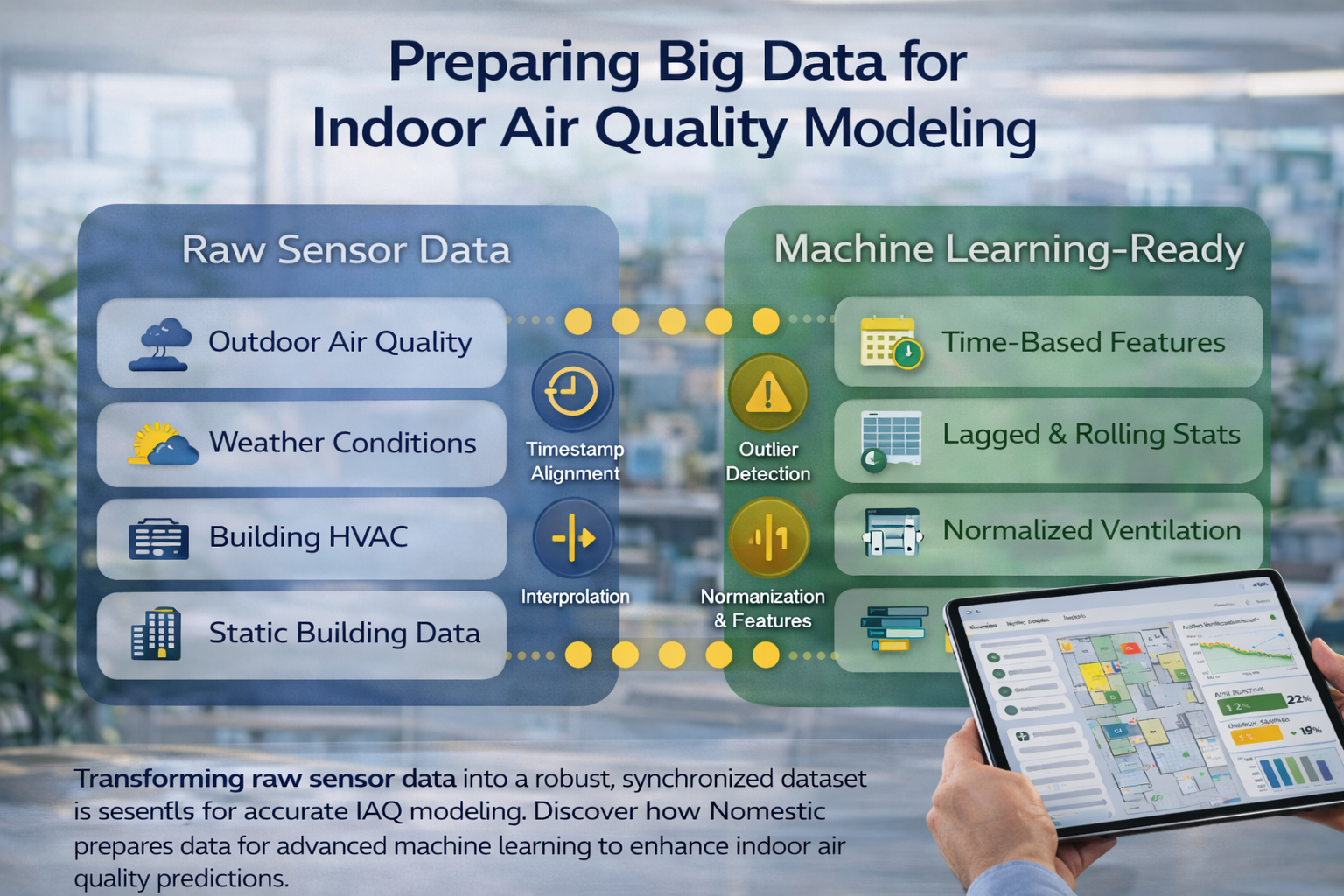
A strong IAQ data pipeline usually starts with timestamp alignment so all data follows the same timeline. Then comes data cleaning, where sensor spikes, invalid readings, and unrealistic values are removed. Missing data must also be handled carefully, often through interpolation or context-aware estimation. After that, variables are normalized so they can be used consistently in analytics and machine learning workflows.
Turning Raw Data into Useful Signals
But good indoor air quality data is not just clean. It must also be meaningful. This is where feature engineering becomes important. Time-based features such as hour of day, day of week, and occupancy trends help explain recurring patterns. Lagged values and rate-of-change indicators help reveal whether conditions are improving, worsening, or becoming unstable. These steps turn raw measurements into useful signals for IAQ modeling and HVAC optimization.
Why Consistency Matters in Real-World Deployment
Consistency also matters. If data is prepared one way during model development and another way during real-world deployment, results quickly become unreliable. The same preprocessing, scaling, and feature logic should be used every time.
This matters because indoor air quality monitoring is not only about seeing data. It is about making better operational decisions. Poor data can lead to delayed action, wasted HVAC energy, and recurring comfort complaints. Good data supports faster detection, better root-cause analysis, and smarter building performance improvements.
How Nomestic Helps
At Nomestic, we help building teams go beyond monitoring. Our Indoor Climate Intelligence Platform combines room-level sensing, predictive analytics, workflows, control, verification, and reporting to detect ventilation performance issues, identify likely causes, and turn room-level data into clear actions and verified results.
The future of indoor air quality modeling is not about collecting more data. It is about using better data to make better decisions.