Technology
BACnet and Modbus explained for building owners
BACnet and Modbus are two protocols building equipment uses to share data. Who maintains each, how they differ, and what to ask your installer.

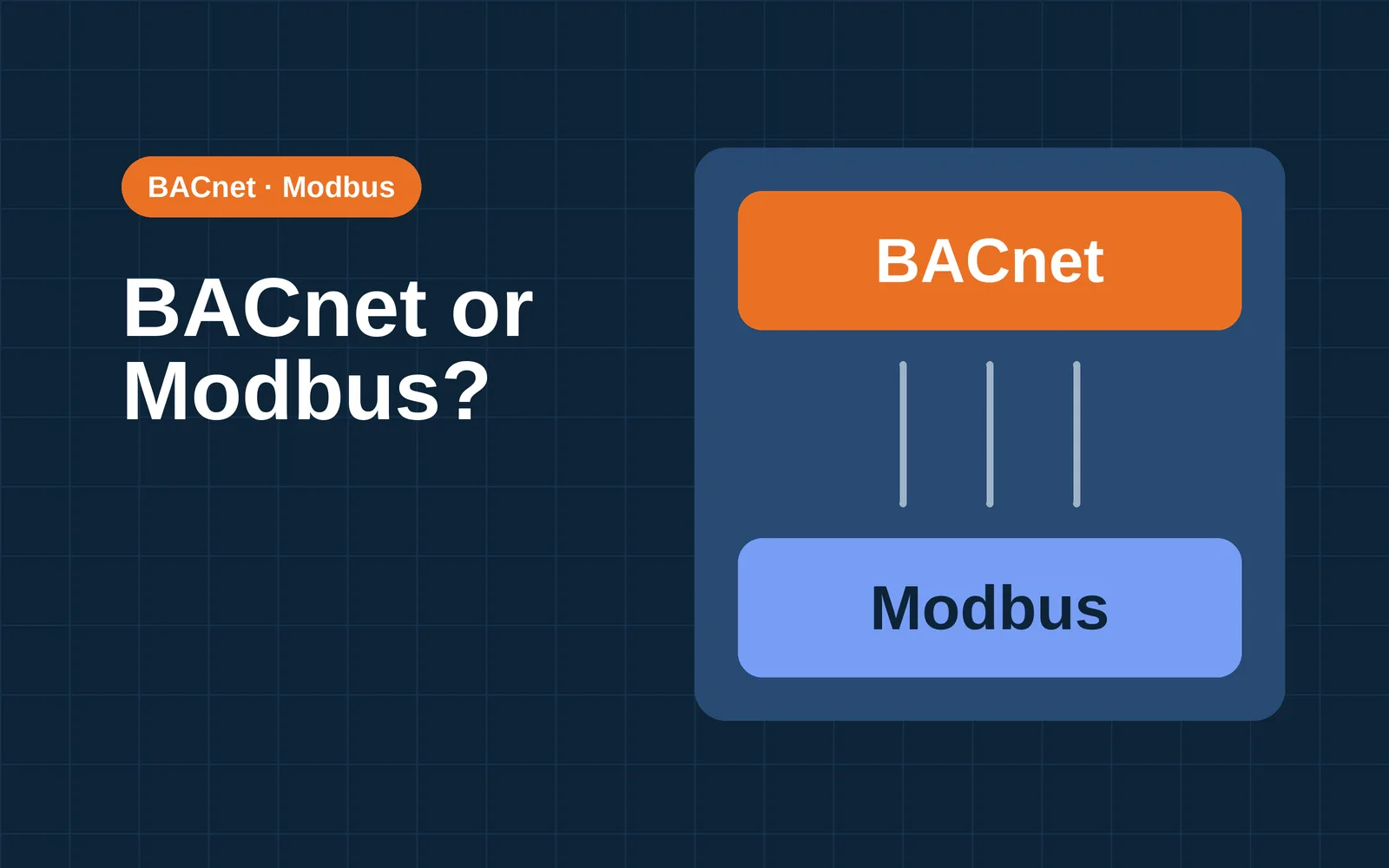
BACnet and Modbus are two protocols used when building equipment has to share data. A protocol is an agreed set of rules for messages between devices. BACnet was written for building automation and is maintained by ASHRAE. Modbus was introduced by Modicon in 1979 for programmable logic controllers (PLCs) and is maintained by the Modbus Organization. Neither is a product, and one device can support either or both.
What BACnet is
BACnet is defined by ANSI/ASHRAE Standard 135, which sets out data communication services and protocols for computer equipment used for monitoring and control of building systems. The ASHRAE BACnet Committee (SSPC 135) develops and maintains the standard, and it is also an ISO standard, ISO 16484-5. The 2024 edition, ANSI/ASHRAE 135-2024, was announced on 31 December 2024 and includes 17 addenda to the 2020 edition. They include support for configuring BACnet Secure Connect (BACnet/SC) and managing its certificates.
The protocol describes equipment as objects. An object is a standard building block such as an analog input (a sensor reading), a schedule or an alarm, and each has properties such as its present value or alarm limits. Services are the standard messages that read or write those properties. Devices can be found and identified on a network with the standard Who-Is and I-Am messages.
It runs over several kinds of network. BACnet/IP uses ordinary IP networks, and MS/TP is a serial field bus over RS-485 wiring, commonly used for controllers and sensors. BACnet/SC adds encryption based on TLS 1.3, runs over secure web connections without a VPN and works with BACnet/IP and MS/TP networks, according to INCIBE-CERT, part of the Spanish cybersecurity institute INCIBE.
Products can be BTL certified. BACnet International, an association of building owners, consulting engineers, facility managers and manufacturers that promotes the successful use of BACnet, works through the BACnet Testing Laboratories (BTL), which manages a global product certification program. Its own FAQ says all BACnet products should be BTL tested for a high level of interoperability, and that BTL certificates are a regulatory requirement in project submittals in some countries and regions.
What Modbus is
The Modbus Organization describes Modbus as a messaging structure for client-server communication between intelligent devices. The organization is an independent, member-based non-profit, and it says no licensing fees are required to use Modbus or Modbus TCP/IP.
Modbus keeps data in four tables: discrete inputs (single bits, read-only), coils (single bits, read-write), input registers (16-bit values, read-only) and holding registers (16-bit values, read-write). One device (the client) sends a request with a function code, and the other (the server) answers. On serial lines it can run as Modbus RTU, a compact binary format, over links such as RS-232 or RS-485. On Ethernet it can run as Modbus TCP/IP, which uses port 502. The Modbus Organization also lists a Modbus Security Protocol that adds TLS and X.509 certificates, and EMQX, an IoT software vendor, notes that the basic protocol has no security features.
How BACnet and Modbus differ
One difference is what the data means. A Modbus register is a number at an address, and what it holds is left to each device maker. BACnet International puts it this way: Modbus defines message encoding and physical connections but does not address the meaning of messages, so an integrator must learn how each device represents its information and build an interface for it. That comparison comes from the BACnet side, and the Modbus Organization pages describe the messaging structure without making the same point.
BACnet is used to share data between building automation devices from different manufacturers, and ANSI lists HVAC, lighting control, access control, elevators and fire detection among the systems it covers. Modbus is found on individual equipment as well. A Schneider Electric energy meter (iEM3155) lists a Modbus 485 communication port, and EMQX's example of a Modbus RTU network links digital power meters and variable frequency drives. Some devices offer both: ABB's ACH580 HVAC drive lists BACnet MS/TP and Modbus RTU as standard on its RS-485 terminal.
EMQX rates Modbus as faster and simpler to configure but less suited to large systems, and BACnet as richer in data types but more complex to set up. That is a vendor view, and a manufacturer's documentation for a given device settles what it supports.
A building can have both. When two systems speak different protocols, a protocol converter can sit between them. A 1997 overview reproduced by BACnet International describes gateways, which translate between BACnet and non-BACnet protocols. The article on what a building management system is covers the system itself, and BEMS vs BMS explains the naming.
EU law touches this point. Article 13(10)(c) of Directive (EU) 2024/1275 asks that a building automation and control system be able to communicate with connected technical systems and work across different technologies, devices and manufacturers. The text names no protocol. Which protocols a building needs depends on its equipment, and national rules may say more.
Questions to ask an installer or vendor
- Which protocol does each device speak, and over which network: IP or serial RS-485?
- Are the BACnet products BTL listed?
- For Modbus devices, who supplies the register list, and who maps it to the system?
- Is anything on the network reachable from outside the building, and is encryption such as BACnet/SC available?