Technology
Building automation systems and indoor air quality monitoring: how they fit together
A building automation system acts on the air quality sensors it has. What it does with CO2 data, what the EU text asks of a BACS, and what room-level monitoring adds when few zones have sensors.

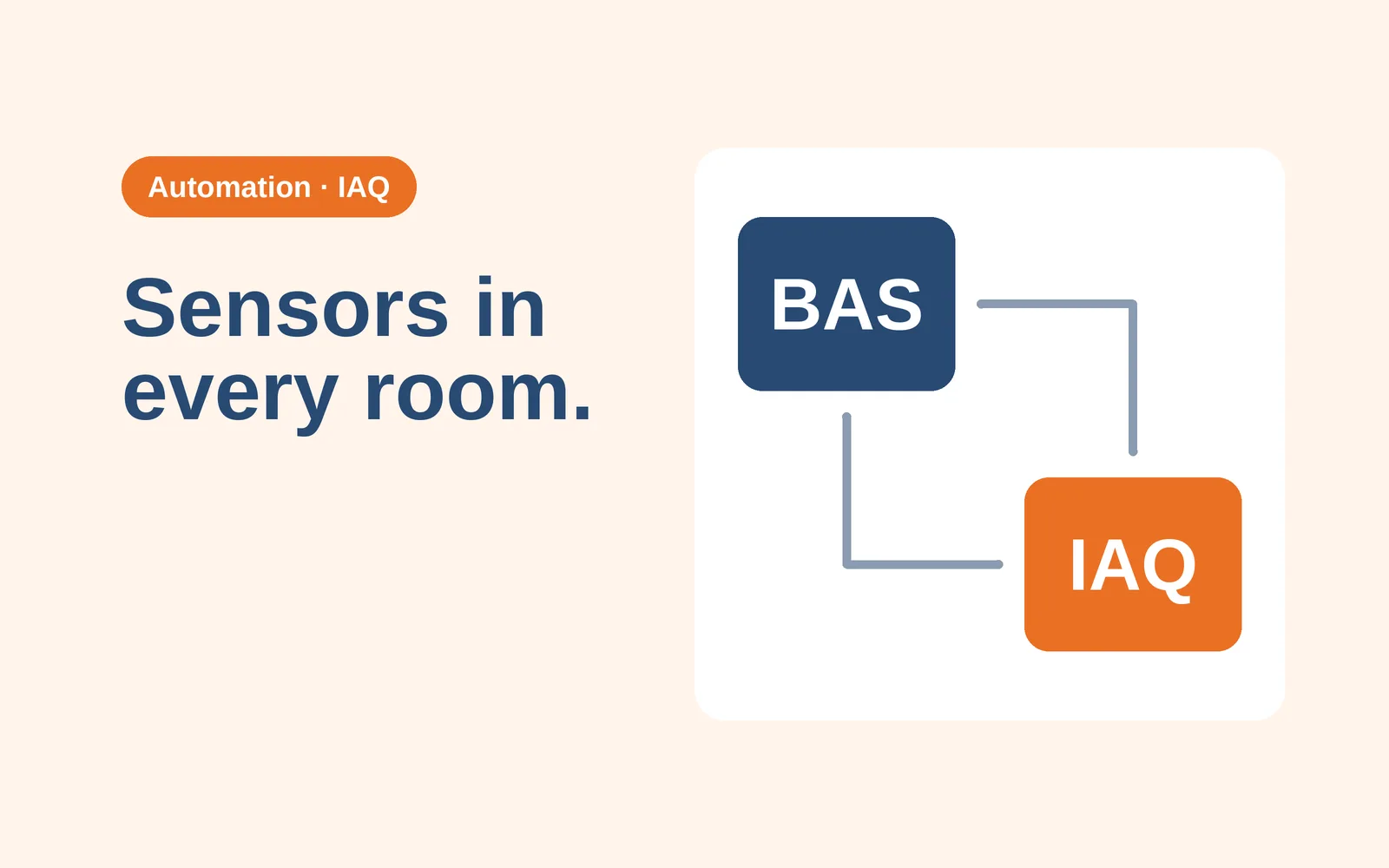
A building automation system (BAS) reads sensors and adjusts equipment, and air quality can be one of the signals it reads. How well that works in a given room depends on whether the room has a sensor. Where a BAS has CO2 sensors in only some zones, room-level monitoring adds readings for the rest, with or without a central building management system (BMS).
What a building automation system does with air quality data
ANSI/ASHRAE Standard 62.1-2022 addendum ab covers CO2-based demand-controlled ventilation, in which a zone's reading raises or lowers the outdoor air supplied to that zone. Its Table 6-1 lists a maximum CO2 above ambient for each space type (600 ppm for office space) and lets ambient be assumed at 400 ppm. ASHRAE Guideline 36-2021, High-Performance Sequences of Operation for HVAC Systems, as revised by its addendum q, adds that differential to ambient (400 ppm by default) to get each zone's CO2 maximum and switches the demand loop off when the zone is not in occupied mode.
Addendum q also sets alarm logic for zones with CO2 sensors. A level 3 alarm is raised if CO2 reads below 300 ppm, or above 600 ppm after more than 2 hours in unoccupied mode, with text saying the sensor may be out of calibration. A second level 3 alarm is raised if CO2 exceeds the maximum plus 10% for more than 10 minutes.
REHVA's page on the eu.bac and REHVA guide to EN ISO 52120-1 (26 May 2026) gives example audit questions that cover both sensors and records: were CO2 sensors installed and linked to the ventilation system, and are trend logs recording energy and climate data. An eu.bac guide on the standard that replaces EN 15232 lists a new demand-based function for supply air flow at room level, dependent on the air quality demand, measured for example by CO2 or VOC.
What the EU text asks of a building automation and control system
EU law calls it a BACS. Article 2(7) of Directive (EU) 2024/1275 defines it as a system comprising all products, software and engineering services that can support energy-efficient, economical and safe operation of technical building systems through automatic controls and by facilitating their manual management. Article 13(9) has Member States set requirements so that, where technically and economically feasible, non-residential buildings are equipped with BACS: by 31 December 2024 where heating or air-conditioning output (alone or combined with ventilation) is over 290 kW, and by 31 December 2029 where it is over 70 kW. Article 13(10)(d) adds that by 29 May 2026 the system must be able to monitor indoor environmental quality. As reproduced by LawPlayer, point (d) reads "by 29 May 2026 monitoring of indoor environmental quality" and names no parameters and no spaces.
Article 13(5) is separate. It asks for measuring and control devices for indoor air quality in non-residential zero-emission buildings, and in existing non-residential buildings undergoing major renovation where feasible. National law decides which buildings are covered and when, and dates differ by country. The Official Journal text on EUR-Lex is the authoritative version. The EPBD on one page gives the overview. This is general information, not legal advice.
EN ISO 52120-1:2022 (energy performance of buildings, contribution of building automation, controls and building management) specifies a structured list of control and management functions, a method to define minimum requirements and a factor-based method for a first estimate of their effect, according to the listing of EVS, the Estonian standards body. The standard is paywalled. Building automation for buildings without a BMS goes through the classes.
What a few zone sensors miss
ASHRAE has addressed one shortcut. In interpretation IC 62.1-2013-6 (approved 16 March 2017), a requester proposed CO2 sensors in the return air of a multiple-zone system to estimate total occupants and adjust outdoor air for the whole system. ASHRAE answered no, commenting that besides the total number of people one must identify in which zones they are, and that the multiple-zone process requires at least the minimum ventilation for each zone.
The sensors a BAS does have need checking too. In LBNL report 3279E (Fisk et al., 2010), 40% of 208 single-location CO2 sensors in 34 commercial buildings were off by more than 75 ppm at 1,010 ppm, and 19% by more than 200 ppm. No facility manager said they had calibrated a sensor since installation. Across 113 pairs, error estimates from the energy management system and from the sensor display differed by 25 ppm on average, which the authors read as showing that the large errors were sensor errors. In meeting rooms, concentrations at different wall-mounted sample points sometimes varied by more than 200 ppm.
A room without its own sensor is controlled by a schedule or by another room's reading (general reasoning). Room-level data: the missing layer in most buildings covers that gap, and why one CO2 sensor per floor misses the problem rooms covers the floor-level version.
What room-level monitoring adds to a building automation system
This section is reasoning, not a published study. Room-level monitoring gives a BAS with a few zone sensors three things. It gives a reading for each room the zone sensors do not cover. It gives a second, independent reading in rooms they do cover, so a drifting sensor shows up before it crosses an alarm limit. And it keeps a record of what the room did after the BAS acted.
The 2025 model indoor environmental quality regulation, prepared by the Nordic Ventilation Group and the REHVA Technology and Research Committee and reviewed by Eurovent, is an example text whose numeric values are examples, not law. Its explanatory report says airflow control in demand-controlled systems can be designed for individual rooms or larger zones, names room CO2 and occupancy sensors as commonly used in practice, and recommends testing CO2 sensor accuracy against a reference sensor when a building is re-commissioned.
With or without a BMS
Sources use BAS, BMS and BEMS loosely. The EU's Joint Research Centre says a BAS is also known as a BMS or BEMS. What is a building management system and BEMS vs BMS sort out the names. Whether a central system can accept outside room readings, who may change its programming and who answers its alarms are questions for the vendor or integrator (practical suggestion).
Where there is no central system, ACEEE's November 2025 brief lists smaller options: networked thermostats, advanced rooftop unit controls (demand-controlled ventilation is one example it names) and light commercial building automation systems. Adding demand-controlled ventilation to a building without a BMS shows one case.
Questions to settle first
These are practical suggestions, not requirements.
- Which rooms have a CO2 sensor that feeds the BAS, and which are controlled by a schedule or by another room's reading?
- When was each of those sensors last checked against a reference?
- Who receives the alarms the BAS raises, and what do they do with them?
- Does a national rule apply to the building's heating and air-conditioning capacity in kW, and what functions does it list?
Nomestic measures indoor climate room by room (CO2, temperature, humidity and more) and works with or without a building management system. Nothing in the existing HVAC gets replaced, and operators can override automatic adjustments at any time. The devices are wireless and battery-powered, so a room takes minutes to equip.