Regulation
The EPBD on one page: what building owners need to know
What Directive (EU) 2024/1275 says about building automation and indoor environmental quality in non-residential buildings, and what an owner should check first.


The EPBD is the EU's Energy Performance of Buildings Directive, now Directive (EU) 2024/1275. For non-residential buildings it asks Member States to require building automation and control systems (BACS) above two power thresholds, and it says those systems must be able to monitor indoor environmental quality by 29 May 2026. Article 35 requires Member States to bring the laws needed to comply into force, so what the Directive means for an owner is set in the national or regional law that applies it, and the dates differ.
What the EPBD says about building automation
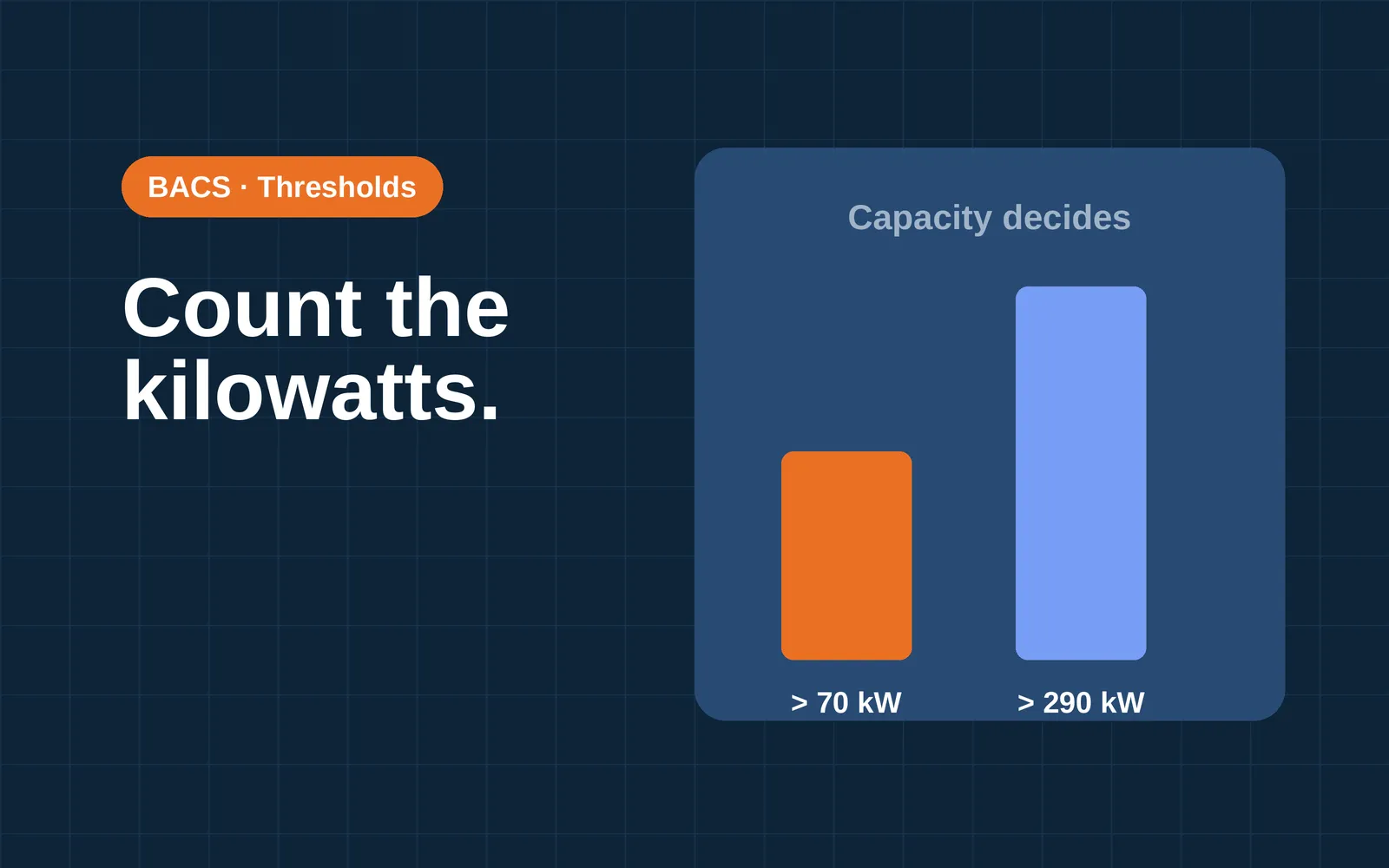
Article 13(9) asks Member States to require BACS in non-residential buildings where that is technically and economically feasible. Two tiers apply, both based on the effective rated output of heating systems, air-conditioning systems and systems that combine either with ventilation: over 290 kW by 31 December 2024, and over 70 kW by 31 December 2029. The trigger is power in kilowatts. Floor area is not part of it. How the kilowatts are counted is covered in Does the 290 kW or 70 kW threshold apply to your building?
Article 13(10) lists what such a system must be capable of: monitoring, logging, analyzing and allowing adjustment of energy use; benchmarking efficiency and detecting losses; communicating with connected technical building systems and working across manufacturers; and, by 29 May 2026, monitoring indoor environmental quality. Article 13(10)(d) does not list which indoor parameters to measure. That point and the exact wording are in EPBD indoor environmental quality monitoring: what the May 2026 date means. The Article 13 wording here follows the English copy on LawPlayer, cross-checked against German copies (gesetze.legal and gesetzefinden.at); the Official Journal text on EUR-Lex prevails.
Article 13(12) adds automatic lighting controls for the same two tiers, where feasible: over 290 kW by 31 December 2027 and over 70 kW by 31 December 2029. The controls must be zoned and able to detect occupancy.
How the Directive reaches a building
The energy performance of buildings directive entered into force on 28 May 2024. Member States had to bring most of its articles, including Article 13, into national law by 29 May 2026. On 15 July 2026 the European Commission sent letters of formal notice to all 27 Member States because they had not fully notified their national measures. A page that describes a national rule is only as good as its date, so check it. EPBD for non-residential buildings: what applies in NL, DE, FR, BE, AT and IE has the detail for six countries.
The feasibility condition is also handled nationally. Ireland's technical guidance (Department of Housing, undated) and the French ministry's BACS guide (January 2026), for example, describe payback tests with different limits, and the Flemish government reads "not feasible" as buildings that have only one of heating, cooling or ventilation.
What an owner should check
- The rated output in kW of each heating, air-conditioning and combined ventilation system, taken from nameplates or handover documents.
- Which national or regional rule applies to the building's location, its kW threshold, how it counts output and its date.
- Who carries the duty under that rule: the owner in some texts, the holder of a right over the systems in others.
- What the existing controls already do against the Article 13(10) functions, including indoor environmental quality monitoring.
- Whether a feasibility test applies and who has to carry it out.
Where to start with building automation compliance: a checklist for owners puts these in order. The list above is a practical suggestion, not a requirement of the Directive. Other parts of the Directive touch the same systems: Article 13(5) covers measuring and control devices for indoor air quality in non-residential zero-emission buildings and, where feasible, in existing non-residential buildings on major renovation, and Article 23(7) exempts buildings that comply with Article 13(10) or (11) from the inspection duty in Article 23(1). This is general information, not legal advice, and it does not say whether any building is covered. For the longer view, see future-proofing a building for the next regulation.