Regulation
Does the 290 kW or 70 kW threshold apply to your building?
How the BACS thresholds of 290 kW and 70 kW are measured in the EPBD, how separate systems are added up, and where national texts count differently.

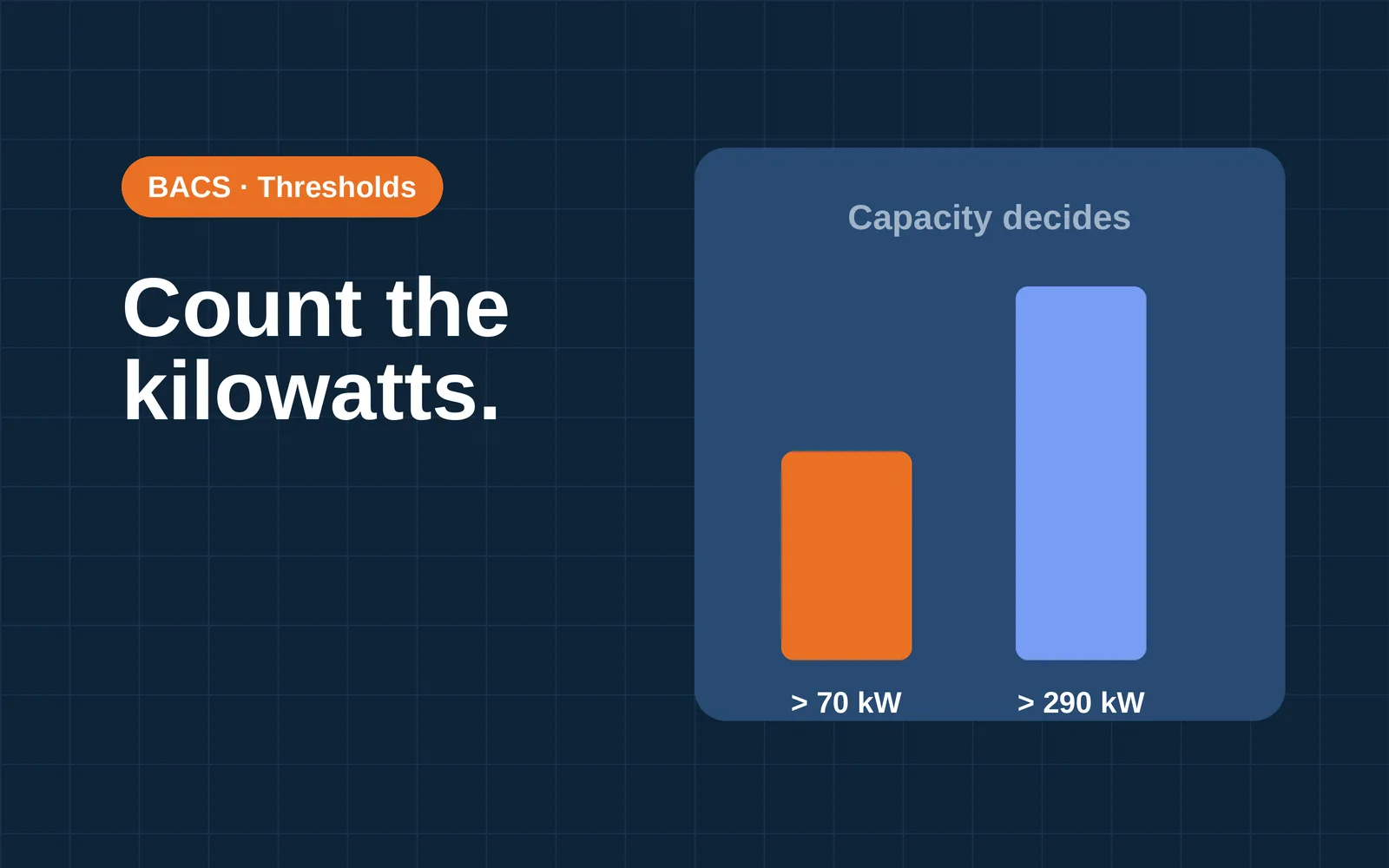
The BACS thresholds in the EPBD, 290 kW and 70 kW, are measured in kilowatts of effective rated output. Article 13(9) does not mention floor area, occupancy or the energy bill. BACS stands for building automation and control systems, and Directive (EU) 2024/1275 asks Member States to require them in non-residential buildings above those two lines, where technically and economically feasible. Which side of a line a building falls on depends on what is counted and how it is added up, and national texts do not all do that the same way.
What counts toward the BACS thresholds
Article 13(9) names four kinds of system: heating systems, air-conditioning systems, systems that combine space heating with ventilation, and systems that combine air-conditioning with ventilation. Ventilation on its own is not on the list. The first tier is an effective rated output over 290 kW by 31 December 2024, the second over 70 kW by 31 December 2029. Both say "over", so a rating of exactly 290 kW is not above the first line. The article wording here follows the English copy on LawPlayer and the German copy on gesetze.legal; the Official Journal text on EUR-Lex prevails.
Article 2(49) defines effective rated output as the maximum calorific output in kilowatts that the manufacturer specifies, deliverable in continuous operation at the useful efficiency the manufacturer indicates. Read plainly, that points to the data sheet or nameplate of each generator, and SEAI, Ireland's energy authority, takes the figure from handover documents or nameplate data. A measured load or a typical day's demand does not enter into it. The definition speaks of calorific output, and the copy read does not say how it applies to cooling capacity, so national texts deal with cooling in their own way.
How separate systems are added up
Article 13(9), in the copies read, has no sentence on adding up several boilers, heat pumps or chillers. Article 23 does, for inspections of heating, ventilation and air-conditioning systems above 70 kW: the output of a system is the sum of the rated outputs of its heat generators and its cooling generators. The copies read do not say whether that sentence also governs Article 13(9). National texts fill the gap in different ways:
- Netherlands and Flanders: the Dutch information point IPLO (page modified 4 September 2026) says the output for heating and for cooling is not added together, and that if either exceeds 290 kW the system falls under the GACS duty, the Dutch term for a BACS. Flanders' official page sets 290 kW for heating and a separate 290 kW for cooling, and adds up all generators that are hydraulically or cooling-technically connected. The Dutch enterprise agency RVO says to add the nominal capacity of the systems that heat or cool rooms where people stay and that the highest total value counts, without spelling out whether heating and cooling are combined.
- Ireland: two documents differ. The SEAI factsheet (undated, naming 31 December 2025, a date that S.I. No. 642 of 2024 changed to 31 December 2024) adds heating, air-conditioning and ventilation into one combined total, and its worked example adds boilers and an air-conditioning unit to 350 kW. The Department of Housing's technical guidance (undated) says the 290 kW threshold applies to each system individually (heating, combined heating and ventilation, air-conditioning, combined air-conditioning and ventilation) and that the outputs of units operating jointly in one system are summed.
- France: the ministry's application guide (version 2, January 2026; the decree text on Légifrance was not checked) treats several thermodynamic machines that produce heat or cold in the same building as one system whose power is the sum of theirs, treats boilers networked in one room as one boiler, takes the higher of heating and cooling power for a heat pump (measured to EN 14511), and otherwise uses the power of each system individually. It does not say outright whether heating and cooling plant are added together.
A hypothetical building with 200 kW of heating plant and 200 kW of cooling plant shows why the method matters. Counted separately, each figure is 200 kW. Added together, the total is 400 kW. Against a 290 kW line the two methods give different answers. The example is arithmetic only and says nothing about a real building.
Which date goes with which line
The Directive dates are 31 December 2024 for the 290 kW tier and 31 December 2029 for the 70 kW tier. National dates differ and, in Belgium and Austria, differ by region; the detail is in EPBD for non-residential buildings: what applies in NL, DE, FR, BE, AT and IE. Germany shows how far a national text can depart from the two-tier ladder. Its section 56 GModG sets one line for non-residential buildings, over 70 kW by 31 December 2029, and uses 290 kW only in the automation level required for new buildings. Germany's building automation rule now starts at 70 kW: what changed has the details.
Feasibility and who counts the kilowatts
Both tiers apply where technically and economically feasible, and national texts set out the test. Ireland's technical guidance from the Department of Housing (undated) has an independent competent professional complete the assessment and gives typical maximum paybacks of 10 years for public buildings and 3 years for other buildings; the SEAI factsheet gives the same figures. The French ministry guide describes an exemption for existing buildings where a study shows a payback of more than 10 years, net of aid and energy-saving certificates. Flanders' official page reads "not feasible" as buildings that have only one of space heating, cooling or ventilation. These are three different tests.
Who counts the kilowatts also differs. The RVO page puts the duty on the owner of a rented building. Flanders puts it on the owner or the holder of a right over the systems, which in some leases is the tenant. Where tenants run their own plant, SEAI's leased-buildings document (undated) says landlord and tenant systems should be assessed individually.
Where nameplate data is missing, the SEAI factsheet gives a fallback of 200 W per square meter of floor area to estimate capacity. That fills a data gap in one national factsheet. The Directive's test stays in kilowatts.
A practical suggestion is a table with one row per unit: rated output, type, the system it belongs to, who operates it and where the figure came from. With that table and the national text, an adviser or the competent authority can answer the scope question. Where to start with building automation compliance: a checklist for owners sets out the steps around it. This is general information, not legal advice.