Regulation
Germany's building automation rule now starts at 70 kW: what changed
Section 71a GEG (above 290 kW, end 2024) is repealed. Section 56 GModG covers Gebäudeautomation above 70 kW by end 2029. The functions, exemptions, in-force date and open points.

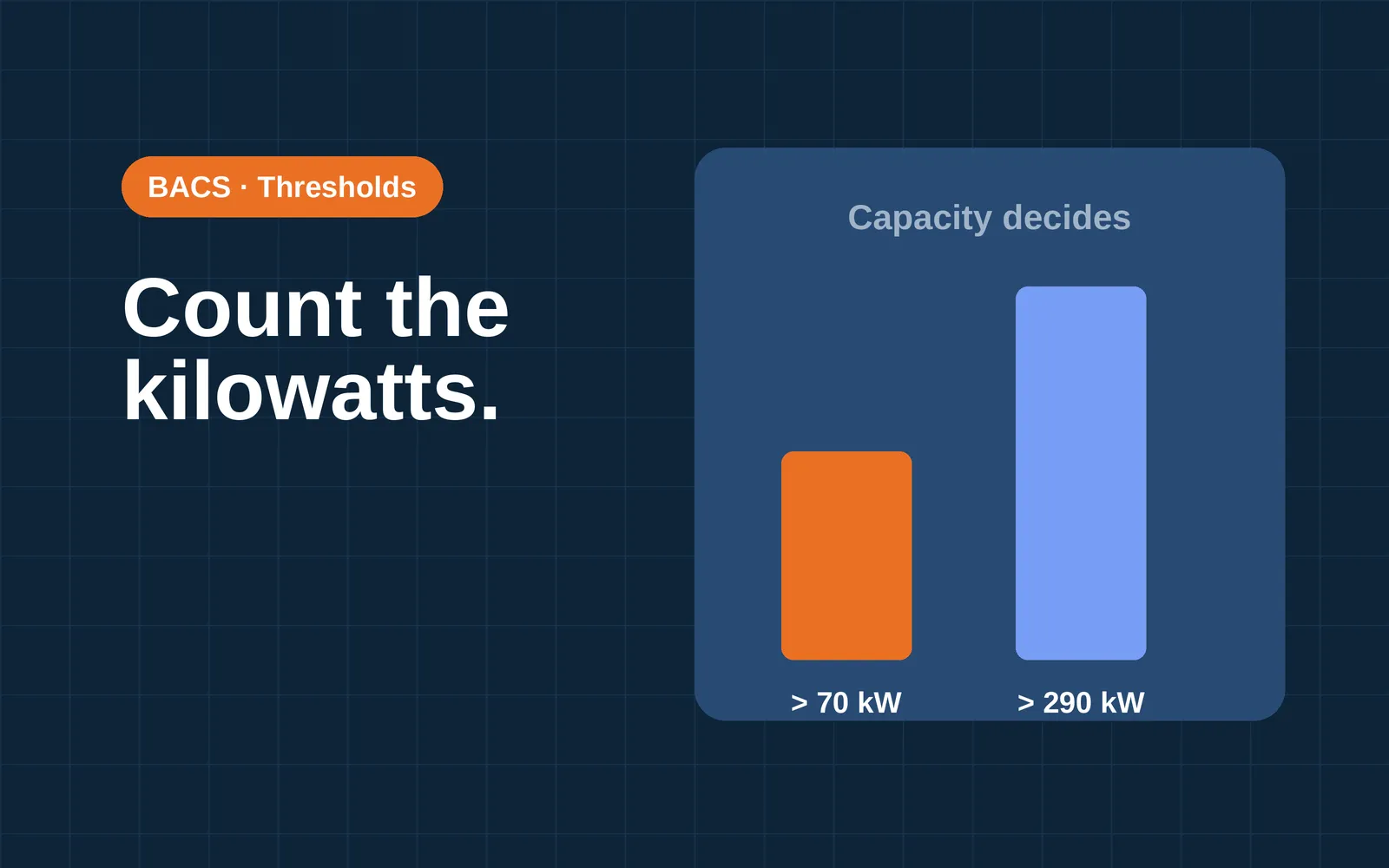
Germany's rule on Gebäudeautomation for non-residential buildings changed on 29 July 2026. It used to be section 71a of the Gebäudeenergiegesetz (GEG), with a threshold of 290 kW and a date of 31 December 2024. It is now section 56 of the Gebäudemodernisierungsgesetz (GModG, formerly the GEG), with a threshold of 70 kW and a date of 31 December 2029. What the change means for buildings that were already due under the old rule could not be confirmed, and the end of this article lists the other open points. It is general information, not legal advice, and it does not say whether any building is covered.
What changed from section 71a GEG to section 56 GModG
The old section 71a, in the version valid until 29 July 2026, applied to non-residential buildings with a heating system or a combined heating and ventilation system of "mehr als 290 Kilowatt" (and, in a second sentence, an air-conditioning system of that size). Such a building had to be equipped "bis zum Ablauf des 31. Dezember 2024". buzer.de now shows the section as repealed from 29 July 2026 under the law of 23 July 2026 (BGBl. 2026 I Nr. 226). The wording of section 71a read here has no exemption clause of its own. A separate section 73 headed "Ausnahme" in the old law was repealed with sections 71 and 72; its text was not read.
Section 56 has one threshold for existing buildings, 70 kW, and one date, 31 December 2029. The 290 kW figure survives only in the new-building rule in paragraph 3. Bundestag document 21/7797, a parliamentary question (Kleine Anfrage) of 28 August 2026 about the GModG and federal buildings, also gives section 56 as "in Kraft ab 29. Juli 2026" (Artikel 9 Absatz 1). That document is a question to the government and not the statute text, and the text of Artikel 9 was not read.
What section 56 GModG requires
Paragraph 1 covers a Nichtwohngebäude (non-residential building) whose heating system, combined heating and ventilation system, air-conditioning system or combined air-conditioning and ventilation system has a rated output "von mehr als 70 Kilowatt". The building has to be equipped with a system for Gebäudeautomatisierung und Gebäudesteuerung by the end of 31 December 2029, "es sei denn, die Ausrüstung ist technisch nicht möglich oder wirtschaftlich unzumutbar" (unless fitting it is technically impossible or economically unreasonable). Section 56 itself does not define "wirtschaftlich unzumutbar", and it does not say how several systems in one building are counted against 70 kW. Floor area is not part of the test.
Paragraph 1 is worded as a duty of the building and names no party. The owner (Eigentümer) appears in paragraph 4. Paragraph 5 takes some buildings out: paragraphs 1 to 4 do not apply to a building owned by the federal government, the allied armed forces or a company with federal participation that serves national and alliance defense (Landes- und Bündnisverteidigung). Section 108 (Bußgeldvorschriften) makes it an administrative offense, when done intentionally or recklessly, to fail to equip a non-residential building under section 56 paragraph 1 "nicht, nicht richtig oder nicht rechtzeitig". Section 108 paragraph 2 sets the fine for that case at up to 5,000 euros.
What the Gebäudeautomation system has to do
Paragraph 2 says the Gebäudeautomation system must be able to:
- monitor, log and analyze consumption continuously, for all main energy carriers and all building technical systems, and adjust the consumption of the main energy carriers
- make the collected data accessible through a common, configurable interface ("gängige und frei konfigurierbare Schnittstelle")
- set target values for the building's energy efficiency
- detect efficiency losses in building technical systems
- inform the operator about possible efficiency improvements
- monitor indoor climate quality ("die Raumklimaqualität zu überwachen")
This is close to the list in Article 13(10) of Directive (EU) 2024/1275, with one difference in dating. The Directive says the indoor environmental quality function applies "by 29 May 2026". The German paragraph attaches no separate date to Raumklimaqualität, and paragraph 1 gives 31 December 2029 for the system as a whole. Paragraph 2 names no parameters such as CO2 or temperature, and Article 13(10)(d) names none either; the EU article covers that wording.
New buildings have more to meet. Paragraph 3 adds an automation level (Automationsgrad) as defined in DIN/TS 18599-11:2025-10, level B for systems above 290 kW and level C for systems above 70 kW. It also requires a technical commissioning process (Inbetriebnahme-Management) that includes adjusting the building technical systems (Einregelung) and covers at least one heating period for heat generation and one cooling period for cooling. Paragraph 6 adds automatic lighting control by 31 December 2029 for buildings with a system above the paragraph 1 threshold, with the same kind of exemption. The control should be zoned appropriately and have occupancy detection (Belegungserkennung).
The transition rule for existing buildings
Paragraph 4 is a transition for existing non-residential buildings. Where a system for building automation that does not meet the requirements of paragraph 2 was installed in a building in the period of up to three years before 1 January 2027, the owner may carry out the retrofit needed to meet paragraph 1 after 31 December 2029. The paragraph ends "Die Frist zur Erfüllung dieser Verpflichtung beträgt zehn Jahre", that the period for meeting the obligation is ten years. It does not say when the ten years start or end.
That paragraph deals with recent installations. It does not say what happens to a building that had to be equipped by 31 December 2024 under section 71a and was not. No transitional rule on that point turned up, and the law's own transitional provisions were not read.
What could not be confirmed
- How section 56 treats buildings that were due under section 71a (above 290 kW, 31 December 2024).
- When the ten-year period in paragraph 4 starts and ends. The paragraph does not say.
- Which authority supervises section 56. Only the fine provision in section 108 was found.
- The text of section 73 ("Ausnahme") in the old law, and whether any exemption outside section 56 applies to building automation.
An owner who wants to see where a building stands can start with the rated output of each heating, ventilation and air-conditioning system in kW, as shown on the equipment, and with what the existing Gebäudeautomation can already do against the six functions in paragraph 2. The kW threshold article explains how the 290 kW and 70 kW tiers work at EU level, and the country overview puts the German rule next to the other countries.