Regulation
Future-proofing a building for the next regulation
The EPBD dates already set, two announced standards revisions, and practical steps for building automation that follow from rules already adopted.

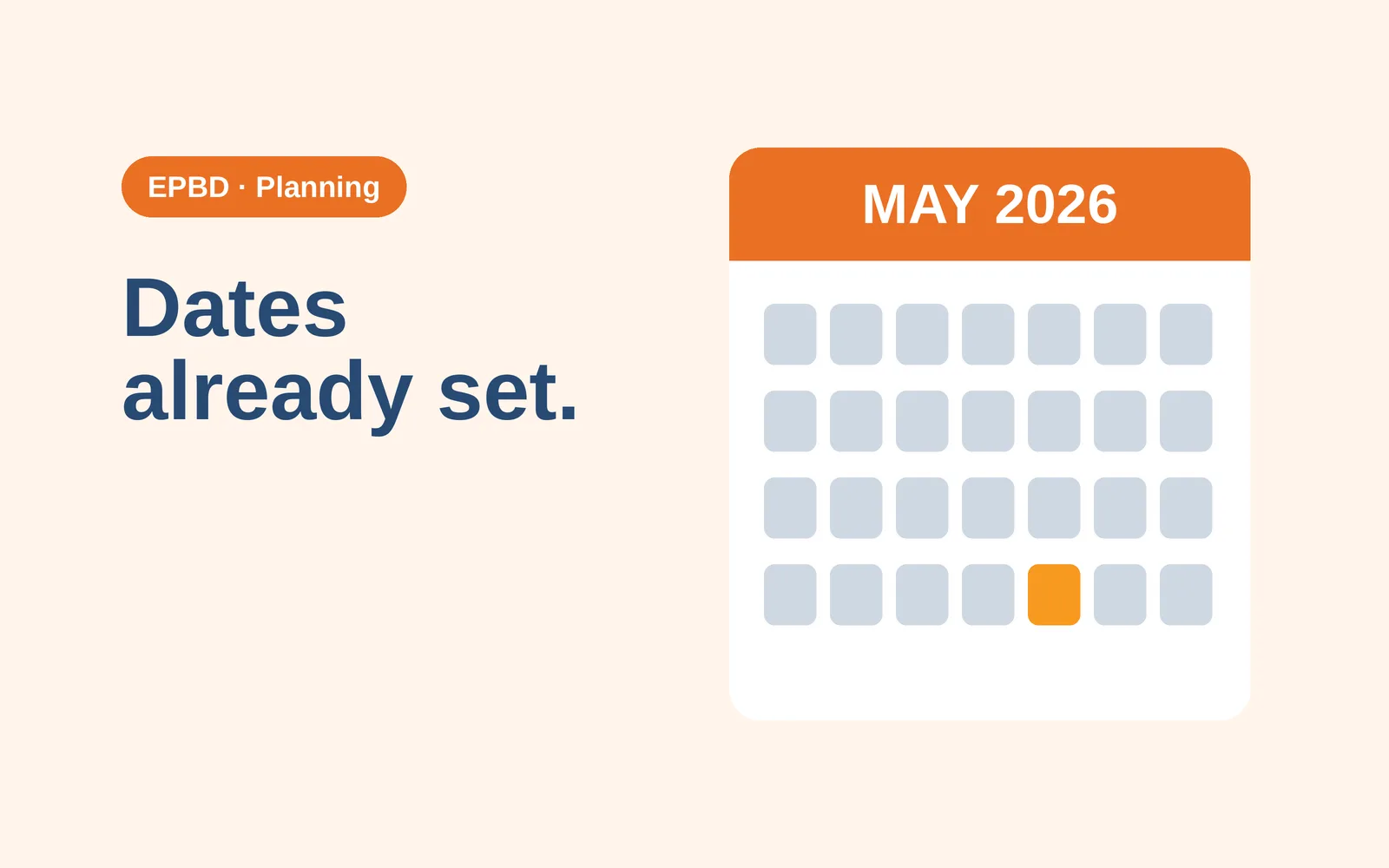
For most owners of non-residential buildings in the EU, the next regulation is the national law that applies the EPBD (Directive (EU) 2024/1275). The Directive's own dates, including those for building automation, run from 2026 to 2033, and transposition into national law was still incomplete in mid-2026. The dates and standards below are already set or announced, and none is a forecast.
Dates already set in the EPBD
These are EU dates, and national laws set their own. The 70 kW BACS date is 31 December 2029 in Germany (section 56 GModG) and Flanders (Flemish government page) and 1 January 2030 in the Netherlands (RVO). For France, Banque des Territoires reports 1 January 2030 for existing buildings under décret n° 2025-1343, and the decree text on Légifrance was not checked. EPBD for non-residential buildings: what applies in NL, DE, FR, BE, AT and IE has the detail. The percentages in Article 9 are fixed by the Directive, but each Member State sets the energy performance value that corresponds to them, so a building's position cannot be read from the Directive. The Directive wording here follows the English copy on LawPlayer, with Articles 13 and 15 cross-checked against German copies. The Commission's pages repeat the Article 7 dates and the 16% and 26% figures of Article 9. The Official Journal text on EUR-Lex prevails.
The smart readiness indicator
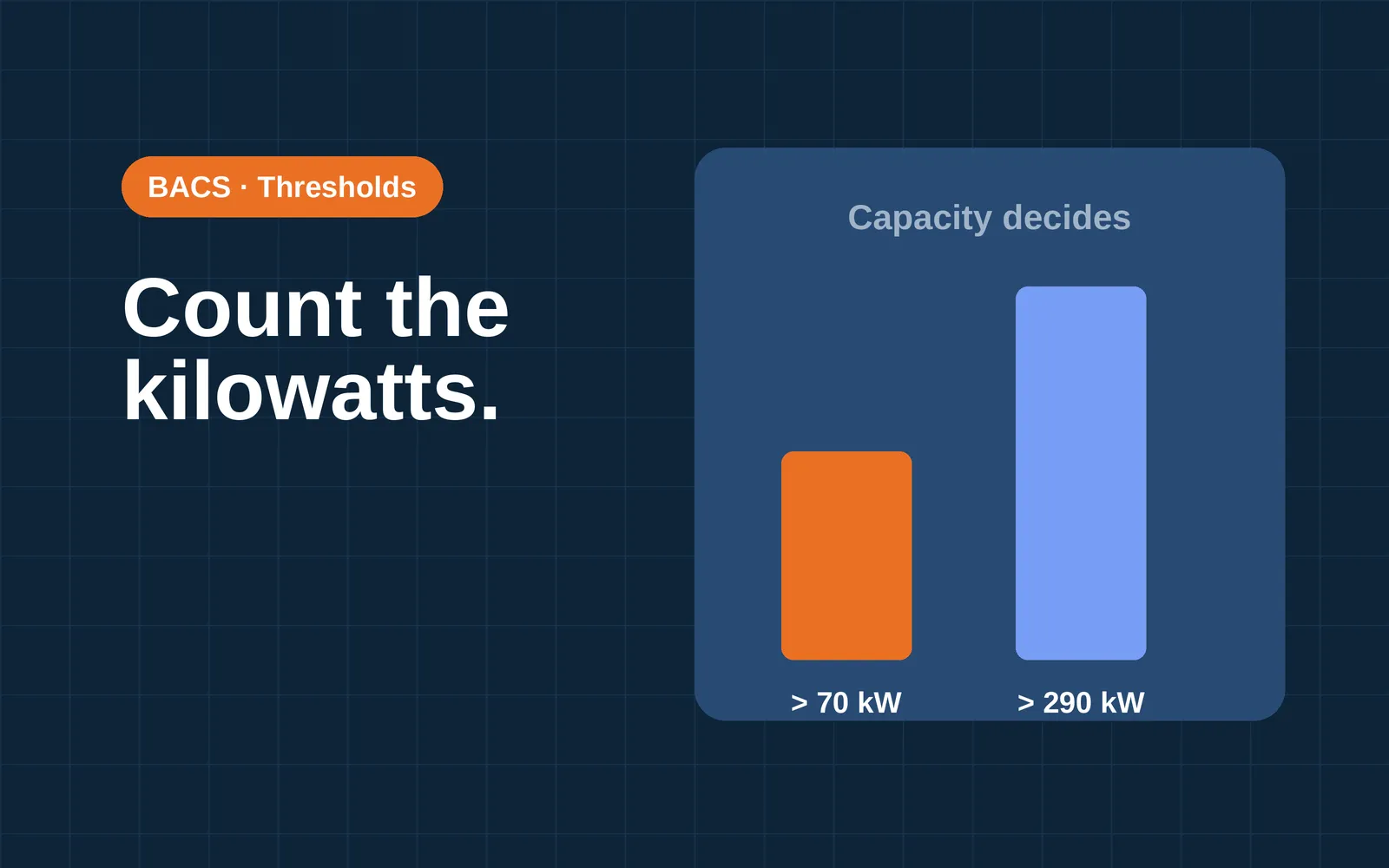
The smart readiness indicator (SRI) is an EU scheme for rating how ready a building is for smart technology. Article 15(1) calls it an optional common Union scheme. The Commission was due to report on the national test phases by 30 June 2026, and its SRI page says the report is delayed and expects publication at the beginning of 2027. Article 15(2) also tells the Commission, taking the report into account, to adopt a delegated act by 30 June 2027 requiring the scheme to apply to non-residential buildings with systems over 290 kW. The Commission's SRI page does not mention this act, so what it will require is not known.
Standards revisions that are announced
ISO 52120-1:2021 (first edition, December 2021) sets out building automation functions and efficiency classes that some national guidance uses to score systems. The Dutch enterprise agency RVO, for one, scores existing systems against classes A to D of NEN-EN-ISO 52120-1. ISO lists a second edition as an approved work item, ISO/AWI 52120-1, which is an early stage of standard development.
EN 16798-1:2019 is the European standard for indoor environmental input parameters. BSI's standards development site has a project titled "Revision of EN 16798-1 ... Part 1.3: Design and assessment of indoor air quality", open for comment, whose scope is to be developed with parts 1.1, 1.2, 1.4 and 1.5. A conference abstract by Bjarne Olesen of the Technical University of Denmark (undated) names topics for it, including yearly indoor environmental quality indicators and CO2 as an indicator of ventilation. Neither source gives a publication date. REHVA's summary of the Commission guidance on Articles 13, 23 and 24 says the recommended ranges for new buildings correspond to EN 16798-1 category II values.
Germany's section 56 names DIN/TS 18599-11:2025-10 by edition for the automation level of new buildings. Naming the edition in a specification keeps the reference unambiguous when a revision appears. This is a practical suggestion, not a rule.
What follows in practice for building automation
The Directive does not prescribe the items below as a package. They follow from rules already adopted, and they are practical suggestions.
- Record the rated output of every heating and cooling unit in kW. Both BACS tiers, the lighting tiers and the inspection threshold in Article 23 are kW tests.
- When controls are upgraded, specify logging of energy data and a documented data interface. Article 13(10)(a) and (c) ask for logging of energy use and for communication and interoperability across manufacturers, and Germany's section 56 asks for a common, freely configurable interface. [BACnet and Modbus explained for building owners](/blog/bacnet/) covers the protocols.
- Include indoor environmental quality monitoring in the scope of controls work. Article 13(10)(d) sets 29 May 2026 as the capability date, and Article 13(5) covers measuring and control devices for indoor air quality in non-residential zero-emission buildings and, where feasible, in existing non-residential buildings on major renovation; [EPBD indoor environmental quality monitoring: what the May 2026 date means](/blog/energy-performance-of-buildings-directive/) explains what the text leaves open.
- Plan zoned lighting controls with occupancy detection alongside HVAC works, because Article 13(12) sets its own dates.
- When a technical building system is installed, Article 13(6) has its energy performance assessed and documented and the results passed to the owner. When a heat or cooling generator is replaced in an existing building, Article 13(3) asks for self-regulating room temperature devices where technically and economically feasible.
- Keep each feasibility assessment with its date and author. Ireland's technical guidance and the French ministry guide both describe one, and a rule change can make an earlier assessment worth rereading.
Where to start with building automation compliance: a checklist for owners turns the first steps into an order of work. This is general information, not legal advice.