Regulation
Where to start with building automation compliance: a checklist for owners
An eight-step checklist for BACS compliance work: list the plant in kW, find the national rule, compare your controls with Article 13(10), and document it.

BACS compliance work can start before any national text is read. Write down what heating, cooling and ventilation plant the building has and what each unit is rated at, then work through the steps below. BACS stands for building automation and control systems. The steps follow Article 13 of the EPBD (Directive (EU) 2024/1275) and the national pages named along the way. They do not say whether a building is covered or compliant, and they are not legal advice.
Eight steps for BACS compliance in building automation
- List every unit and its rated output For each boiler, heat pump, chiller, air-conditioning unit and combined heating or cooling and ventilation system, record the rated output in kW, the area it serves and who owns and operates it. The Directive's test uses effective rated output (Article 2(49)), which points to the manufacturer's data. SEAI's Irish guidance names nameplates, handover documents and design files as sources. Write down where each number came from.
- Find the rule for the building's location Look up the national rule, or the regional rule in Belgium and Austria. Record the kW threshold, the date, the name of the legal text and the date of the page you read. Transposition of the Directive was still incomplete in mid-2026, and Germany's section 56 applies in its current wording only from 29 July 2026, so an undated source is hard to rely on. EPBD for non-residential buildings: what applies in NL, DE, FR, BE, AT and IE lists sources for six countries.
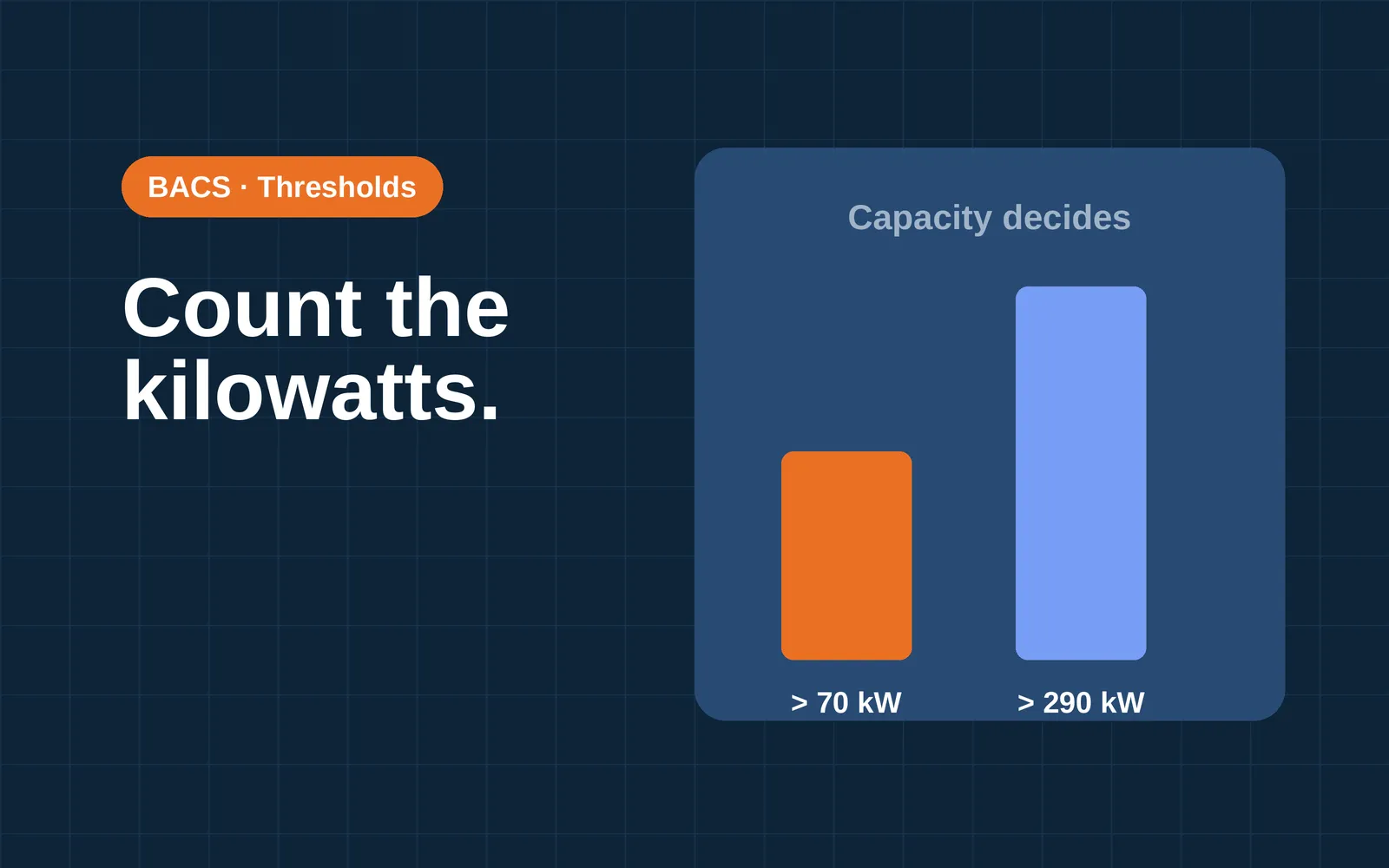
- Add up the kilowatts the way that rule does National texts differ on whether heating and cooling are added together, and on how combined systems and heat pumps are counted. Apply the counting method of the text that applies and note its source next to the total. Does the 290 kW or 70 kW threshold apply to your building? shows the differences.
- Name the party who carries the duty Under some national texts the owner carries it. Under others it is the owner or the holder of a right over the systems, which in some Flemish leases is the tenant. In a multi-tenant building, mark which plant the landlord operates and which the tenants operate.
- Compare the existing controls with the Article 13(10) functions Article 13(10) says a BACS must be capable of (a) continuously monitoring, logging, analyzing and allowing adjustment of energy use, (b) benchmarking efficiency, detecting efficiency losses and informing the person responsible, (c) communicating with connected technical building systems and working across manufacturers, and (d) by 29 May 2026 monitoring indoor environmental quality (what the text leaves open). For each point, note whether the current controls do it, do part of it or cannot, and keep the evidence, such as trend logs or point lists. The Directive defines a BACS as a system comprising all products, software and engineering services that can support the operation of technical building systems (Article 2(7)), and RVO says a GACS can consist of components from different brands. National texts add detail: Germany's section 56 names a common, freely configurable data interface.
- Run the feasibility test if the rule asks for one The tiers apply where technically and economically feasible. Ireland's SEAI factsheet has an independent competent professional complete the assessment. The French ministry guide describes an exemption for existing buildings with a payback of more than 10 years, net of aid and energy-saving certificates. Use the method the national text names and keep the result with its date.
- List the gaps and put them in order Write one line per gap: the function, what is missing, the unit or room it concerns and the date from the rule. Sort by the earliest legal date first, then by what is quick to close. This ordering is a practical suggestion. Automatic lighting controls with occupancy detection (Article 13(12): 31 December 2027 for systems over 290 kW, 31 December 2029 for systems over 70 kW, where feasible) belong on the same list.
- Document it and set a review date Keep the unit list, the rule and its date, the counting method, the function comparison, the feasibility assessment, the gap list and any commissioning records in one place. In Ireland's SEAI factsheet, the building owner keeps a record of the assessment and gives it to the building control authority on request, and records of an installed system's functionality are kept for review by Building Control. Review the file when plant is replaced, when the national text changes and before each date on the gap list. Future-proofing a building for the next regulation lists the dates already set.
Whether a building falls under a national rule is a legal question for the competent authority or an adviser, and the checklist only prepares the facts. The order of the steps and the contents of the file are practical suggestions. The Directive wording here follows the English LawPlayer copy and the German copies on gesetze.legal; the Official Journal text on EUR-Lex prevails.