Regulation
EPBD for non-residential buildings: what applies in NL, DE, FR, BE, AT and IE
One EU directive, different national rules. What the EPBD means for non-residential buildings in the Netherlands, Germany, France, Belgium, Austria and Ireland: kW thresholds, dates and open questions.

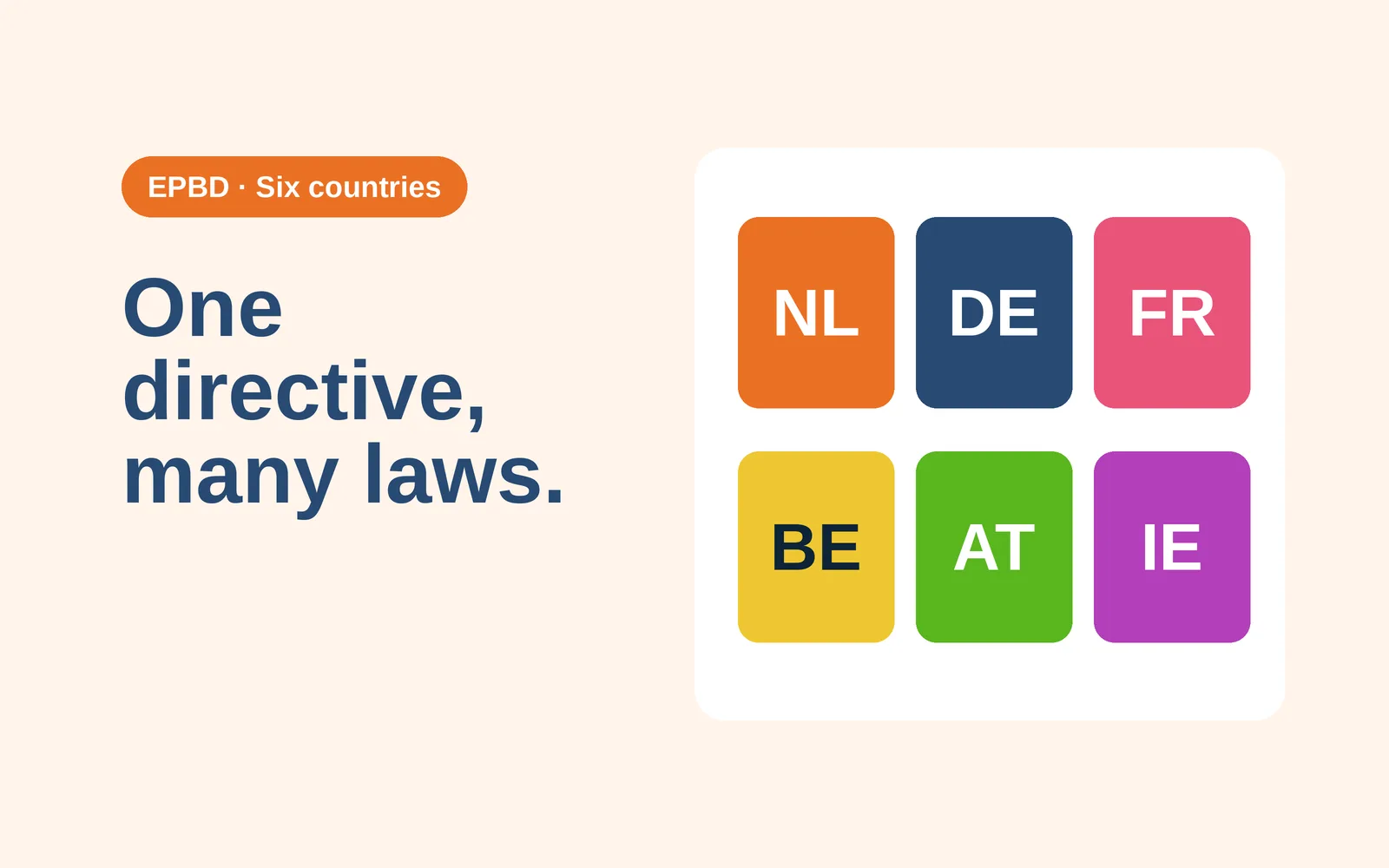
The EPBD (Directive (EU) 2024/1275, the EU's Energy Performance of Buildings Directive) sets one rule for building automation and control systems (BACS) in non-residential buildings, and each country turns it into its own national law. Thresholds, dates and the party that carries the duty differ, and in Belgium and Austria they differ between regions and states. In the texts read here, scope starts from the rated output of heating and air-conditioning systems in kW, so floor area alone does not settle whether a building is covered. Where sources conflict, both are named. This is general information, not legal advice.
What the EPBD sets at EU level
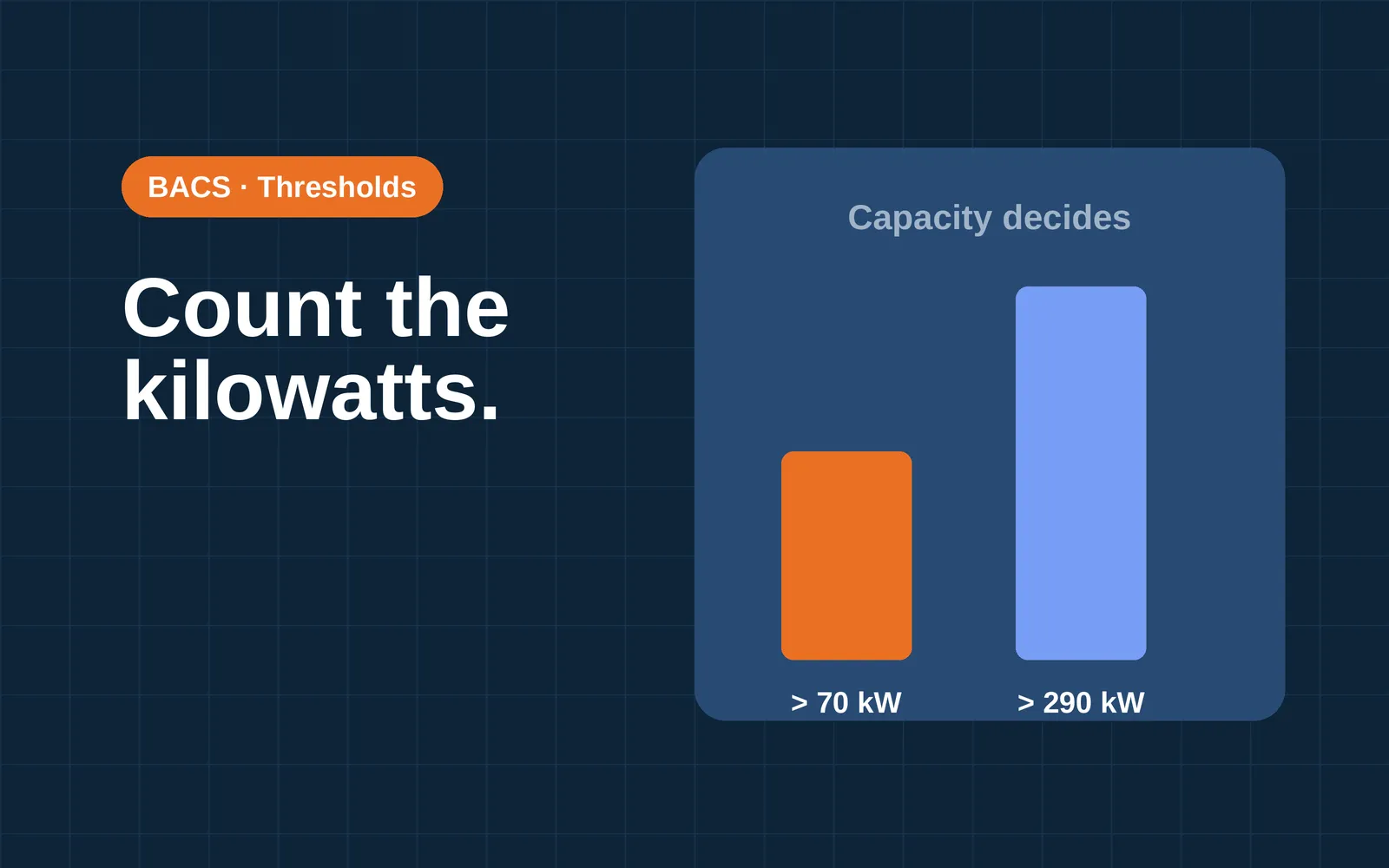
Article 13(9) tells Member States to require BACS in non-residential buildings where technically and economically feasible. The trigger is the effective rated output of heating, air-conditioning or combined heating and ventilation systems: over 290 kW, and later over 70 kW (dates below). Article 13(10) lists what the systems must be capable of, including monitoring of indoor environmental quality from 29 May 2026. What that last date does and does not mean is covered in EPBD indoor environmental quality monitoring: what the May 2026 date means.
The Directive binds Member States, and the duties of a building owner come from national law. Transposition was still incomplete in mid-2026, so check the date on any page you rely on. For what a BACS looks like in practice, see Building automation for buildings without a BMS.
Netherlands
The Dutch name for a BACS is GACS (gebouwautomatiserings- en controlesysteem). RVO, the national enterprise agency, says that from 1 January 2026 non-residential buildings with heating or air-conditioning of more than 290 kW must have one, and that from 1 January 2030 the duty covers all non-residential buildings above 70 kW. The owner carries the obligation, not the tenant. Buildings that also contain homes do not have to comply, and municipalities are the competent authority. RVO adds up the nominal capacity of the systems; IPLO, the government's Informatiepunt Leefomgeving, says heating and cooling are assessed separately.
On indoor air quality, the decree behind the 2026 changes (Staatsblad 2026, 103, published 7 May 2026) adds the item "de binnenluchtkwaliteit te monitoren" to article 3.146 of the Besluit bouwwerken leefomgeving, in force from 29 May 2026. The item names no parameters. Government pages describe it differently. RVO's GACS page (content checked 19 October 2026) lists energy and communication functions and no indoor environmental quality monitoring. IPLO says a GACS must be able to monitor indoor air quality. The housing ministry's page on EPBD IV (modified 10 June 2026) speaks of monitoring and controlling indoor environmental quality (binnenmilieukwaliteit) and says the medium-sized tier (above 70 kW) starts on 1 January 2030. The technical detail sits in the Omgevingsregeling. Which parameters a municipality expects is not stated in the sources read.
Germany
The German rule is in section 56 of the Gebäudemodernisierungsgesetz (GModG), in the version in force from 29 July 2026. Non-residential buildings with a heating, combined heating and ventilation, air-conditioning or combined air-conditioning and ventilation system above 70 kW must have an automation system by 31 December 2029, unless that is technically impossible or economically unreasonable ("wirtschaftlich unzumutbar"). Paragraph 2 lists the functions: continuous monitoring, logging and analysis of consumption, access to the data through a common, freely configurable interface, and monitoring of indoor climate quality ("die Raumklimaqualität zu überwachen"). New buildings need automation level B above 290 kW and level C above 70 kW. Paragraph 4 is a transition: where a system that does not meet paragraph 2 was installed in an existing non-residential building up to three years before 1 January 2027, the owner may retrofit it after 31 December 2029. The paragraph sets a ten-year period for meeting the obligation and does not say when it starts. Paragraph 5 excludes some federal and defense-related buildings.
The old rule, section 71a of the Gebäudeenergiegesetz (GEG), applied to non-residential buildings with systems above 290 kW and set 31 December 2024. A law of 23 July 2026 (BGBl. 2026 I Nr. 226) repealed it with effect from 29 July 2026. Section 56 has no 290 kW tier for existing buildings, and how it treats buildings that were due under the old rule is not confirmed.
France
The French rules cover tertiary buildings with a heating or air-conditioning system, with or without ventilation, above 290 kW or above 70 kW of useful nominal power. The ministry's application guide (version 2, January 2026) says existing buildings must comply before 1 January 2025 or 2030, depending on installed power. According to Banque des Territoires, décret n° 2025-1343 of 26 December 2025, published the next day, moved the 70 kW date for existing buildings from 1 January 2027 to 1 January 2030. The decree text on Légifrance was not checked, so this rests on the ministry guide and Banque des Territoires, and new-build dates are left out.
The owner of the system is the obligated party. An existing building can be exempt if a study shows a payback of more than 10 years on a BACS, net of grants and energy-saving certificates. The guide's required functions are energy monitoring, benchmarking, loss detection, interoperability and manual shutdown. Indoor air quality monitoring is not among them, and none of the French sources read adds it from 29 May 2026.
Belgium: three regions
Flanders requires a BACS in new and existing non-residential buildings with a heating or cooling system (or a combined system) above 290 kW by 31 December 2025, with heating and cooling each judged against 290 kW on their own. The threshold drops to 70 kW by 31 December 2029. The duty sits with the owner or the holder of a real right (zakelijk recht) over the systems, which in some leases is the tenant. Required functions include monitoring the indoor environment. Buildings where compliance is not feasible are exempt, in practice those with only one of space heating, cooling or ventilation.
Brussels works differently. Its information sheet (dated 1 January 2025) sets 1 January 2025 for new and existing heating or cooling systems above 290 kW that serve mainly non-residential uses, meaning non-residential units make up more than half of the area served. It lists three functions (energy monitoring, benchmarking, interoperability), no indoor environment function, and no 70 kW date.
Wallonia has a conflict between sources. Article 19/3 of the Walloon government decree of 11 January 2023 (version read dated 27 March 2023) requires non-residential buildings with heating or cooling above 290 kW to have a BACS meeting annex C4 by 31 December 2025. A presentation by the regional energy administration (SPW Énergie, 8 October 2025) shows 1 January 2025 for above 290 kW and 1 January 2030 for above 70 kW. The decree text read has no 70 kW rule. Confirm the date with the region before relying on either.
Austria: nine states
Austria has nine federal states, and the BACS rules sit in state law, so there are nine rule sets and no single Austrian rule to quote. Four were read, and they are not identical:
- Tyrol (Technische Bauvorschriften 2026, section 38, in force since 16 July 2026): non-residential buildings with systems above 290 kW and, from 31 December 2029, above 70 kW, where technically and economically feasible. The systems must be able to monitor indoor climate quality ("die Raumklimaqualität zu überwachen").
- Lower Austria (Bauordnung 2014, section 44a, version in force from 29 May 2026): a 290 kW tier with no date for BACS and a 70 kW tier by 31 December 2029, both where feasible. The listed functions include indoor climate quality.
- Vienna (Heizungs- und Klimaanlagengesetz 2015, section 14b, in force since 15 July 2026): the building owner must equip non-residential buildings above 290 kW (the text shows no BACS date) and above 70 kW by 31 December 2029, where feasible. The listed functions include indoor climate quality.
- Burgenland (Bauverordnung 2008, section 34c, version in force since 10 May 2025): systems above 290 kW "bis zum Jahr 2025", where feasible. The text read has no 70 kW tier and no indoor climate function.
The other five states were not checked, so this article says nothing about them.
Ireland
Ireland's rule is regulation 5(c) of S.I. No. 393 of 2021. It covers existing buildings other than dwellings with heating or air-conditioning systems, alone or combined with ventilation, of effective rated output over 290 kW, where technically and economically feasible. The original date was before 31 December 2025. S.I. No. 642 of 2024, signed on 20 November 2024, replaced it with 31 December 2024, about six weeks after signing, and added a definition of a BACS that includes, "on and from 29 May 2026, monitoring of indoor environmental quality". Regulation 5(c) does not name who must comply.
The Department of Housing's technical guidance (undated) says the feasibility assessment is completed by an independent competent professional such as a chartered engineer. It still shows the 2025 date and does not mention indoor environmental quality. S.I. Nos. 168 and 195 of 2026 (in operation from 24 May 2026) cover energy ratings and zero-emission buildings and do not mention building automation. No Irish 70 kW BACS rule turned up in the sources read.