Technology
Building automation for buildings without a BMS
What building automation and control (BACS) means, what the EU directive asks of non-residential buildings in general terms, and the options when a building has no BMS.

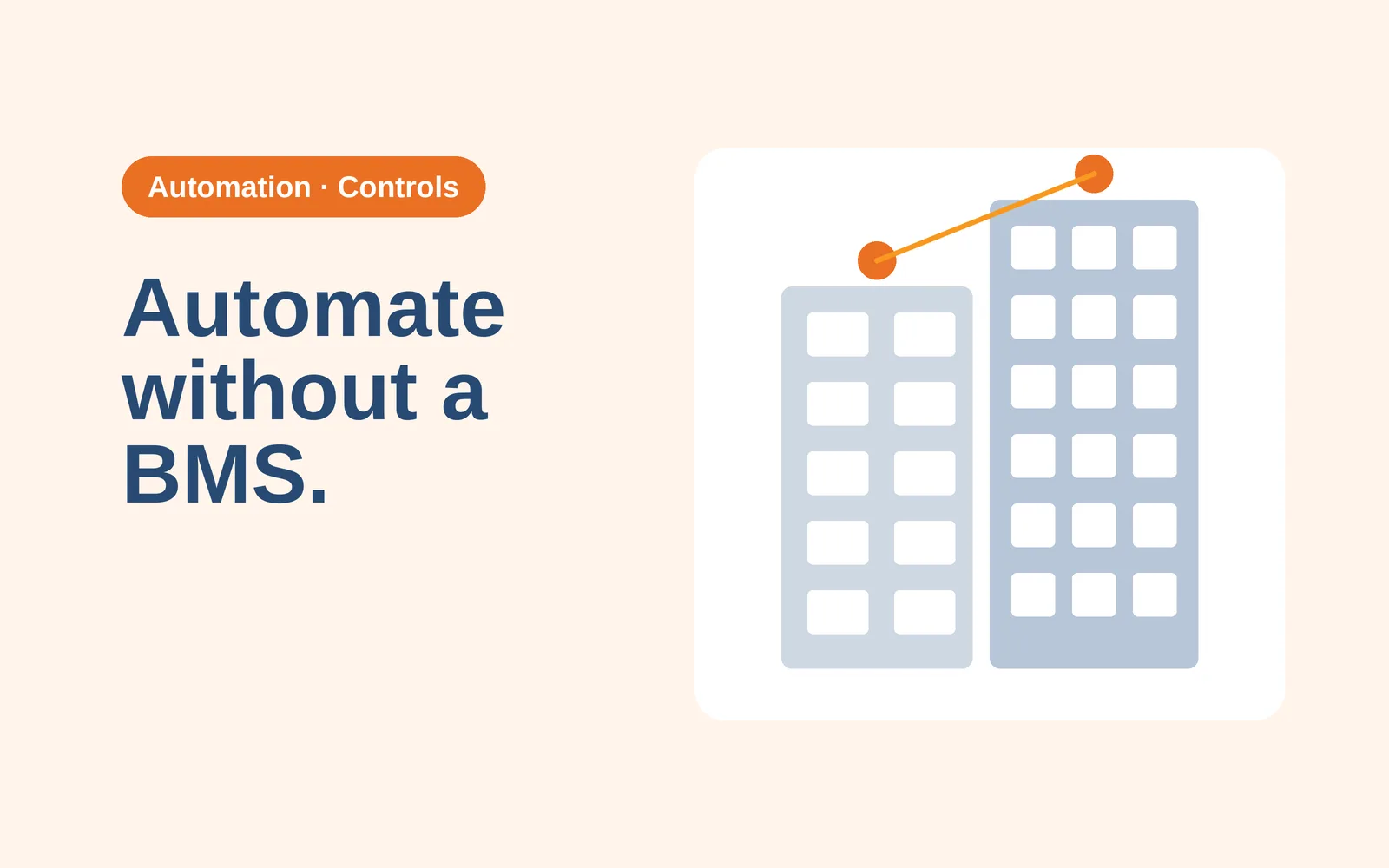
Building automation means the equipment adjusts itself. Sensors measure, controllers decide, and fans, valves and dampers respond without anyone changing a setting by hand. A building without a building management system (BMS) can still have some building automation, from a networked thermostat to a rooftop unit with an advanced controller. In EU rules the term is BACS, building automation and control system, and the directive lists what such a system must be able to do.
What building automation and control means
Article 2 of Directive (EU) 2024/1275 defines a BACS as a system comprising all products, software and engineering services that support energy-efficient, economical and safe operation of technical building systems through automatic controls and by facilitating manual management. Technical building systems include space heating, space cooling, ventilation, domestic hot water and built-in lighting, among others. The definition describes a system by what it does and names no particular product.
The European standard EN ISO 52120-1:2022 grades building automation in four classes, A to D, depending on the level of control functions reached for each service, such as heating, ventilation and lighting. Class C is the reference, standard automation. Class D is energy-inefficient, and a Belgian summary by Buildwise says to avoid it in new buildings. Class B adds some specific technical building management functions, and its room controllers must be able to communicate with the central system. Class A is high-performance automation with full integration of systems.
The standard also has a factor-based method for a first estimate of the effect of these functions. In Buildwise's example, an office at class B has a combined thermal efficiency factor of 0.80 against class C, which Buildwise reads as 20% savings on heating, cooling and hot water (by use the factors are 0.79, 0.80 and 0.90). Buildwise calls this an approximate method for a first assessment and says proper commissioning and monitoring are needed to realize the savings. The standard is paywalled, so this comes from Buildwise and from the epb.center listing.
What the EU directive says about building automation
Directive (EU) 2024/1275 entered into force on 28 May 2024, and EU countries had to put it into national law by 29 May 2026, according to the European Commission. Building automation sits in Article 13. The dates below are the directive's own. National law decides what applies to a given building, and the dates and details differ between countries.
Article 13(10) lists what a BACS must be able to do: continuously monitor, log and analyze energy use and allow it to be adjusted; benchmark energy efficiency, detect efficiency losses and inform the person responsible about improvement opportunities; communicate with connected systems, including those from different manufacturers; and, from 29 May 2026, monitor indoor environmental quality. Article 13(12) adds automatic lighting controls with occupancy detection on the same thresholds, by 31 December 2027 above 290 kW and by 31 December 2029 above 70 kW.
Scope depends on the rated output in kW of the heating or air-conditioning systems, so floor area alone does not tell you. Whether a building falls in, and whether a given setup meets the capability list, is for the national text and a qualified engineer to say. CEN, the European standards body, published a checklist report in 2026 (CEN/TR 18276) for policy makers, planners, owners and inspectors. The May 2026 indoor environmental quality date has its own article.
Options when a building has no BMS
Most small and medium buildings have no central system. A 2013 US Department of Energy (DOE) scoping page says fewer than 10% of buildings have a BAS. ACEEE's 2025 brief, citing a 2018 US survey, puts use of building energy management and control systems at 42% of commercial buildings but only 11% of those under 10,000 square feet. The totals differ, but ACEEE's size breakdown shows the pattern: the smaller the building, the less likely it has one. What smaller buildings use instead falls into a few groups.
- Networked thermostats connect single-zone rooftop units to software, so schedules and setpoints can be changed remotely from a web or mobile app (ACEEE).
- Advanced rooftop unit controls add functions such as demand-controlled ventilation, economizer control, variable-speed fans and coordination of several units, as added hardware or as software only (ACEEE).
- Light commercial building automation systems are smaller and simpler versions of the systems used in larger buildings that can still control more complex HVAC equipment, plus lighting, pumps and fans (ACEEE).
- A full central BMS, which DOE's size guidance names for buildings above 20,000 square feet (about 1,860 m²).
- Energy meters and energy information software, which DOE describes as performance monitoring software, data acquisition hardware and communication systems that store, analyze and display building energy data.
ACEEE gives typical savings of 10 to 20% of energy use for building energy management and control systems in small and medium buildings, in US figures. Choosing one of these options does not by itself settle compliance. The directive's capability list includes communication between systems and, from 29 May 2026, indoor environmental quality monitoring, so each option needs checking against that list and against your national rules. Adding demand-controlled ventilation to a building without a BMS shows how one of them works in practice.
Nomestic measures indoor climate room by room (CO2, temperature, humidity and more) and works with or without a building management system. Nothing in the existing HVAC gets replaced, and the wireless, battery-powered devices mean a room takes minutes to equip. Operators can override automatic adjustments at any time, and savings are verified by comparing measured data before and after a change.