Technology
No BMS in your building? Here is what you can still automate
Schedules, thermostats, rooftop unit controls, demand ventilation and lighting sensors all work without a building management system. What each needs, and where a BMS is still needed.

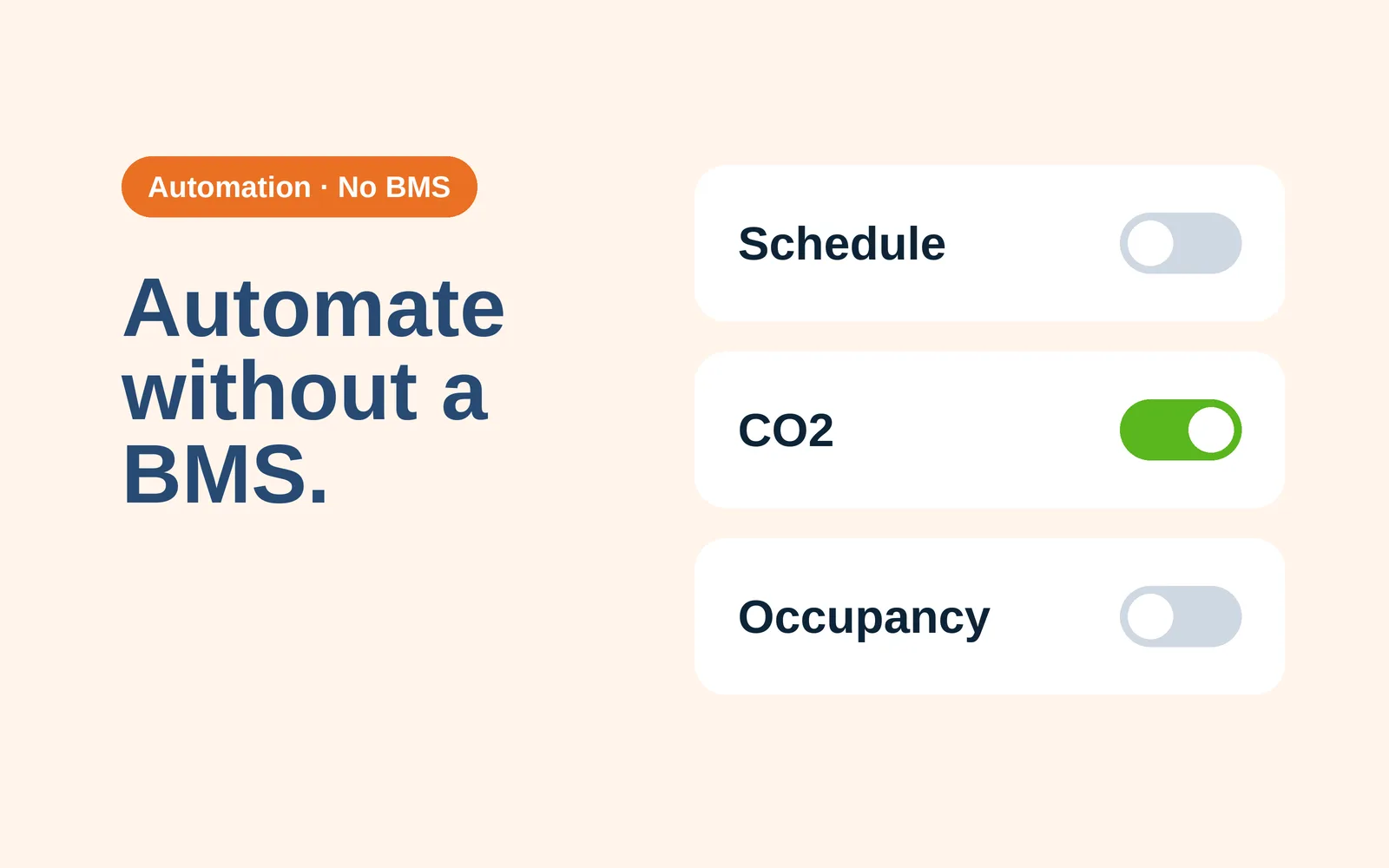
A building with no BMS can still have a good deal of building automation. Time schedules, setback, networked thermostats, advanced rooftop unit controllers, standalone demand ventilation controllers and presence sensors for lighting all work without a BMS. A US scoping study by national laboratories (PNNL-22169, on the Department of Energy's OSTI service) reports that about 10% of US buildings use a building automation system (BAS) or central controls, typically buildings larger than 100,000 square feet. For smaller buildings it names the simpler options listed below.
Time schedules and setback
The simplest automation is a clock. US energy codes include time-based controls. DOE webinar slides on code-required HVAC controls (March 2019, drawing on ASHRAE 90.1-2013 and the 2015 IECC) give thermostat setback as an example: setback when spaces are unoccupied, programmable controls that start and stop HVAC fans with at least 7 schedules, and a manual unoccupied override of no more than 2 hours. The same slides say setback savings can be 5% to 20% of HVAC energy use. They also warn that optimum start, which begins heating or cooling early so a room is ready on arrival, may not be needed and can lengthen operating hours compared with a simple schedule. These are US code measures, shown here as an example of what a schedule can look like.
Thermostats and rooftop unit controls
The PNNL study matched controls to building size. Below 1,000 square feet (about 90 m²) it names an easily programmable thermostat and occupancy-based lighting controls. From 1,000 to 5,000 square feet it adds a networked programmable thermostat, so the building can be monitored centrally. From 5,000 to 20,000 square feet it adds a replacement advanced rooftop unit controller. Above 20,000 square feet (about 1,860 m²) it recommends a true central BAS.
An ACEEE brief from November 2025 describes the middle options. Networked thermostats link several single-zone rooftop units to one web or mobile app, where setpoints and schedules can be changed remotely. Advanced rooftop unit controls add demand-controlled ventilation, economizer control (bringing in outdoor air when it can do the cooling), variable-speed fan control and coordination between units, as added hardware, as software, or both. ACEEE cites an estimate by Crowe, Hart and House of 10 to 20% HVAC savings from control improvements in small and medium buildings (the brief's introduction says 10 to 25%), and examples of projects that range from no savings to over 50%. Results depend on the building.
Demand ventilation without a BMS
A demand ventilation controller reads a sensor and changes fan speed. One fan manufacturer's data sheet for such a controller lists 0 to 10 V sensor inputs (one or two sensors), fan speed caps, a 0 to 10 V or PWM output for the fans, and an input for remote enabling from a BMS. It also lists local run/stop and setpoint inputs but does not say in so many words that the controller works without a BMS. The fan has to be able to change speed for this to work. A DOE federal technology alert on CO2-based demand-controlled ventilation (DOE/EE-0293) says the technique is suitable only when there is a means of automatically adjusting the ventilation air supply, such as variable-speed fans or variable dampers, and that properly functioning modulating dampers are necessary. It also says CO2-based capability can be added to an existing system by installing sensors. Adding demand-controlled ventilation to a building without a BMS walks through the work, and demand-controlled ventilation for commercial buildings explains the principle.
Lighting by presence
PNNL's size guidance lists occupancy-based lighting controls in every band below 20,000 square feet. In the EU, Article 13(12) of Directive (EU) 2024/1275 asks for automatic lighting controls that are suitably zoned and capable of occupancy detection in non-residential buildings where heating or air-conditioning systems (alone or combined with ventilation) are rated above 290 kW (by 31 December 2027) or above 70 kW (by 31 December 2029), where technically and economically feasible. National law decides how that applies to a given building.
Where building automation with no BMS runs out
Standalone controls each cover one piece of the building. ACEEE says networked thermostats and advanced rooftop unit controls are confined to controlling the heating and cooling system. A light commercial BAS, which ACEEE describes as a smaller and simpler version of the building energy management and control systems used in larger buildings, can control more complex equipment such as rooftop units with variable-air-volume distribution, and some also switch lighting, pumps and fans. PNNL's guidance reaches a true central BAS above 20,000 square feet.
EU rules add a second reason. Article 13(10) lists what a building automation and control system must be able to do: continuously monitor, log, analyze and allow adjustment of energy use; benchmark efficiency and detect efficiency losses; communicate with connected systems across manufacturers; and, by 29 May 2026, monitor indoor environmental quality. Eurovent, an industry association, argues that controls built into air handling units can meet the indoor air quality monitoring provisions (Articles 13(5) and 13(10)(d)) without a separate system, and also says such controls may not cover every technical building system. Whether a setup meets the rules for a given building is for the national text and a qualified engineer. A checklist report for non-residential buildings, PD CEN/TR 18276:2026, was published by BSI on 28 February 2026 for policy makers, planners, owners and inspectors, and building automation for buildings without a BMS covers the EU definition and thresholds.
A central system does not settle the matter either. The PNNL study attributes a significant portion of wasted building energy to missing controls or to a BAS that is not used properly. What a building management system is covers when the step up is worth it.
Nomestic measures indoor climate room by room (CO2, temperature, humidity and more) and works with or without a BMS. Nothing in the existing HVAC gets replaced, and the wireless, battery-powered devices mean a room takes minutes to equip. Operators can override automatic adjustments at any time, and savings are verified by comparing measured data before and after a change.