Technology
Demand-controlled ventilation for commercial buildings
Demand-controlled ventilation matches outdoor air to the people actually in a room. How CO2, occupancy and schedule signals differ, what the standards say and what savings studies found.

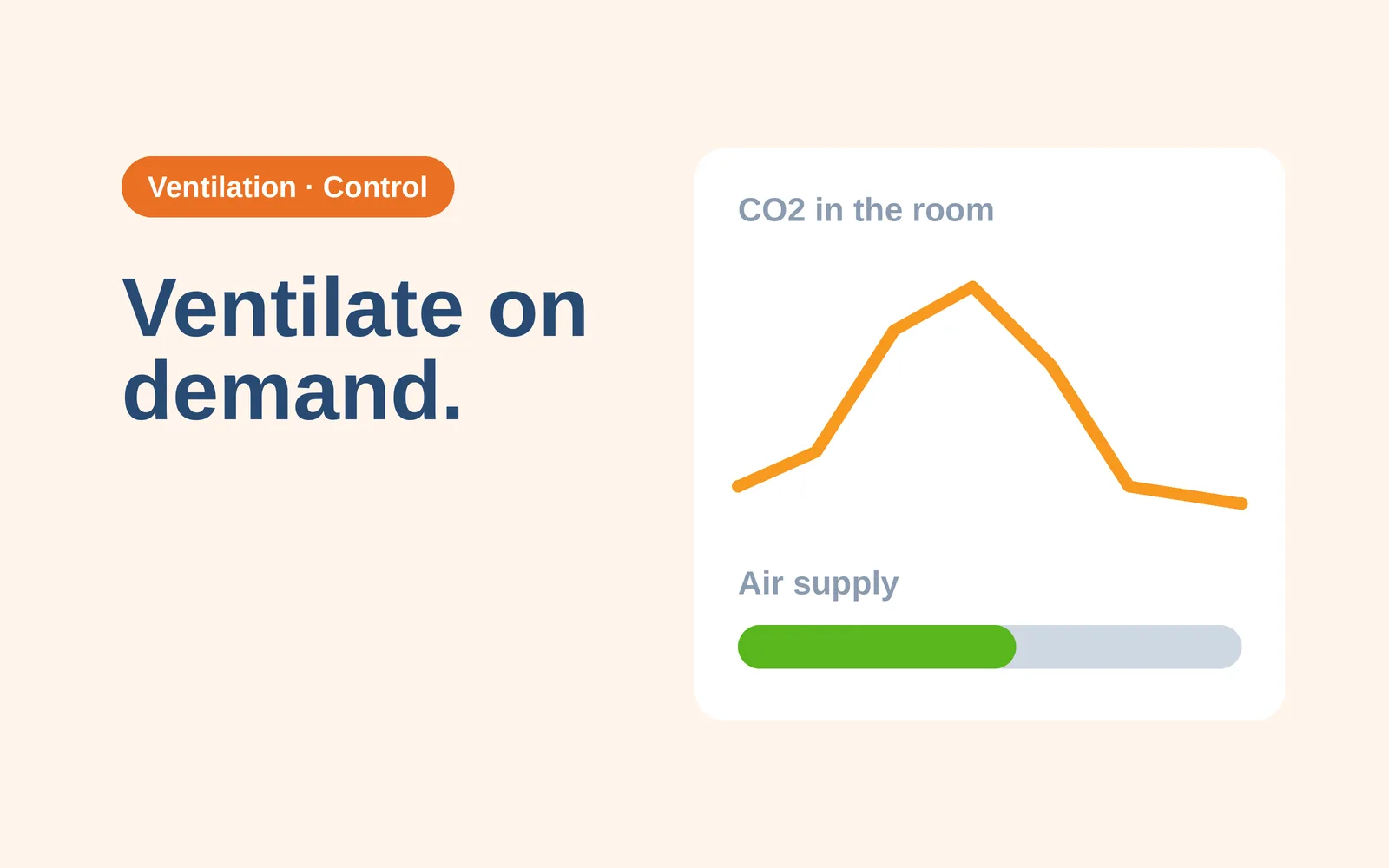
Demand-controlled ventilation (DCV) changes the amount of outdoor air a building brings in as the number of people in each space changes. A conventional system moves the same airflow whether a meeting room holds twelve people or none. With demand controlled ventilation the airflow follows a measured signal, so fans run slower and less outdoor air has to be heated or cooled when rooms are half empty.
Pacific Northwest National Laboratory (PNNL), in a 2012 literature review for the US Department of Energy, describes DCV as ventilation that adjusts automatically to the occupancy of the space served and brings in less outdoor air than the design rate when actual occupancy is below design occupancy. An article in the REHVA Journal on commissioning DCV defines it as a system in which the airflow is controlled automatically according to a measured demand at room level.
How demand controlled ventilation sets the airflow
Standards that allow DCV split the required outdoor air into two parts. ASHRAE Standard 62.1 calculates the breathing-zone outdoor airflow as a people rate times the number of people, plus an area rate times the floor area. Only the people part follows occupancy. The area part stays.
Take a classroom for ages 9 and older, using the Table 6-1 values of 10 cfm per person and 0.12 cfm per ft² as printed in ASHRAE addendum w to Standard 62.1-2022. At the default density of 35 people per 1,000 ft², a 1,000 ft² room needs 470 cfm. With 10 students it needs 220 cfm. That is a cut of more than half, and the room still gets 120 cfm for its floor area. These are breathing-zone figures worked out from the table. The full procedure adds corrections, for example for how well air reaches the breathing zone.
Three ways to detect demand
CO2 is the most common signal. People exhale it, so in a room where people are the main source the CO2 level shows how much outdoor air each person gets. PNNL's review calls CO2-based DCV the most common design and notes that CO2 responds slowly, with a delay of at least 10 to 20 minutes after occupancy rises. It only works where people are the dominant CO2 source. A US Department of Energy federal technology alert (DOE/EE-0293, listed in a library catalog as March 2004) calls industrial and laboratory spaces unsuitable. ASHRAE 62.1-2022 addendum ab does not allow CO2 DCV in zones with other CO2 sources, and marks some occupancies, such as animal facilities and laboratories, as not allowed.
Occupancy-based control uses presence detectors or people counters. A 2012 study by Lawrence Berkeley National Laboratory (LBNL) found that optical people counters work well much of the time and have large counting errors in some situations.
Schedule-based control reduces airflow at fixed times, for example outside office hours. It needs no sensors and cannot tell a full room from a half-empty one. PNNL's review notes that the 2010 edition of Standard 62.1 accepts schedules, timers, occupancy sensors and population counting as well as CO2. The article on ventilation control compares the three in more detail.
CO2 targets in the standards
ASHRAE addendum ab to Standard 62.1-2022, approved on 31 October 2023, adds differential CO2 limits above ambient to Table 6-1 for CO2 DCV. Zone CO2 must stay at or below ambient plus the limit for the space type, and ambient can be assumed to be 400 ppm without measuring it.
Sensors go 3 to 6 ft (0.9 to 1.8 m) above the floor, with at least one per ventilation zone and one per 5,000 ft² (460 m²) of net occupiable floor area. ASHRAE's bookstore lists control sequences for demand-based ventilation as new in the 2025 edition, which is the current one.
EN 16798-1:2019 states its CO2 values as levels above outdoor air. A 2019 REHVA Journal summary of the standard lists 550 ppm for category I, 800 ppm for category II and 1,350 ppm for category III in offices and classrooms. A 2024 REHVA Journal summary lists different values that depend on occupant density and on how polluting the building is. The article on ventilation rates compares the two. The standard is paywalled, so check the edition and national annex that apply to your project.
What demand controlled ventilation saves in practice
Published numbers vary widely, so the conditions matter. A REHVA Journal article states that correctly implemented DCV can cut ventilation energy by more than 50% (citing Maripuu, 2009), and also that real-world evaluations show the potential is seldom met (citing Mysen and colleagues, 2010).
ASHRAE research project RP-1747, on CO2-based DCV for multi-zone systems, reports 7 to 44% HVAC energy savings against non-DCV baselines. Its simulations of an office building with realistic occupancy schedules showed 10 to 30% across several climates, and ASHRAE notes that actual savings depend on each building's occupancy profile.
LBNL's work for California's Title 24 found DCV in general offices cost effective only if ventilation rates without DCV are very high relative to code requirements. In an April 2010 LBNL report, DCV in California general offices was generally not cost effective if existing offices had minimum ventilation rates of 28 cfm per person and often cost effective at 80 cfm per person, against a California minimum of approximately 15 cfm per person.
The US Department of Energy alert adds more conditions. Savings are generally larger for heating than for cooling. In dry climates such as the desert Southwest, economizer operation may save more cooling energy than DCV. A building that was chronically under-ventilated before might use more energy afterwards. The alert also says DCV may not reduce energy use in buildings with heat exchangers.
What goes wrong in the field
The control is only as good as the CO2 reading. LBNL checked 208 CO2 sensors in 34 commercial buildings. At about 1,010 ppm, 40% of them were off by more than 75 ppm and 13% by more than 300 ppm. Sensor age was not a consistent predictor of error. In the field studies behind LBNL's April 2010 report on Title 24 specifications, no facility manager reported calibrating CO2 sensors after the initial installation period.
Standard 62.1 now sets accuracy and calibration rules. Addendum ab set accuracy within ±75 ppm at 600, 1,000 and 2,500 ppm and required sensors to be certified to need calibration no more often than every five years. Addendum d, approved on 31 March 2025, modifies the accuracy range, and its foreword says the 2,500 ppm requirement exceeded the accuracy of the most advanced commercial sensors. Check the current text of the standard for the accuracy figure that applies.
Commissioning catches many problems. The REHVA article suggests checking that all CO2 sensors give the same ppm reading when the building is empty in the evening or at night. It also asks for a test of each DCV unit, overriding the room signal to force maximum and minimum airflow and recording the airflow rate and opening rate, and for a review after about a year of operation. What this takes in a building with no BMS is covered in the article on adding demand-controlled ventilation without a BMS.
Nomestic measures indoor climate room by room, including CO2, temperature and humidity, and works with or without a building management system. Savings are verified by comparing measured data before and after a change, and operators can override automatic adjustments at any time. More is on the ClimateIQ platform page.