Technology
Ventilation control in commercial buildings: schedule, CO2 or occupancy
Schedule, CO2 and occupancy signals each have a blind spot. What the research and the standards say about each, and which rooms suit which method.

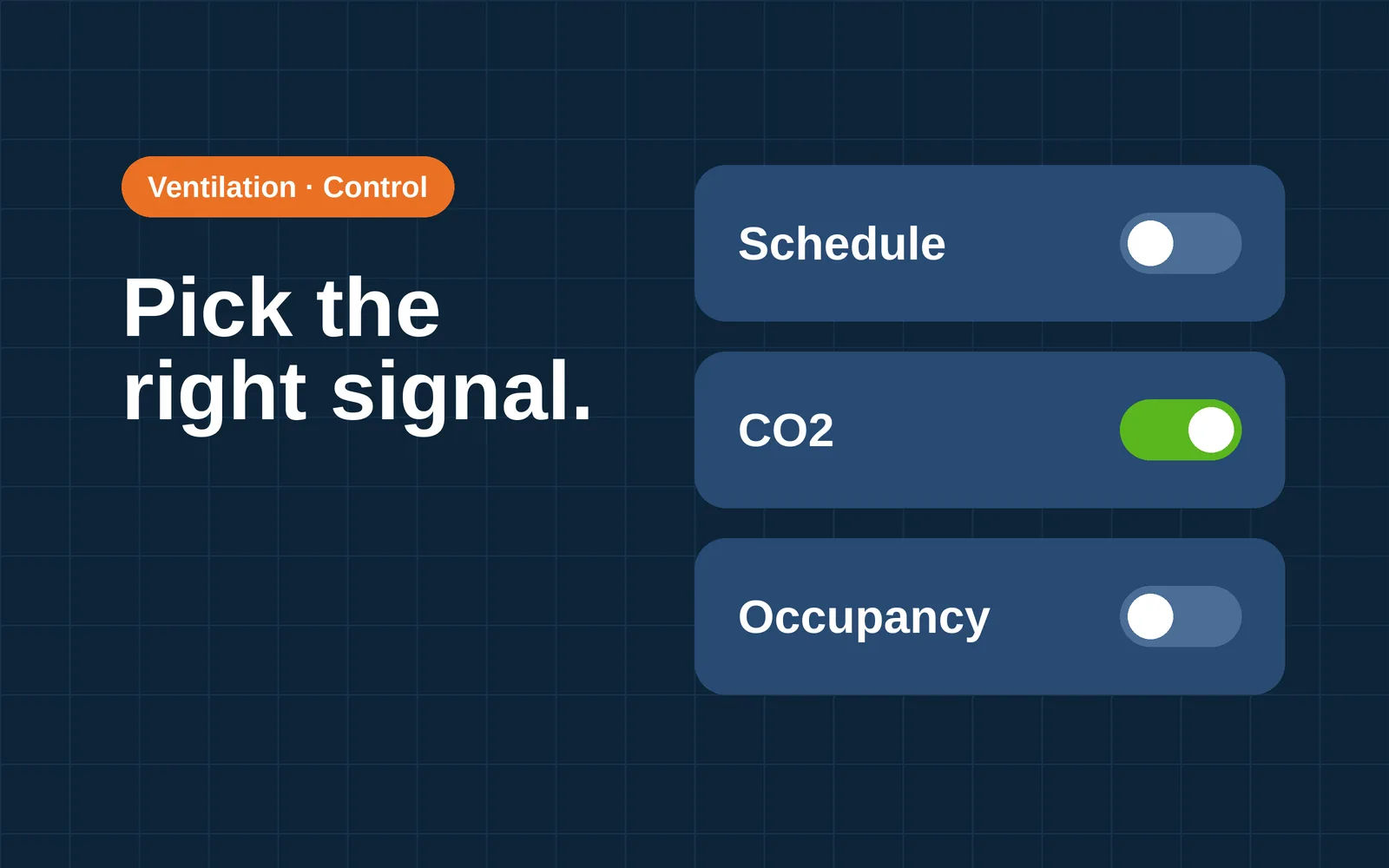
Ventilation control decides how much air a system moves and when. In commercial buildings three approaches are common: run to a schedule, follow CO2, or follow occupancy. A schedule is the simplest and cannot see how many people are in a room. CO2 follows people indirectly and needs accurate, well-placed sensors. Occupancy sensors detect or count people directly, and their counting accuracy varies from one situation to the next.
CO2 and occupancy control need a ventilation unit that can change its airflow. The US Department of Energy's federal technology alert on CO2-based demand-controlled ventilation (DCV) says the technique is suitable only when there is a means of adjusting the ventilation air supply automatically. A unit with a fixed fan speed and a fixed outdoor air damper has nothing to control.
Schedule-based control
A schedule sets airflow by time of day and day of week: full flow during opening hours, reduced or off outside them. It needs no sensors, and it is easy to understand and to test. The weakness is that it assumes the building is used as planned. A meeting room gets the same air for two people as for twenty.
An HPAC Engineering article from 2008 by John Murphy and Brenda Bradley lists occupancy schedules, in which the building automation system predicts the population by time of day, as one of three ways to assess ventilation demand, next to occupancy sensors and CO2 sensors. In the combined strategy they describe, schedules or occupancy sensors reduce ventilation in zones that are unoccupied.
CO2-based ventilation control
CO2 control raises the airflow when the CO2 level in a room climbs and lowers it when the level falls. The HPAC Engineering article describes CO2-based DCV as monitoring CO2 as a by-product of respiration. A review by Pacific Northwest National Laboratory (PNNL) for the US Department of Energy calls this the most common DCV design.
Slow response is one limit. Sensor accuracy is another. Lawrence Berkeley National Laboratory (LBNL) checked 208 CO2 sensors in 34 commercial buildings, and at about 1,010 ppm 40% of them were off by more than 75 ppm. The DOE alert adds that CO2 from human respiration must be the dominant pollutant in a space, and calls industrial and laboratory spaces unsuitable. ASHRAE 62.1-2022 addendum ab, approved on 31 October 2023, does not allow CO2 DCV in zones with non-occupant CO2 sources.
Where the sensor sits changes the reading. LBNL's 2012 report found that single-location CO2 sensors often have large errors, and that in meeting rooms a reading at the return-air grille appears to be a better choice than a wall-mounted sensor. Addendum ab asks for sensors 3 to 6 ft (0.9 to 1.8 m) above the floor. The article on where to place CO2 sensors for ventilation control goes through the options.
Occupancy-based control
Occupancy-based control uses presence detectors or people counters. A presence detector says whether a room is in use. A counter gives a number the airflow can be scaled to. LBNL found that optical people counters work well much of the time and have large counting errors in some situations.
A 2025 experiment at the University of Coimbra tested two occupancy strategies in one 25 m² test room over two days. The strategy that scaled airflow to occupancy level used 0.034 kWh of fan energy per day, against 0.081 kWh per day for the strategy that ventilated during the occupied period. It also ran at a higher average CO2 level, 948 ppm against 822 ppm. The authors say occupancy differed between the two days, so a definite comparison cannot be made, and the results may not represent real offices with diverse layouts or HVAC systems.
The two signals can be combined. ASHRAE research project RP-1747 produced a control sequence for multi-zone systems that uses real-time CO2 and occupancy presence sensing, with an occupied-standby mode that allows a zone's ventilation to be reduced to zero when the zone is detected to be empty. It was evaluated in simulations and lab-scale tests, and when ASHRAE reported on it in 2019 it said it hoped to do further field-scale testing in a separate project.
Choosing a ventilation control method
The DOE alert says the best payback comes in variable-occupancy, high-density spaces, where heating or cooling demand is high and utility rates are high. The alert names auditoriums, some school buildings and meeting areas as examples. In a room used on a fixed pattern, a schedule may be enough.
Codes use density as a trigger. PNNL summarizes ASHRAE Standard 90.1-2010 as requiring DCV for spaces over 500 ft² with a design occupancy above 40 people per 1,000 ft², served by systems with an economizer, a modulating outdoor-air damper or a design outdoor airflow above 3,000 cfm. That is the 2010 edition and a US energy code, so check the edition and rules that apply where the building is.
Whatever the signal, keep a way for staff to override it. ASHRAE addendum f to 62.1-2022, approved on 30 September 2025, adds emergency control modes that may be started manually or by a sensed value. One of them disables DCV and sets outdoor air intake and exhaust to the designer's maximum, for example during a temporary period of unusual indoor contaminant source. Standard 62.1-2025 is the current edition, and ASHRAE lists control sequences for demand-based ventilation as new in it. The numbers behind these controls are covered in the article on ventilation rates, and demand-controlled ventilation goes further into the standards and the savings studies.