Technology
Where to place CO2 sensors for ventilation control
Height, distance from people, doors and supply air, and the outdoor reference: where guidance and field data put a CO2 sensor for ventilation control.

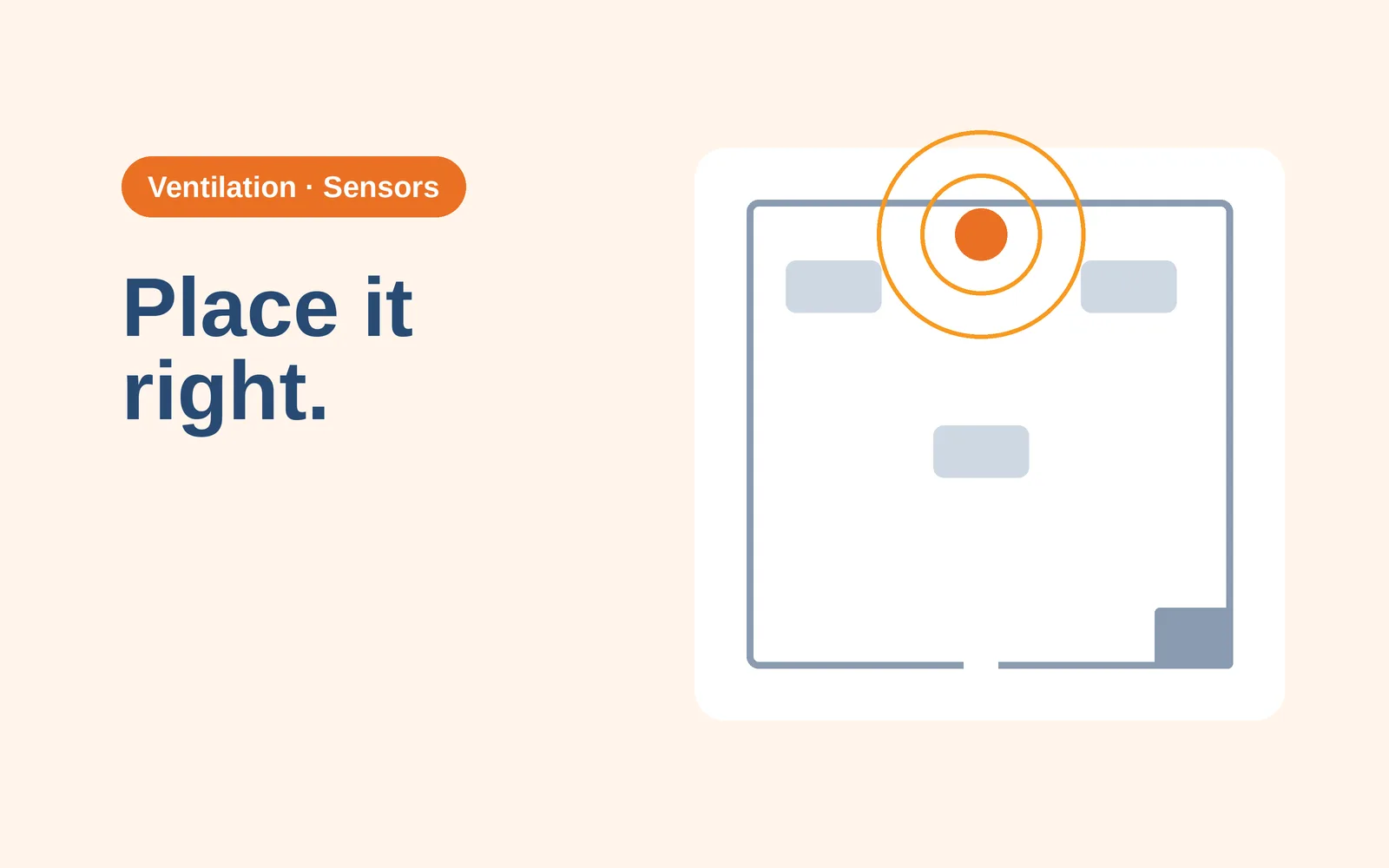
A CO2 sensor for ventilation control usually goes inside the occupied room, on a wall at roughly head height, at least half a meter from people and away from doors, windows and supply air openings. Published guidance differs on the exact height, but it agrees on what to avoid. Position matters because the ventilation controller acts on whatever number the sensor reports.
This kind of control is called demand-controlled ventilation: the outdoor air supply rises and falls with a CO2 reading, which stands in for how many people are in the room. A sensor in the wrong spot sends the fans the wrong instruction.
Where to mount a CO2 sensor for ventilation control
No single height appears in all guidance. California's energy code (2025 edition, read as reproduced by GoCodebook) says between 3 feet and 6 feet above the floor, or at the anticipated height of the occupants' heads. Other published guidance:
- UK Health and Safety Executive (HSE), portable CO2 monitors in workplaces: head height.
- Vaisala, installation guide for its wall transmitters: 1.2 to 1.8 m (4 to 6 ft).
- Singapore National Environment Agency: 75 cm to 120 cm from the floor, as close to breathing-zone height as practical.
- Zhang, Ding and Bluyssen (TU Delft, 2022), classrooms: wall devices at 1.1 m, about seated head height.
- Ackley and colleagues (2023), three naturally ventilated primary school classrooms: about 1.5 m on a vertical wall.
That is a spread of roughly 0.75 to 1.8 m. The evidence on height itself is mixed. In the Delft study CO2 was in most cases higher at a higher location in the room, while a Lawrence Berkeley National Laboratory (LBNL) field study of commercial buildings found no consistent trend with height. Pick one height inside the range and use it in every room, so readings can be compared between rooms.
What to keep away from the sensor
The HSE says to keep a monitor away from windows, doors and air supply openings, and more than 50 cm from people, because exhaled breath contains CO2. The UK Department for Education gives the same 0.5 m distance for classrooms. Vaisala's installation guide adds heat and moisture sources, direct sunlight, spots blocked by furniture, the discharge of supply air ducts, the floor and the ceiling.
A Vaisala application engineer also advises against mounting on exterior concrete or steel walls, which can act as a heat sink or heat source, and against a spot above a printer or photocopier. Fresh concrete and some plasters absorb CO2 for a time and can pull readings down in a new building.
Distance from people matters more than it looks. In LBNL's field work in meeting rooms, readings at different wall-mounted points sometimes differed by more than 200 ppm and fluctuated rapidly, partly because of exhaled breath from nearby occupants.
Room, return air or exhaust
Many existing systems measure in the return duct instead of in the room. LBNL compared average CO2 at return grilles with wall locations. In four of seven data sets the grille average was within 5% of the wall average. In the other three it deviated by 7%, 11% and 16%. The authors wrote that return grille measurements may be preferred to wall-mounted ones, and also that their research did not give definitive guidance.
Ventilation type changes the answer. A computational fluid dynamics study (Pei, Rim, Schiavon and Vannucci, Energy and Buildings, 2019) found that with mixing ventilation, sensors at the room exhaust met the accuracy requirements of ASTM E741 and California Title 24. With displacement ventilation, position errors could exceed the acceptable threshold, and exhaust sensors could overestimate the CO2 level in the breathing zone.
A duct sensor also gives one blended value for every room on that branch. If one meeting room is full and the others are empty, the blend can hide it. The studies above did not test that case. It follows from averaging, so check how many rooms share an air handler before relying on a duct sensor, and see how many CO2 sensors a building needs.
The outdoor reference
A CO2 sensor for ventilation control reports an indoor value, but the control logic and the standards both work with the difference between indoor and outdoor CO2, so the outdoor value matters too. NOAA's Mauna Loa record, a remote background site, shows a monthly mean of 426.07 ppm for September 2026 (preliminary data). Air next to a building can read higher. LBNL reported one building where the outdoor sensor averaged approximately 510 ppm, about 110 ppm above typical outdoor levels.
California's code lets a controller assume 400 ppm without any direct measurement, or measure outdoors with a sensor within 4 feet of the outdoor air intake. If a controller assumes 400 ppm and the real outdoor level is 500 ppm, every room looks 100 ppm more crowded than it is.
Check the sensor as well as the position
Placement cannot fix a CO2 sensor for ventilation control that reads wrong. In LBNL's 2010 field study, at 1,010 ppm, 40% of the sensors were off by more than 75 ppm and 19% by more than 200 ppm. Sensor age was not a consistent predictor of error, and no facility manager reported calibrating sensors since installation. California's code asks for sensors certified accurate within ±75 ppm at 600 and 1,000 ppm and factory calibrated so that calibration is needed no more than once every 5 years.
The HSE recommends non-dispersive infrared (NDIR) CO2 monitors. Some manufacturers build automatic baseline correction (ABC) into their NDIR sensors to correct drift, and ABC assumes the sensor sees fresh air regularly. Sensirion's data sheet for its SCD4x sensors says the algorithm assumes exposure to 400 ppm at least once per week. Amphenol's note on its ABCLogic function describes it as suited to spaces that are unoccupied for 4 hours per day or more, and says to deactivate it where CO2 is unlikely to drop to background levels regularly, such as spaces occupied around the clock. With it deactivated, the note says calibration may be required every 2 to 3 years.
Where Nomestic fits
Nomestic measures indoor climate room by room (CO2, temperature, humidity and more) with wireless, battery-powered devices, so a room takes minutes to equip. Nothing in the existing HVAC gets replaced, and operators can override automatic adjustments at any time. The ClimateIQ platform page has the detail.