Technology
Three signs your ventilation runs when nobody is there
Night power use the schedule does not explain, CO2 at the outdoor level while fans run, and rooms that look the same busy or empty. How to check each one.

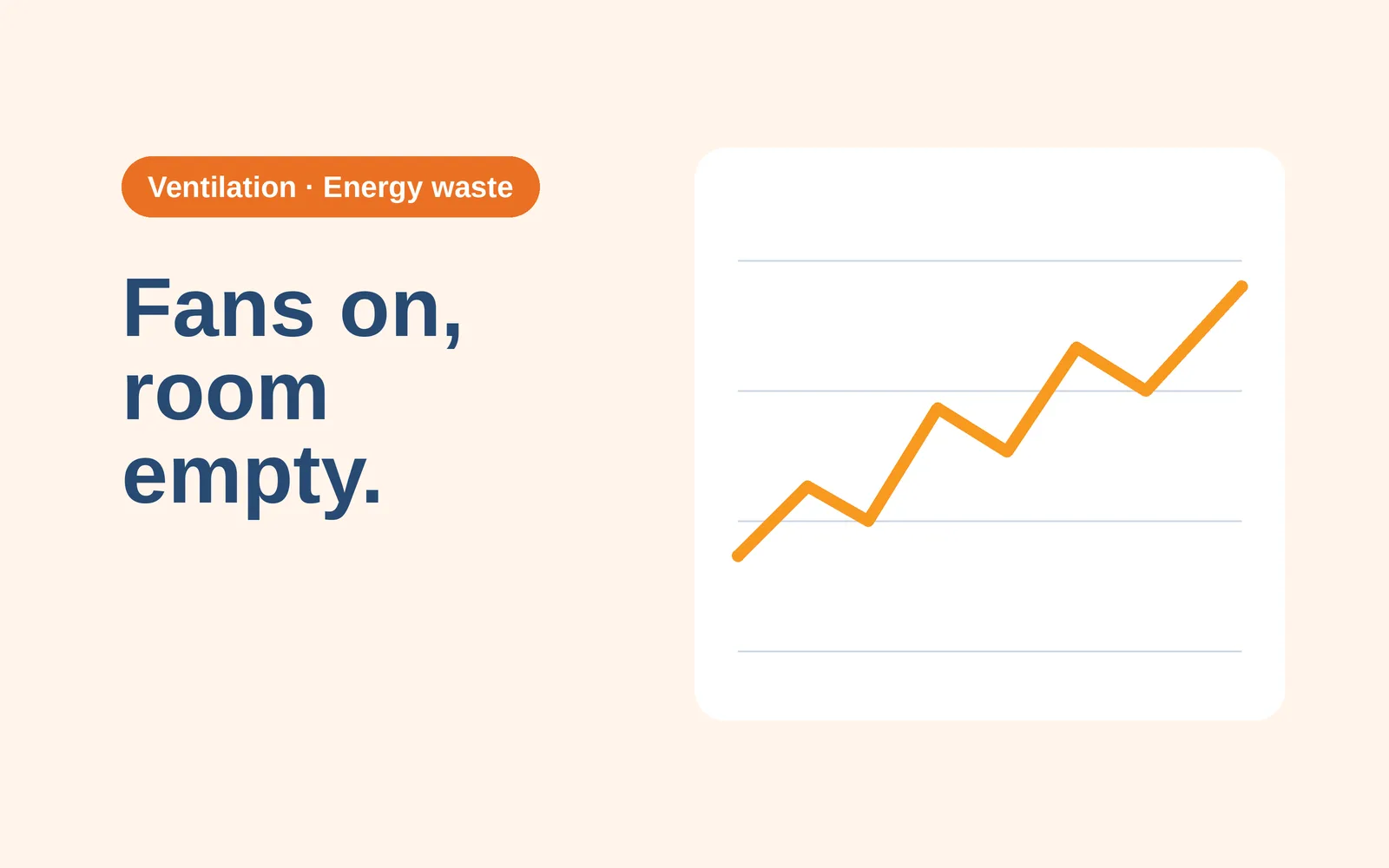
Ventilation control that runs on a schedule can leave three traces when the building is empty: power use at night and on weekends that the schedule does not explain, CO2 that has sat at the outdoor level for hours while the fans keep going, and rooms where a busy day and an empty one look the same. Each can be checked with a few weeks of data or one walk-round, and each is a form of energy waste. The wider list of places where energy goes is in where ventilation wastes energy.
Sign one: power use at night that the schedule does not explain
The Better Buildings Partnership's guidance note GN 4.5 defines the overnight base load as the energy consumption that occurs when a property is unoccupied, generally at night. It says significant demand during unoccupied or out-of-service hours may indicate inefficient use of heating or cooling plant, lighting or other equipment, and that submeter data can show the exact contribution of specific equipment. Half-hourly data can be requested from the utility company, and the note advises comparing consumption over several periods.
Then set that profile against the schedule. The Pacific Northwest National Laboratory (PNNL) Re-tuning Measure Guide (PNNL-SA-183964, April 2023) lists what should be off after hours. Dedicated outdoor air systems and exhaust systems should not be enabled after hours, there is no reason for an air handling unit to come on for a night heating cycle, and minimum outdoor air dampers can be kept completely shut on a schedule for all hours outside occupancy. It also says to check whether federal holidays are programmed in the scheduler. PNNL's training for small and medium buildings (PNNL-SA-92685) adds that a thermostat left in Hold mode may increase energy consumption needlessly, and that exhaust fans with time clocks should run only when the building is occupied.
Without a building management system (BMS), the ventilation control schedule may live in a time clock, a thermostat or the unit's own controller. Read it there, then stand in the building at night or on a Sunday and note which fans and pumps are running. The meter data says how much power is involved and the walk-round says which equipment. Morning start-up is a separate question: the Re-tuning guide describes optimal start, in which air handlers start at different times each morning, and checks that most spaces are conditioned by the start of occupancy. The question here is what happens in the hours after people leave.
Sign two: CO2 at the outdoor level while the fans run
As general reasoning, in a room where people are the main source, CO2 falls toward the outdoor level once they leave and the air is replaced. A US Department of Energy (DOE) federal technology alert on CO2-based demand control (DOE/EE-0293, listed in a library catalog as March 2004) puts outdoor CO2 at around 400 to 450 ppm, and ASHRAE addendum ab to Standard 62.1-2022 lets designers assume 400 ppm without measuring it. NOAA's Global Monitoring Laboratory lists a preliminary monthly mean of 426.07 ppm, measured at Mauna Loa Observatory in Hawaii, for September 2026. That is one observatory, and NOAA says its figures may differ from the global average, so the air outside a particular building can read differently.
A line sitting near that level overnight suggests the room is empty and has been flushed. It does not show whether the fan is running, so it needs a second record: fan status, or the schedule. If CO2 reaches its baseline a few hours before the system stops, the fans are probably running in an empty room, which is energy waste. This is general reasoning, not a published method, and some designs include a deliberate flush before or after occupancy, so check the design intent before changing a schedule.
Overnight data also tests the sensor. The REHVA Journal paper on commissioning demand-controlled ventilation (Mysen and colleagues, 2015) suggests checking that all CO2 sensors give the same ppm reading when the building is empty. The Re-tuning Measure Guide says to re-calibrate or replace first any CO2 sensor reading below 400 ppm. Lawrence Berkeley National Laboratory (LBNL) found 40% of 208 field sensors off by more than 75 ppm at about 1,010 ppm, so a baseline that sits far from the outdoor level in one room may be a sensor error. How to read ventilation data in five minutes covers the overnight baseline in a full day of data.
Sign three: rooms that look the same busy or empty
Some rooms get the same air whether anyone uses them or not. PNNL's 2012 literature review (PNNL-21281) says conference rooms often receive the airflow designed for full occupancy even when empty, and that installers often set the minimum airflow of a terminal box at 30% to 50% of maximum. The Re-tuning Measure Guide recommends limiting VAV box minimums to 10% to 15% of each box's maximum airflow, and treats outdoor air requirements as a separate check against ASHRAE 62.1.
In the data this looks like a CO2 trace with no working-day peak. If a meeting room's CO2 stays close to its overnight level through a week of scheduled hours, the room is either hardly used or used and flushed with so much air that CO2 cannot rise. In both cases the supply is larger than the use, which is energy waste. A booking calendar or a quick count separates the two, and the airflow at the diffuser, compared with the design figure in the balancing report, shows how much air the room gets. This reading and the check are practical suggestions, not published findings. The DOE alert finds the most potential for demand-controlled ventilation where occupancy fluctuates during a 24-hour period.
Turning the findings into a ventilation control change
When two or more signs point at the same equipment, a practical first step (a suggestion, not a published finding) is to change the schedule: shorter hours, a holiday calendar, and a manual override for the exceptions. Keep the measurement running afterwards, on the same sensors and at the same points, so the before and after profiles can be compared. The article on verifying ventilation savings covers what makes that comparison fair. For why so many buildings run on a schedule in the first place, see why most buildings ventilate on a schedule instead of on need.
Nomestic measures indoor climate room by room, including CO2, temperature and humidity. The devices are wireless and battery-powered, so a room takes minutes to equip, and the system works with or without a BMS.