Technology
Why one CO2 sensor per floor misses the problem rooms
A CO2 sensor on a floor or in the return air reports an average of the rooms it serves. Field data from meeting rooms and classrooms shows how far one point can differ from another.

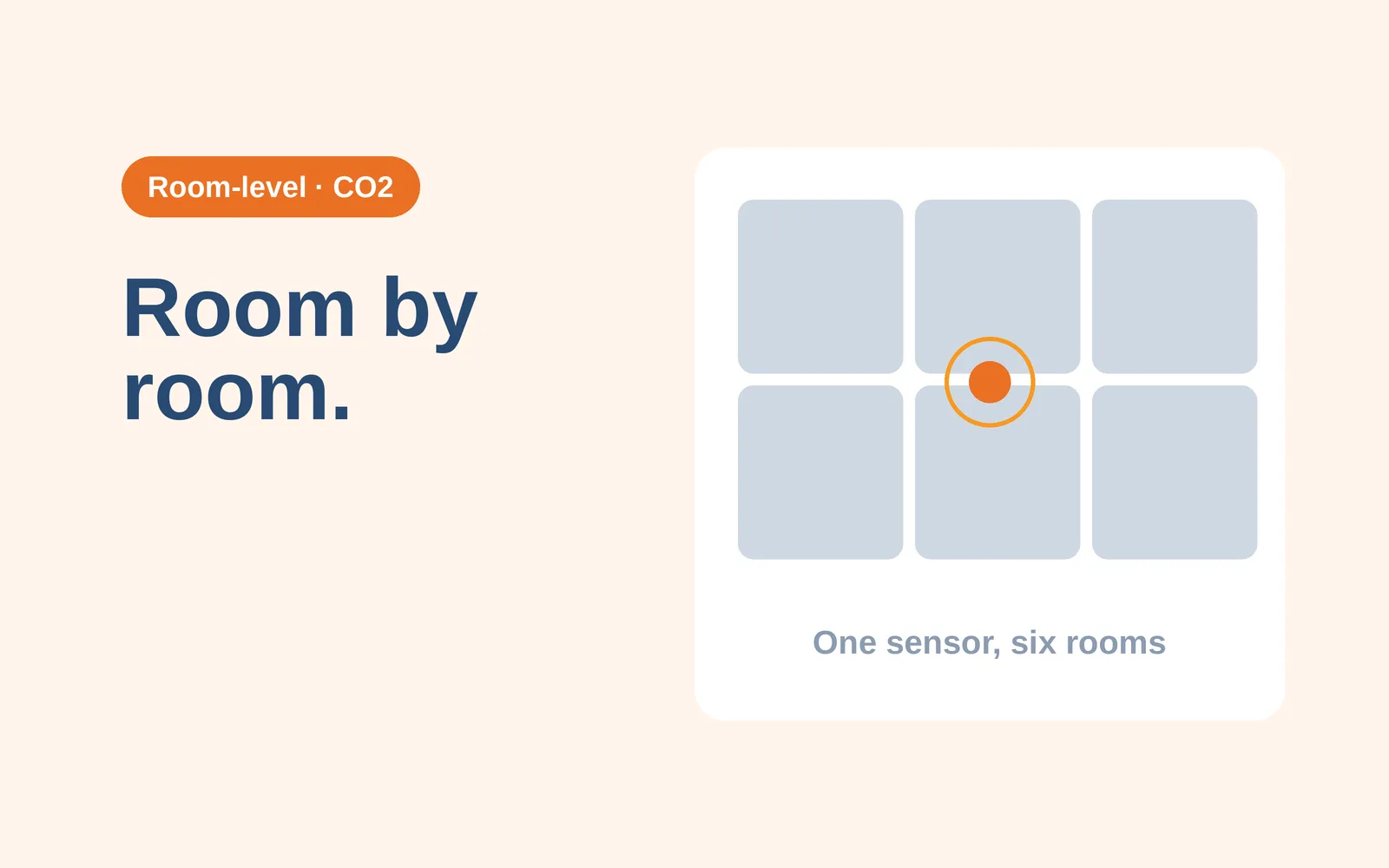
A CO2 sensor on each floor, or one in the return air of an air handler, reports a blend of the rooms it serves. The rooms with a problem are the ones that differ from the blend: a meeting room that fills for two hours, or a room that gets less air than its neighbors. Room-level monitoring puts a CO2 sensor in each space whose occupancy or air supply can differ from the rest, so every reading describes one room.
A floor-level reading can be a fair picture of the system and a poor picture of a single room. None of the studies cited here gives a figure for how often an average hides a problem room.
What a CO2 sensor in the return air measures
Return air is a mix from every room on that branch. ASHRAE has addressed using it as a stand-in for the rooms. In interpretation IC 62.1-2013-6 (approved 16 March 2017), a requester proposed that CO2 sensors in the return air of a multiple-zone system could estimate total occupancy and adjust outdoor air for the whole system, under section 6.2.7.1.1 of ANSI/ASHRAE Standard 62.1-2013. ASHRAE answered that the proposed interpretation was not correct. Its comment says that besides the total number of people, one must identify the zones where they are, and that the multiple-zone process requires at least the minimum ventilation for each zone.
Field data from 1993 supports return air as a measure of the average. Reardon and Shaw (National Research Council of Canada, Indoor Environment, 1993) measured CO2 in a 22-storey office building in Ottawa, with return-air intakes monitored on eight test floors and eight occupied-zone locations on each of two of them. On those two floors the return-intake profile closely matched the spatial average of the occupied-zone locations. CO2 profiles in the occupied zones showed greater variability than those at the intakes, and the authors say the set point should be adjusted to account for local variability. On those floors the return air described the average, and the variation was in the occupied zones.
How much CO2 varies between rooms and within them
The next two studies compare points inside a single room, which shows how much one reading can miss. Lawrence Berkeley National Laboratory (LBNL-3279E, 2010) measured CO2 at nine locations in six meeting rooms over seven time periods. In one crowded seminar, concentrations differed by up to about 300 ppm between locations at the same moment. Within each room, the spread between the highest and lowest period averages at wall-mounted points ranged from 43 to 242 ppm across the seven data sets, and the report says part of the difference may be a consequence of exhaled breath from nearby occupants.
TU Delft researchers (Zhang, Ding and Bluyssen, Indoor and Built Environment, 2022) measured seven classrooms in two Dutch secondary schools. In some of the naturally ventilated classrooms, two points in the same room differed by more than 300 ppm (or 40%). In the one mechanically balanced classroom there were no significant differences between locations, and the authors say one measurement point seemed enough because CO2 was well mixed. A 2024 conference paper by Marín López and colleagues, based on 37 on-site measurements over five months in primary schools and university classrooms, reports spatial discrepancies beyond 100 ppm and says sensor position and ventilation strategy often outweigh sensor specifications.
Evidence between rooms is thinner. Palacios, Bhangar, Pyke and Kok (INDOOR AIR 2018 conference abstract) used a distributed sensor network covering 10 buildings and about 500 rooms. Their abstract reports that CO2 distributions differed across rooms in ways often missed by traditional approaches to commissioning buildings and building systems operations. It gives no count of problem rooms.
What room-level monitoring catches
This section is reasoning from how averaging works, not published findings. A room that fills while its neighbors stay empty raises its own CO2 while the blended return value moves little. As an illustration with round numbers: if one of four equally sized rooms on a branch reads 1,400 ppm and the other three read 500 ppm, an equal-airflow blend reads about 725 ppm. That is under the 800 ppm that UK Department for Education guidance for schools calls good ventilation, and it describes none of the four rooms.
Two more cases fit the same pattern. A room with a closed damper or a blocked diffuser gets less air than the rest of its branch, and a room ventilated far above what its use needs reads close to outdoor levels all day. Neither shows in a floor average. Where the outdoor air supply follows a CO2 reading, as in demand-controlled ventilation, the controller can only respond to the rooms it can see. Placement inside the room matters as well, and is covered in where to place CO2 sensors for ventilation control.
When one sensor per floor is enough
A floor or return-air sensor suits a system-level question, such as the average CO2 on the floor an air handler serves, and the Ottawa study found the return intakes close to the occupied-zone average on the floors it checked. Where rooms on one branch have similar use and occupancy that moves together, a shared sensor is a candidate, though that is a design judgment and not a published finding. The UK Health and Safety Executive (HSE) says monitors can be used in spaces up to 50 m² when the same number of people use them for over an hour, and that spaces over 320 m² may need multiple monitors to get meaningful measurements.
More sensors mean more devices to check. In the LBNL field study of 208 sensors in 34 commercial buildings, 40% of sensors were off by more than 75 ppm at 1,010 ppm, and no facility manager reported calibrating sensors since installation. How many CO2 sensors a building needs covers how to weigh coverage against that effort.
Where Nomestic fits
Nomestic measures indoor climate room by room, with CO2, temperature, humidity and more. The devices are wireless and battery-powered, so a room takes minutes to equip, and nothing in the existing HVAC gets replaced.