Technology
BEMS vs BMS: what is the difference?
Sources use BEMS, BMS and BAS for overlapping systems. What the terms mean, where they differ, and what a BMS alternative can and cannot do.

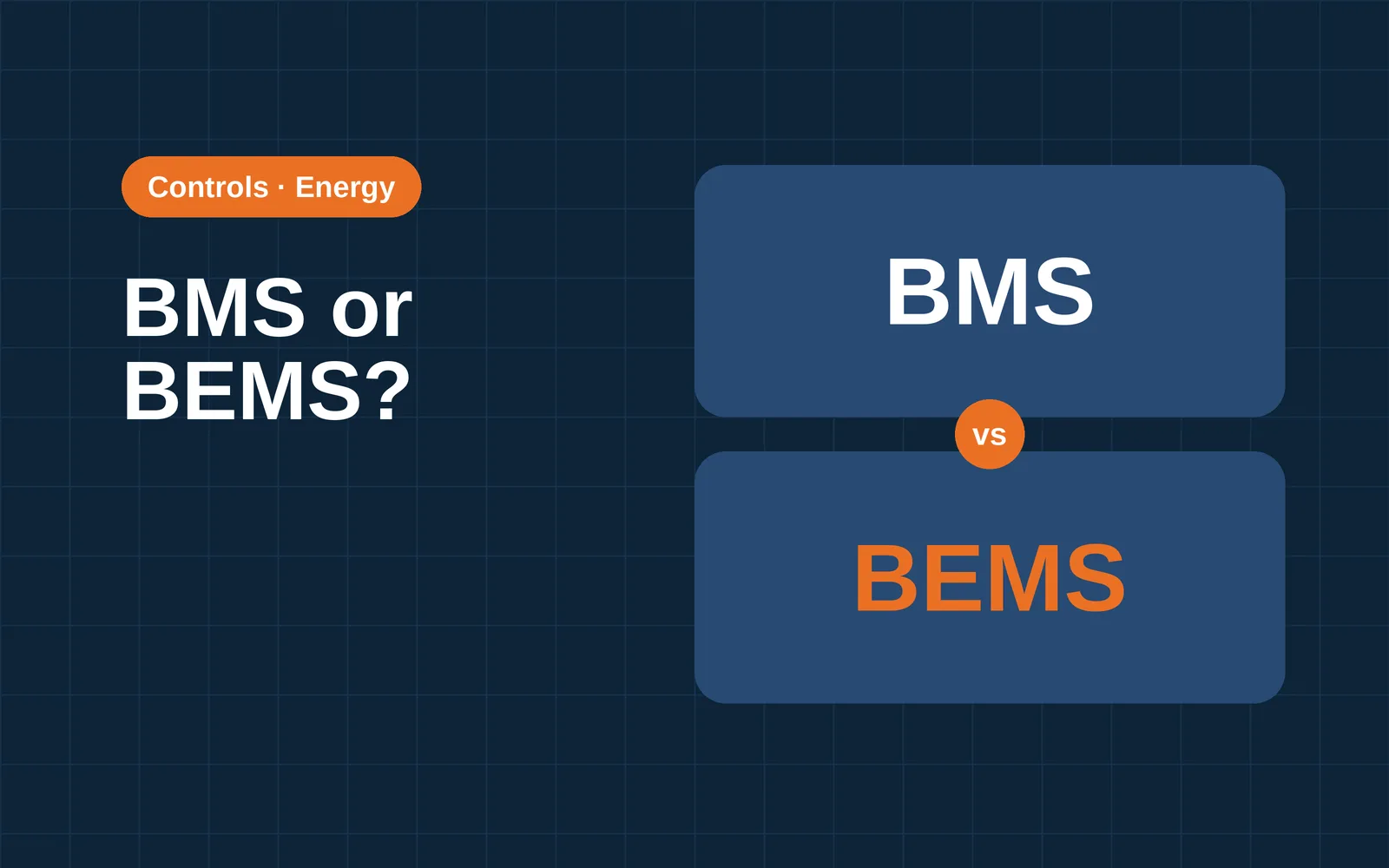
Sources do not agree on a firm line between a BEMS (building energy management system) and a BMS (building management system), and several use the two names for the same thing. That matters if you are looking for a BMS alternative, because the phrase can mean a simpler system that controls equipment, a software layer that reports on energy, or short-term logging to see what the equipment is doing before you decide.
What a BMS and a BEMS are
One way to split them is by scope. A building management system covers a wide range of building systems, including fire, security and lifts as well as HVAC and lighting. A BEMS covers the energy-related plant, typically HVAC, lighting and power. That wording is from Designing Buildings as quoted by the technology site i-SCOOP, which adds that BMS products started as energy management tools and later dropped the "E". i-SCOOP suggests the distinction may fade.
Other sources draw no line at all. The European Commission's Joint Research Centre says a building automation system (BAS) is also called a BMS or a BEMS. The Pennsylvania Department of Environmental Protection treats BAS and building management system as interchangeable. ACEEE's 2025 brief names energy management systems and BAS as other common names for the same kind of control system and does not say how they differ. EU law uses a third term, building automation and control system (BACS), covered in building automation for buildings without a BMS. EN ISO 52120-1 speaks of building automation, controls and technical building management.
So the name on a brochure tells you little. A better test is what the product does: whether it sends commands to the equipment, stores and analyzes data, or both.
Where an energy layer differs from a control system
DOE uses a wider family name, energy management and information systems (EMIS). Its list includes benchmarking and utility tracking tools, advanced energy information systems (EIS), equipment-specific fault detection and diagnostics (FDD), automated system optimization and building automation systems. In that framing a BAS is one member of the family.
A 2018 page from the California Energy Product Evaluation Hub at UC Davis describes the split. A BAS is "primarily a tool to operate building systems". An EIS takes inputs from energy metering hardware and computes, reports and displays metrics. Each can feed the other, since a BAS can provide data to an EIS.
DOE's guidance for federal facilities is direct about the limits. EMIS "should not be considered stand-alone energy efficiency systems capable of producing results". Apart from automated supervisory controls, they need people to identify, act on and implement energy conservation measures, and the document lists the BAS among the data sources EMIS draw on.
Published results come from DOE's Smart Energy Analytics Campaign (2016 to 2020), in which 104 organizations covering 6,500 buildings reported median annual energy savings of 9% for fault detection and diagnostics tools and 3% for energy information systems, with a simple payback of 2 years for EMIS projects. Those are US campaign participants.
Choosing a BMS alternative
If the problem is that the equipment has no central control, a BMS alternative means a smaller control system. DOE's 2013 size guidance for small and medium buildings runs from a programmable thermostat in the smallest buildings, through networked thermostats and replacement rooftop-unit controllers, to a full central BAS above 20,000 square feet (about 1,860 m²). ACEEE adds light commercial building automation systems, which it describes as a smaller and simpler version of the systems used in larger buildings.
If a BMS exists and nobody can see what it is doing, the BMS alternative is not a replacement. It is an energy information system, which can take data from the BAS and from energy meters (Cal-EPE Hub). A smaller first step is also documented: DOE's Federal Energy Management Program describes re-tuning as a low-cost way to optimize HVAC, primarily through the BAS, and says it typically cuts annual building energy use and costs by 5% to 25%.
If a building has neither, short-term logging is one option. A Seattle Tune Up Accelerator tool sheet lists run-time, temperature, CO2 and differential pressure loggers for checking schedules, setpoints, ventilation and pressures. The article on spotting HVAC faults without a BMS covers what such data can show.
For the EU duty, the BACS definition covers automatic control as well as manual management, and Article 13(10) lists energy monitoring, benchmarking, communication between systems and, from 29 May 2026, indoor environmental quality monitoring. A tool that only reports does not do the automatic control in the definition. Whether a setup counts is for the national rules and an engineer to say.
Nomestic measures indoor climate room by room (CO2, temperature, humidity and more) and works with or without a BMS. Nothing in the existing HVAC gets replaced, and operators can override automatic adjustments at any time. Savings are verified by comparing measured data before and after a change.