Technology
How to spot HVAC faults without a BMS
The HVAC faults found most often, how they show up, and what room sensors, loggers and energy data can reveal in a building that has no BMS.

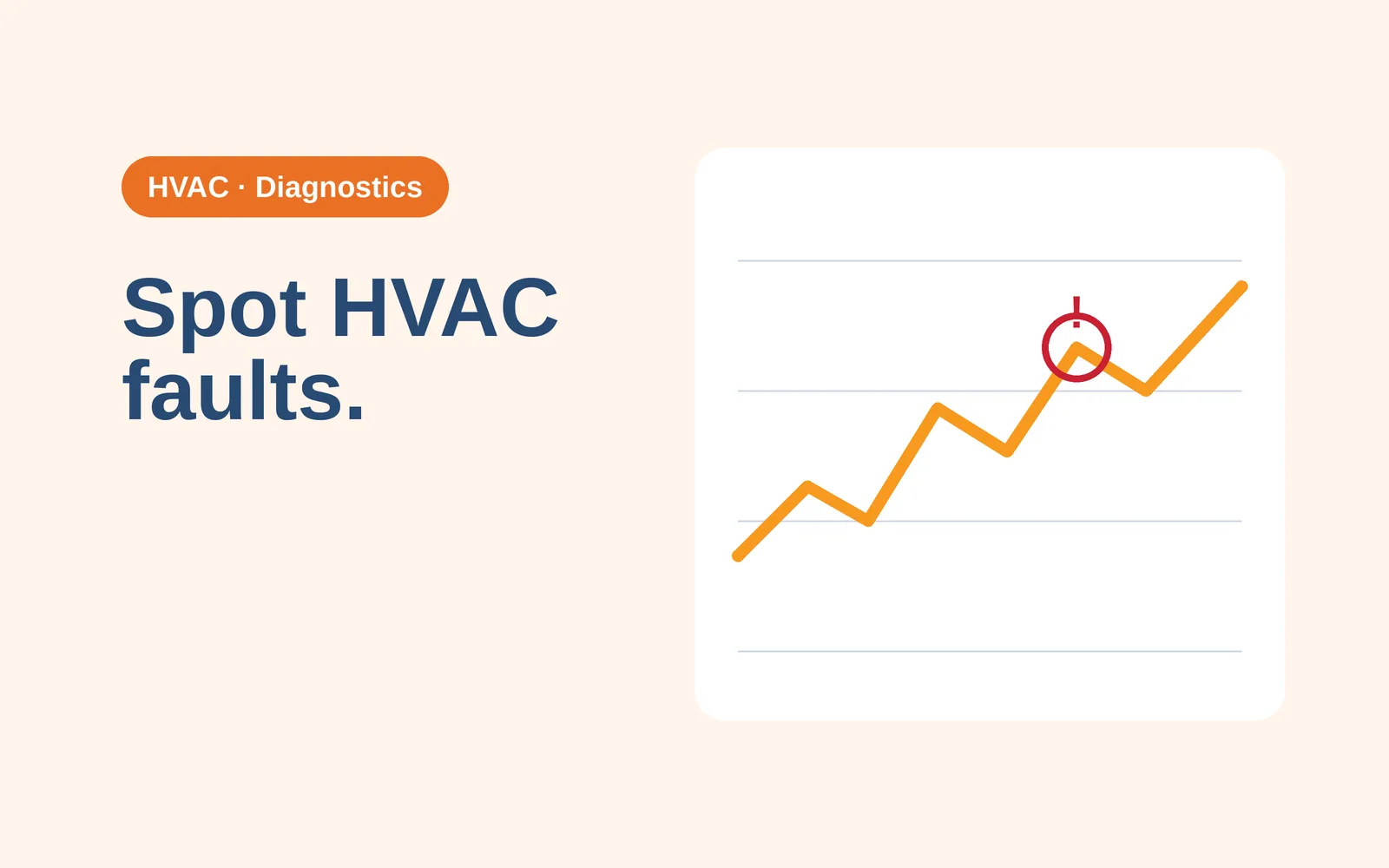
Fault detection and diagnostics for HVAC (FDD) means finding equipment that is not working as intended and saying what kind of problem it is or where. Lawrence Berkeley National Laboratory (LBNL) defines automated FDD as finding deviations from normal or expected operation and identifying the type or location of the problem, which reduces the need for complex manual analysis of operating data. Without a building management system (BMS) there is less data to work with, so it helps to know which faults are reported most often.
What fault detection and diagnostics for HVAC finds most often
A 2023 paper by researchers at LBNL, the Pacific Northwest National Laboratory (PNNL) and other institutions analyzed fault reports from six FDD software providers and one large building portfolio owner. The dataset has over 60,000 pieces of HVAC equipment, and the results cover 3,660 air handling units (AHUs) and 53,865 air terminal units (ATUs, the boxes that control airflow into a zone). On a typical day, a mean of 40% of AHUs and 30% of ATUs had at least one reported fault. The most common AHU fault involved the supply air temperature setpoint, on 55% of AHUs at some point. For ATUs, faulty zone temperature sensors and abnormal zone temperature each appeared on 46%.
Six AHU faults were both common (on at least 20% of units) and long-lasting (at least 20% of monitored time). They were the supply air temperature setpoint, the supply air static pressure setpoint, the economizer sequence, the supply air temperature sensor, a coil valve and an airflow sensor. An economizer lets a unit use outdoor air to meet the cooling load, and PNNL's rule set for rooftop units and air handlers looks for one that is not economizing when it should, one that economizes when it should not, excess outdoor air and insufficient ventilation air. A 2009 PNNL report on self-correcting controls adds biased temperature sensors, dampers stuck in place and a minimum outdoor-air position set too open or too closed.
Read those numbers with care. They are FDD software output, with no first-hand site observation behind each fault. The authors say the sample is not shown to be representative of US commercial buildings, in part because owners who invest in FDD may have above-average buildings, and false positive and false negative rates are not quantified. The National Renewable Energy Laboratory (NREL) found a similar issue in rooftop unit data. In the data from two of the four companies, most "sensor failure" faults were space temperature or humidity readings outside setpoint, not failed sensors.
How the faults show up
DOE's retrocommissioning guidance lists common problems to look for in BAS trend data in large buildings: occupied schedules longer than needed, exhaust fans, lights and circulation pumps running when nobody is there, air handlers heating and cooling at the same time, static pressure setpoints that are too high, economizers bringing in too much outside air, and zone heating and cooling setpoints that sit too close together. For small and medium buildings, its walk-down checks ask whether occupied and unoccupied setpoints differ by at least 5°F (about 3 K) and whether heating and cooling setpoints differ by at least 2°F (about 1 K).
Some faults are hard to see from the room. In an in-progress field check shown in a 2021 DOE project review (Evaluation of Fault Prevalence in Commercial Buildings), comparing the building automation reading with a separate logger at a 2°F threshold flagged 3 of 11 rooftop units (27%) for zone temperature sensor drift. The slide says the analysis was not yet cross-checked against FDD results.
What standalone sensors and reports can show
A Seattle Tune Up Accelerator tool sheet matches common checks to instruments. Run-time loggers compare fan, pump, chiller and boiler start and stop times with the occupancy schedule. Temperature loggers check setpoints and reset schedules. CO2 loggers check ventilation (see what is a good CO2 level in an office for the numbers), and differential pressure loggers check duct, loop and building pressure. The sheet also lists simultaneous heating and cooling, and outside air at none or 100% against ASHRAE 62.1 needs, among the problems to look for. It is a reference sheet and reports no measured results.
Energy data is the other source. DOE describes energy information systems as performance monitoring software, data acquisition hardware and communication systems that store, analyze and display building energy data, and points to interval meter analytics for identifying savings opportunities.
The next limit is general reasoning, not a published finding. A room sensor measures the room. A hot room, a stuffy room or a fan that runs overnight is a symptom, and the cause may sit in a damper, a valve, a sensor or a setting that only someone at the equipment can check. So a logger result is a reason to inspect the equipment, and the diagnosis happens there. The 2018 LBNL paper adds that there are many commercial automated FDD products but no common framework to characterize them.
Here is a suggested order for fault detection and diagnostics in HVAC without a BMS. It comes from general reasoning and has no published source. Compare equipment schedules with how the building is used, then log run time and room conditions across occupied and unoccupied periods, then inspect the equipment behind any room that stays outside its target. Where to place CO2 sensors for ventilation control covers the sensor side.