Health
What is a good CO2 level in an office?
Germany's workplace rule uses 1,000 ppm. Where that number comes from, what EN 16798-1, German and UK guidance say, and what studies found on CO2 and thinking.

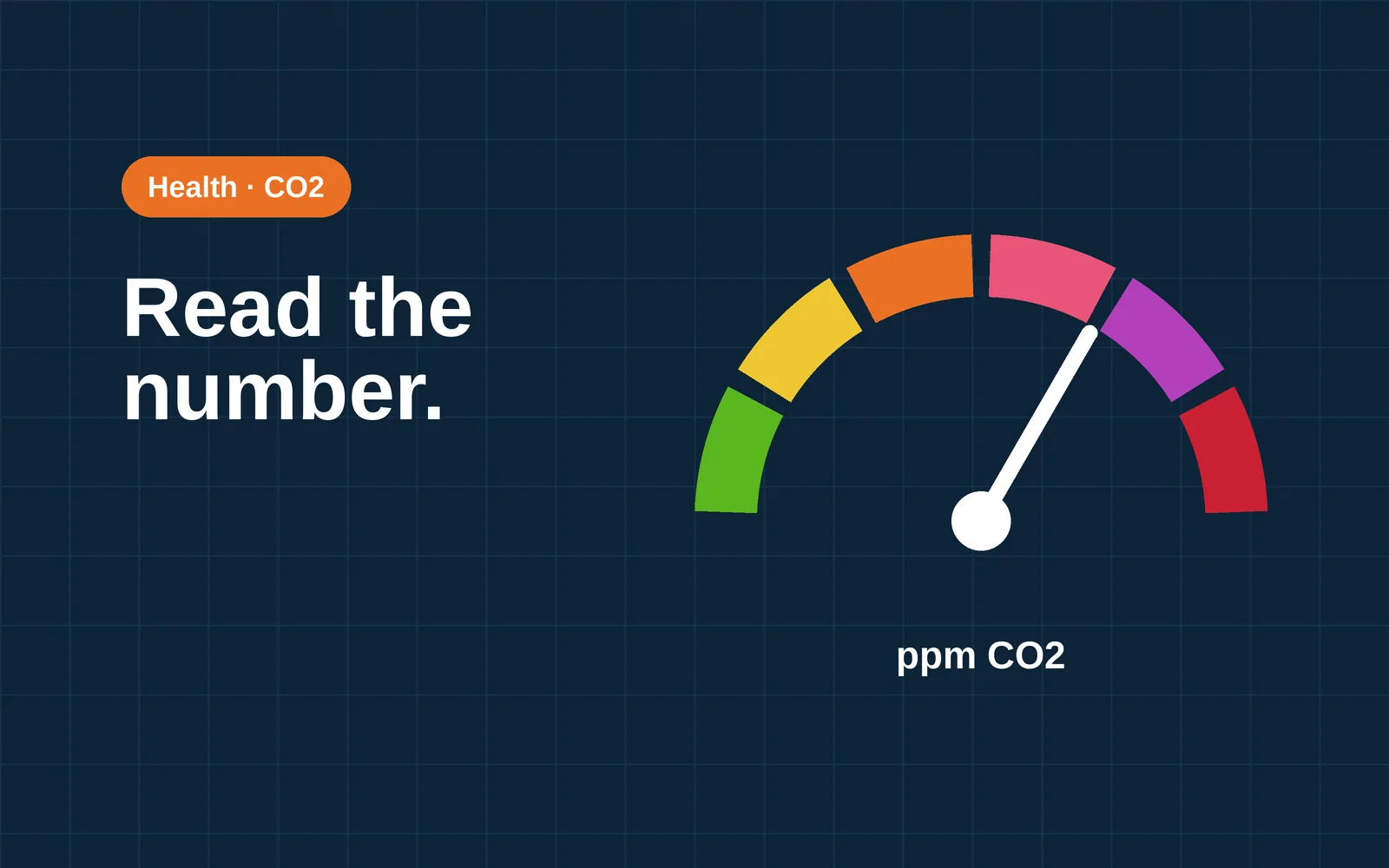
A good CO2 level in office rooms is usually put at about 1,000 ppm or lower while people are present. Germany's workplace rule ASR A3.6 calls for no further measures below that figure, and UK guidance for schools calls readings under 800 ppm good ventilation. Both work as measures of how well a room is ventilated.
What sets the CO2 level in office rooms
People breathe out CO2, so the CO2 level in office rooms climbs while they are present, until the fresh air supply removes it as fast as people add it. At that steady state, the level above outdoors equals the CO2 each person produces divided by the outdoor air each person receives (NIST Technical Note 2213). ASHRAE's technical FAQ puts a number on it for typical office activity.
Outdoor air is not at zero. NOAA's Mauna Loa record shows a monthly mean of 426.07 ppm for September 2026 (preliminary). With outdoors near 425 ppm, 700 ppm above outdoors is about 1,125 ppm indoors.
Where 1,000 ppm comes from
The number has a long history. In the 19th century Max von Pettenkofer argued that bioeffluents from occupants were what made crowded rooms feel bad. CO2 rises and falls with the number of people, which is why it is used as a marker. Later odor studies found that about 7.5 to 9 L/s of outdoor air per person kept body odor acceptable to roughly 80% of unadapted visitors, and the CO2 level that goes with it was about 700 ppm above outdoors. With outdoors taken as 300 ppm, that is about 1,000 ppm.
ASHRAE Standard 62-1981 contained an indoor CO2 limit of 2,500 ppm. According to NIST, it was changed to 1,000 ppm in the 1989 edition without explanation, and many have since viewed 1,000 ppm as a de facto indoor air quality standard. Andrew Persily's 2015 review of the development of Standard 62 says the CO2 limits relate to body odor control. ASHRAE's position document says claims that Standard 62.1 requires indoor CO2 below about 1,000 ppm are incorrect, and that its ventilation standards contain no CO2 limits based on human health and comfort.
So 1,000 ppm began as a ventilation indicator tied to body odor. ASHRAE's FAQ does say CO2 at very high concentrations (greater than 5,000 ppm) can pose a health risk, and adds that in most buildings concentrations almost never rise that high.
Guidance on the CO2 level in office buildings
EN 16798-1:2019 is the European standard for indoor environmental input parameters. ISO 17772-1 is its parallel ISO version. Both are paywalled, so the figures here are as presented by Professor Bjarne Olesen of the Technical University of Denmark in a 2023 presentation. For non-adapted persons, CO2 above outdoors is 550 ppm in category I (10 L/s per person), 800 ppm in category II (7 L/s) and 1,350 ppm in category III (4 L/s).
These are ventilation rates written in ppm. An Olesen presentation on the draft standard (prEN 15251-1), hosted by REHVA, says the CO2 values assume an emission of 20 L/(h·person). Divide that by the airflow and you get about 556, 794 and 1,389 ppm for 10, 7 and 4 L/s, close to the 550, 800 and 1,350 ppm shown above. With outdoors at 425 ppm, category II comes to about 1,225 ppm indoors.
Germany's workplace ventilation rule ASR A3.6 (January 2012, last amended 2018) uses absolute bands:
The German Social Accident Insurance (DGUV) labels these bands hygienically harmless, hygienically conspicuous and hygienically unacceptable. It notes that in offices and meeting rooms the 1,000 ppm value is an instantaneous value under ASR A3.6, while in education it is a mean over a usage unit.
UK guidance for education settings reads under 800 ppm as good ventilation, 800 to 1,500 ppm as adequate and over 1,500 ppm as poor. The HSE says levels consistently above 1,500 ppm in an occupied room indicate poor ventilation, and that readings are only a broad guide to ventilation and do not show that a room is safe. California's energy code sets its demand control ventilation target at 600 ppm above outdoor CO2 (2025 edition). The numbers differ because they were written for different jobs: classroom advice, a workplace rule, a design standard.
What controlled studies found
Three controlled studies, run with different designs, did not reach the same result.
Satish and colleagues (Environmental Health Perspectives, 2012) tested 22 adults, mostly university students, in three 2.5-hour sessions at about 600, 1,000 and 2,500 ppm. Pure CO2 was added to the supply air, the outdoor air supply stayed constant, and neither participants nor the test administrator knew the level. On the Strategic Management Simulation, six of nine decision-making scales showed moderate, statistically significant declines at 1,000 ppm compared with 600 ppm. The authors name the college-age sample as a limit and state that confirmation is needed.
Allen and colleagues (2016) followed 24 office workers over six full workdays in a controlled office. The authors report that cognitive scores were associated with both CO2 and volatile organic compounds, each independently. Green Building Advisor reported lower scores at about 950 ppm and larger differences at 1,400 ppm. Engineer Kenneth Elovitz criticized the study in HPAC Engineering: the moderate-CO2 day broke the pattern, temperature showed a relationship as strong as CO2, and he saw the data as grounds for further testing.
Zhang and colleagues (Indoor Air, 2017) exposed 25 subjects to five conditions of 255 minutes each, including pure CO2 added to a reference of 500 ppm to reach 1,000 and 3,000 ppm. Pure CO2 had no statistically significant effect on perceived air quality, symptoms or cognitive performance. Bioeffluents at 3,000 ppm did: perceived air quality worsened, headache, fatigue and sleepiness were reported more, and some cognitive tasks declined.
ASHRAE's position document calls the evidence for impacts of CO2 on health, well-being, learning and work performance inconsistent, and says it does not currently justify changes to ventilation or indoor air quality standards. Where thinking starts to suffer is not settled. What the number does tell you is how much outdoor air each person in that room is getting.
Reading your own numbers
A single reading of the CO2 level in office rooms says little. The HSE advises several readings across the day while the room is occupied, noted with occupant numbers and the ventilation in use, and repeated as the weather changes. Look at the peak during occupied hours and how fast the level falls after people leave. Sensor position and accuracy decide whether the number is worth reading, which is covered in where to place CO2 sensors for ventilation control. For the airflow behind the ppm, see ventilation rates in offices and classrooms.
CO2 also covers only part of the picture. ASHRAE's FAQ says CO2 concentration is not a reliable indicator of building air quality as a whole. Particles and chemicals from sources other than people need their own sensors, a topic in CO2 monitor or air quality monitor.