Health
Indoor air quality in healthcare facilities: what the standards cover and what monitoring adds
Healthcare ventilation standards such as ASHRAE 170, HTM 03-01 and DIN 1946-4 cover design and testing. Room-level monitoring adds a record between verifications, and has clear limits.

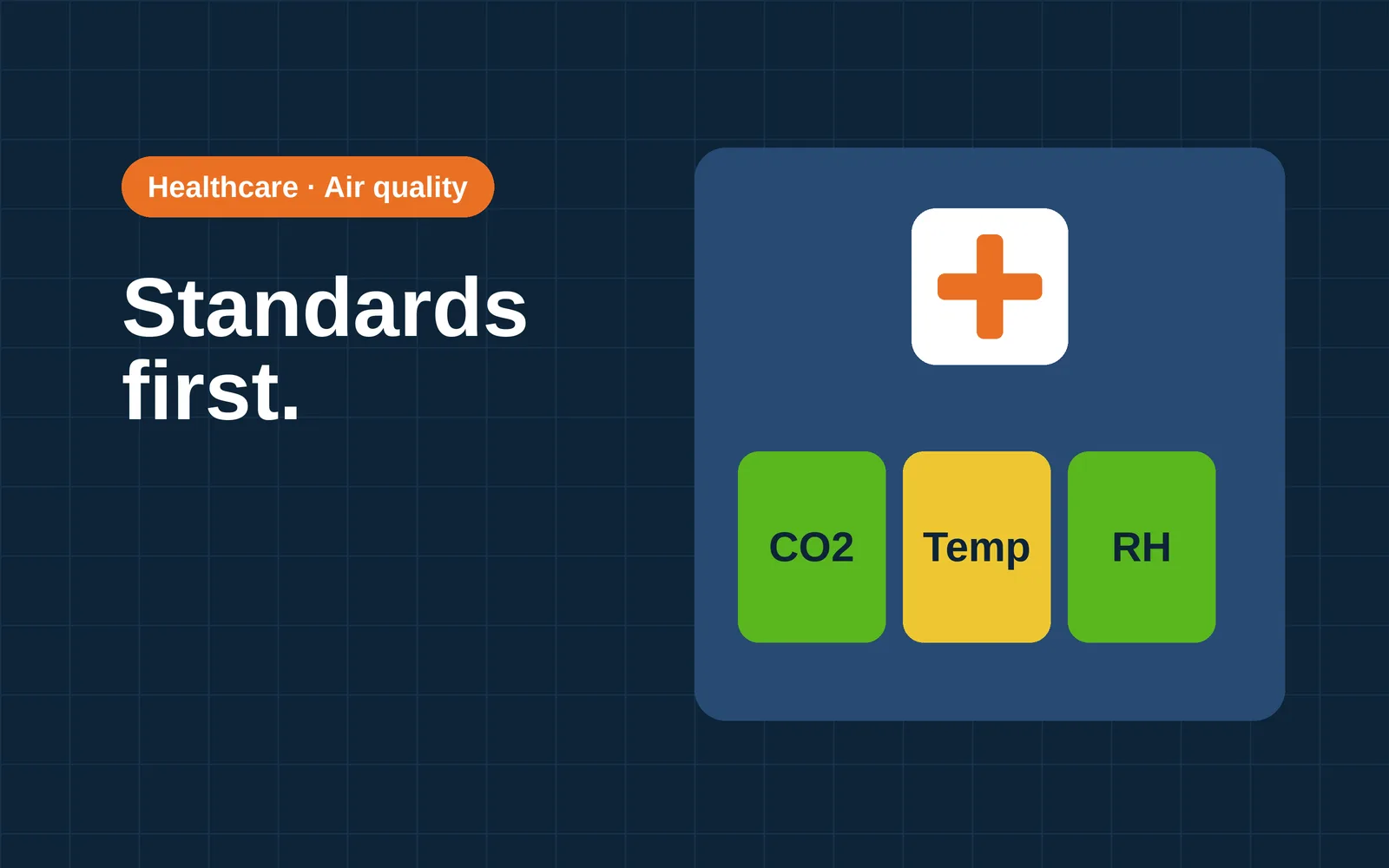
For indoor air quality in healthcare facilities, several ventilation standards are written specifically for health care buildings: ASHRAE Standard 170 in the United States, HTM 03-01 in England and DIN 1946-4 in Germany. Each sets design requirements, and HTM 03-01 and DIN 1946-4 also cover testing. A room-level monitor adds a continuous record of a few conditions, such as CO2, temperature and humidity. It does not replace the verification those standards describe, and it says nothing about clinical risk.
What the healthcare ventilation standards cover
ANSI/ASHRAE/ASHE Standard 170 is the US ventilation standard for health care facilities. A 2019 addendum to the 2017 edition shows the purpose as "environmental control for comfort, asepsis, and odor" and the scope as patient care areas, resident care areas and related support areas in hospitals, nursing facilities and outpatient facilities, in new buildings, additions and the alterations to existing buildings that the standard identifies. The addendum is a proposed revision to the 2017 text, and the 2021 wording is not quoted here. It also establishes design requirements for temperature, humidity, odor control, asepsis and ventilation rates including outdoor air. It states that it does not establish full thermal comfort design requirements, which the foreword says Standard 55 addresses. ASHE says the 2021 edition incorporates 17 addenda to the 2017 edition, revises the scope, changes the outpatient and residential sections and revises the filtration requirements. The standard is paywalled, and no values for individual spaces are quoted here.
In England, Health Technical Memorandum 03-01, Specialised ventilation for healthcare premises, was published on 22 June 2021 and supersedes the 2007 edition. Part A covers new installations and major refurbishments. Part B covers the management, operation, maintenance and routine testing of existing systems, irrespective of their age. NHS England describes the memorandum as written for premises providing acute care. For other settings, such as GP practices, dental clinics and hospices, Part A says the responsible people carry out a risk assessment of the treatment and the patients to decide how far it applies.
In Germany, DIN 1946-4:2018-09 covers ventilation systems in medical examination and treatment areas. This description rests on the publisher's summary (DIN Media); the text of the standard is paywalled and no clauses are quoted here. The publisher names hospitals, day clinics, doctors' practices and dialysis centers as examples of application areas. Its list of changes from the 2008 edition includes requirements for infection protection, system qualification, technical and hygienic acceptance and recurring tests, and says the qualification of operating rooms is based on DIN EN ISO 14644, the cleanroom series. The publisher lists an amendment, DIN 1946-4/A1:2025-11.
EN 16798-1:2019, the general European standard for indoor environmental input parameters, replaced EN 15251:2007. Its scope applies where the indoor criteria are set by human occupancy and where a production or process does not have a major impact on the indoor environment. The scope text does not list building types and does not mention hospitals, so the scope text does not say how it applies to hospital rooms.
What the standards ask for in the most demanding rooms
Isolation rooms and similar spaces have their own requirements. The 2003 CDC guidelines for environmental infection control in health-care facilities describe an airborne infection isolation room as under negative pressure with at least 12 air changes per hour in new construction as of 2001 and at least 6 in construction before 2001. A protective environment room has positive airflow relative to the corridor and at least 12 air changes per hour. These figures come from the guideline's key terms and do not state what applies to a given facility today. Among its performance measures the guideline lists monitoring and documenting daily the negative airflow in isolation rooms and the positive airflow in protective environment rooms.
The WHO roadmap on indoor ventilation in the context of COVID-19 (1 March 2021) gives minimum flows for health care settings in its flowcharts, citing WHO's 2009 guidance on natural ventilation: 160 L/s per patient or 12 air changes per hour where aerosol-generating procedures are performed, and 60 L/s per patient or 6 air changes per hour otherwise. In the same document, the mechanical ventilation flowchart for health care says to disable demand-control ventilation controls that reduce air supply based on temperature or occupancy (CO2 concentration). That advice appears in a document written for COVID-19 and reads best in that context.
HTM 03-01 Part B describes annual verification as including measurement of supply and extract airflow rates, calculation of room air-change rates and measurement of room differential pressures where applicable, plus noise, temperature, humidity and a check of control functions. It says critical systems are inspected quarterly and verified at least annually. It names roles for this work, including an Authorised Person and a Competent Person for ventilation.
What monitoring adds to indoor air quality in healthcare facilities
For indoor air quality in healthcare facilities, the standards above set design requirements and describe periodic testing; HTM 03-01 Part B calls for verification at least annually. A continuous record of temperature, humidity and CO2 in occupied rooms would cover the time between those checks. This is practical reasoning, and the standards do not require it. A reading that drifts away from a room's usual pattern is a reason to ask the engineering team to check the system, and a record of stable readings documents how the room behaved between verifications.
The UK Health and Safety Executive's guidance on CO2 monitors calls CO2 measurements a broad guide to ventilation and says they do not demonstrate safe levels. It treats readings consistently above 1,500 ppm in an occupied room as a sign of poor ventilation, and it lists places where monitors are unsuitable, including rooms where air cleaning units remove contaminants but not CO2, and sparsely occupied or large open spaces. ASHRAE's position document on indoor CO2 (approved 12 February 2025) says CO2 tracks bioeffluent odor but is not a good stand-in for indoor air quality as a whole, because many contaminant sources do not scale with occupancy.
The sources above do not say which rooms count as critical, and a monitor cannot decide that; it is a matter for the applicable standard and the people responsible under it. As a practical judgment, monitoring of CO2, temperature and humidity suits rooms that resemble ordinary occupied rooms, such as waiting areas, offices and staff rooms. For how CO2 relates to outdoor air per person in offices and classrooms, see ventilation rates in offices and classrooms.
What room-level monitoring cannot do
An indoor air quality monitor that measures CO2, temperature and humidity reports those three quantities. It does not measure pressure relationships between rooms, filter performance, air-change rates or microbial contamination. The CDC guideline asks for daily documentation of the negative airflow in isolation rooms and the positive airflow in protective environment rooms, and a CO2 monitor does not provide that. WHO's roadmap states that ventilation alone, even when correctly implemented, is insufficient to provide an adequate level of protection, and the HSE says CO2 readings are only a broad guide to ventilation and do not demonstrate safe levels.
As a practical suggestion, a monitor can be kept read-only, with no link to the control of rooms covered by healthcare standards. Demand-controlled ventilation varies airflow with a signal such as CO2, and the WHO COVID-19 roadmap's flowchart for mechanical ventilation in health care says to disable it. That is advice from a COVID-19 document, and this article does not extend it to other documents or settings. Sensor quality matters as well: the HSE names non-dispersive infrared (NDIR) monitors as the most suitable portable type and tells users to follow the manufacturer's calibration instructions.
Questions to settle before installing monitors in a healthcare building
These are practical suggestions, not requirements from the standards.
- Which standard and which national or regional rules apply to the building, and which rooms are classified as critical.
- Who holds the ventilation responsibility, for example the roles HTM 03-01 names, and whether that person accepts the readings as a record.
- Whether the monitors are read-only, with no link to any ventilation control.
- Who looks at a room that drifts from its usual pattern, and who can authorize a change.
- Which rooms stay out of the scheme.
For readers new to CO2 numbers, What is a good CO2 level in an office? explains where the 1,000 ppm figure comes from and what it does and does not indicate.