Health
Air quality monitoring in classrooms: how to set it up and use the data
Where to put a classroom CO2 monitor, how many a room needs, how long to record and what to do with the readings, from DfE and Welsh guidance and classroom field studies.

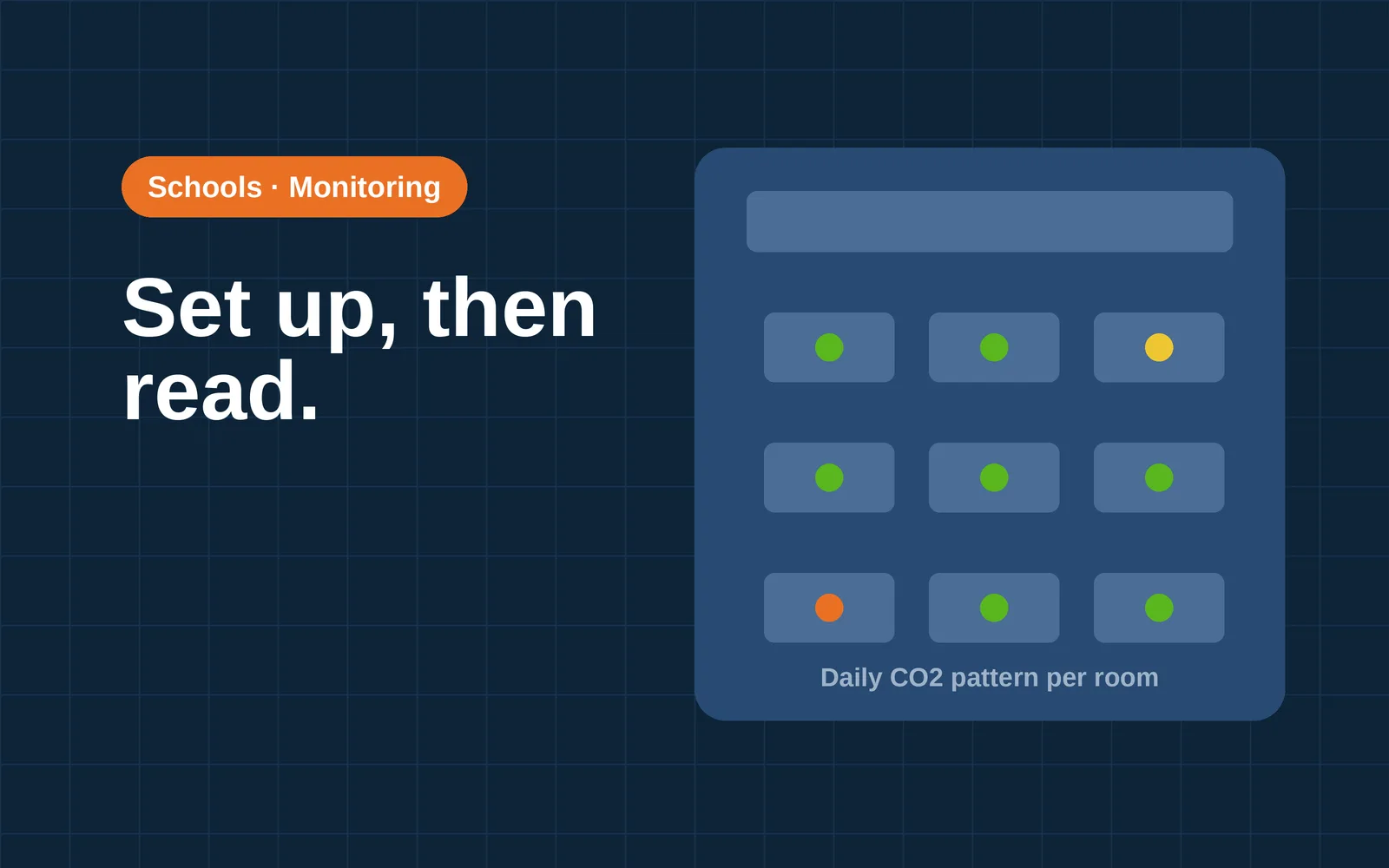
Air quality monitoring in classrooms comes down to three decisions: which rooms get a monitor, where in the room it sits, and who reads the data and acts on it. England's Department for Education (DfE) names non-dispersive infrared (NDIR) CO2 monitors as the most effective type, and DfE, Welsh Government and UK Health and Safety Executive (HSE) guidance agree on placement: away from windows, doors and vents, at head height. Sources differ on how many monitors one room needs and say little about how long to record.
Choosing a monitor for a classroom
The DfE guidance for education and childcare settings in England, published 24 February 2026, says the most effective CO2 monitors are NDIR monitors. They can be dedicated CO2 monitors or multi-functional sensors that also measure temperature, humidity and pollutants, and they can be networked for remote access or run stand-alone with the reading on a screen.
DfE says to test or calibrate monitors periodically, in line with the manufacturer's recommendations. ASHRAE's position document on indoor CO2 (approved 12 February 2025) says sensor performance, location and calibration are all critical for drawing meaningful inferences. In a February 2024 US Department of Energy laboratory report (DOE/GO-102024-6125), anonymous low-cost CO2 sensor systems tracked a reference monitor closely at first, but after simulated aging of one year the differences grew at higher concentrations and several models read low. The report says its results are not representative of the market.
CO2 is the core reading. What to add beyond temperature and humidity is covered in Indoor air quality in schools: what to monitor beyond CO2, and Five questions before installing a CO2 monitor covers the purchase.
Where the monitor goes in the room
DfE says to keep the sensor away from doors, windows and ventilation outlets, at table or head height when seated, and at least 0.5 m from occupants. HSE gives the reason: exhaled breath contains CO2 and can give a misleadingly high reading. The Welsh Government's guidance (15 October 2021) says that if readings in an occupied space are far below 400 ppm or over 1,500 ppm, the monitor may be in the wrong location. Move it and check again.
How many monitors a room needs is where sources differ. DfE says one sensor is enough for a typical classroom. Ackley and colleagues (2023) studied three naturally ventilated primary school classrooms and concluded that one monitor can represent the room if it hangs at head height (about 1.5 m) on a vertical wall, away from windows, doors and air supply.
Zhang, Ding and Bluyssen (TU Delft, 2022) measured seven classrooms in two Dutch secondary schools, for one school day per school. In the naturally ventilated rooms, two points in the same room sometimes differed by more than 300 ppm (or 40%). They recommend at least two points for natural ventilation: one on the wall opposite the windows, which had the highest concentrations, and one on the front wall near the teacher, which was closest to the average. In a classroom with balanced mechanical ventilation CO2 was relatively even, and one point was acceptable. Both studies are small. In a naturally ventilated room with one monitor, the front wall gives a reading near the average and the opposite wall a worst case (reasoning from the Zhang findings).
REHVA's COVID-19 guidance for school buildings (undated) asks for a CO2 monitor with traffic light indication at least in classrooms where ventilation depends on opening windows or grids. The Welsh guidance lists spaces where monitors suit less: large open spaces with high ceilings, corridors and lobbies, kitchens, toilets and offices with one or two people.
How long to record and what to log
The DfE page does not say how long to record. The Welsh guidance says to keep a monitor in a room for at least one full day before moving it and to take several readings through the day and average them over the occupied period. HSE advises repeating the monitoring as the weather changes, because natural ventilation varies with wind and window use, and recording the number of occupants and the ventilation in use next to each reading. Di Gilio and colleagues (2021) logged CO2 every 2 minutes in 11 classrooms in 9 Italian schools for three weeks in January and February 2021.
Batterman (2017) used CO2 sensors and teacher occupancy logs in four mechanically ventilated US elementary school classrooms. In one, the same measured air change rate of 0.51 per hour equaled about 2.6 L/s per person at average occupancy and about 1.0 L/s per person at maximum occupancy. A log with class size next to the CO2 curve is easier to interpret (a practical suggestion).
Reading classroom CO2 data
DfE rates ventilation by CO2 level in three bands.
These bands rate a reading. The school design guidance is written differently. DfE's August 2018 consultation response on BB101, its guidance on ventilation, thermal comfort and indoor air quality in schools, refers to a 1,500 ppm daily average CO2 level allowed in naturally ventilated teaching spaces and 1,000 ppm allowed for mechanically ventilated spaces. The response does not define the averaging period. A monitor log can be summarized as a daily mean to compare with those figures and as the share of lesson time above 1,500 ppm to compare with the poor band (a practical suggestion, not a DfE rule).
For air quality monitoring in classrooms, the Welsh guidance attaches actions to its bands. For occasional readings of 800 to 1,500 ppm it advises opening windows and doors and purging the air for up to 10 minutes before and after lessons. Readings that stay in that range go to estates or facilities management, as do readings over 1,500 ppm, with the advice to purge the air as soon as possible.
A first baseline can look uneven. In the first stage of the Di Gilio study, when window and door opening was left to teachers, mean CO2 in school hours ranged from 720.7 to 1,325 ppm across the 11 classrooms, 6 averaged above 1,000 ppm, and one peaked at 3,947 ppm. It was a three-week winter study, so the figures show how wide the spread can be and say nothing about a typical school.
Using air quality monitoring in classrooms to change what happens
Feedback from a monitor changes behavior, with limits. Wargocki and Da Silva (Indoor Air, 2015) installed CO2 sensors with visual indicators in pairs of classrooms across a heating and a cooling season and compared periods with and without feedback. Feedback lowered CO2 because more windows were opened; heating energy use rose and the summer cooling requirement fell.
Avella and colleagues (2021) put a visual alert device in one of two classrooms in each of four schools for three weeks and report average CO2 down by up to 42% in classrooms with frontal lessons and full occupancy. Beck and Rojas (AIVC conference paper, 2024) ran a field study in ten Austrian schools, with CO2 traffic lights in some classrooms and a control group, and found that air quality improved after the lights were introduced, especially at lower outdoor temperatures.
Behavior has a ceiling, and the data shows where it is. In the Di Gilio study a protocol (door open, windows opened between lessons and whenever CO2 neared 700 ppm, with real-time data in an app) brought 10 of the 11 classrooms to a mean under 1,000 ppm. One classroom got worse, which the authors attribute to the protocol not being followed, and another stayed above 700 ppm because a hallway without windows facing it limited cross-ventilation. A room that stays high with the windows open is the one to take to estates or facilities, with the log attached (a practical suggestion).
What the readings cannot show
Air quality monitoring in classrooms has limits the guidance states plainly. The Welsh guidance says CO2 levels indicate ventilation status and do not show infection risk, and that singing, shouting, physical exercise, gas cooking and Bunsen burners can raise them. HSE says monitors are not suitable in areas with air cleaning units, because the units remove contaminants but not CO2. ASHRAE's position document says indoor CO2 does not indicate indoor air quality as a whole. Limits by country are in Ventilation in schools: CO2 limits, rules and monitoring, and How to read ventilation data in five minutes covers the daily curve.
Nomestic measures indoor climate room by room (CO2, temperature, humidity and more), and its Airsight Pro Monitor is an indoor air quality monitor for rooms that need more than CO2. The devices are wireless and battery-powered, so a room takes minutes to equip, and the system works with or without a building management system. The Airsight CO2 Monitor uses an NDIR CO2 sensor, and the schools page has more.