Health
Indoor air quality in schools: what to monitor beyond CO2
CO2 shows whether a classroom is ventilated. Particles, humidity, VOCs, radon and mold need other checks. What a European school study found and what official guidance says to track.

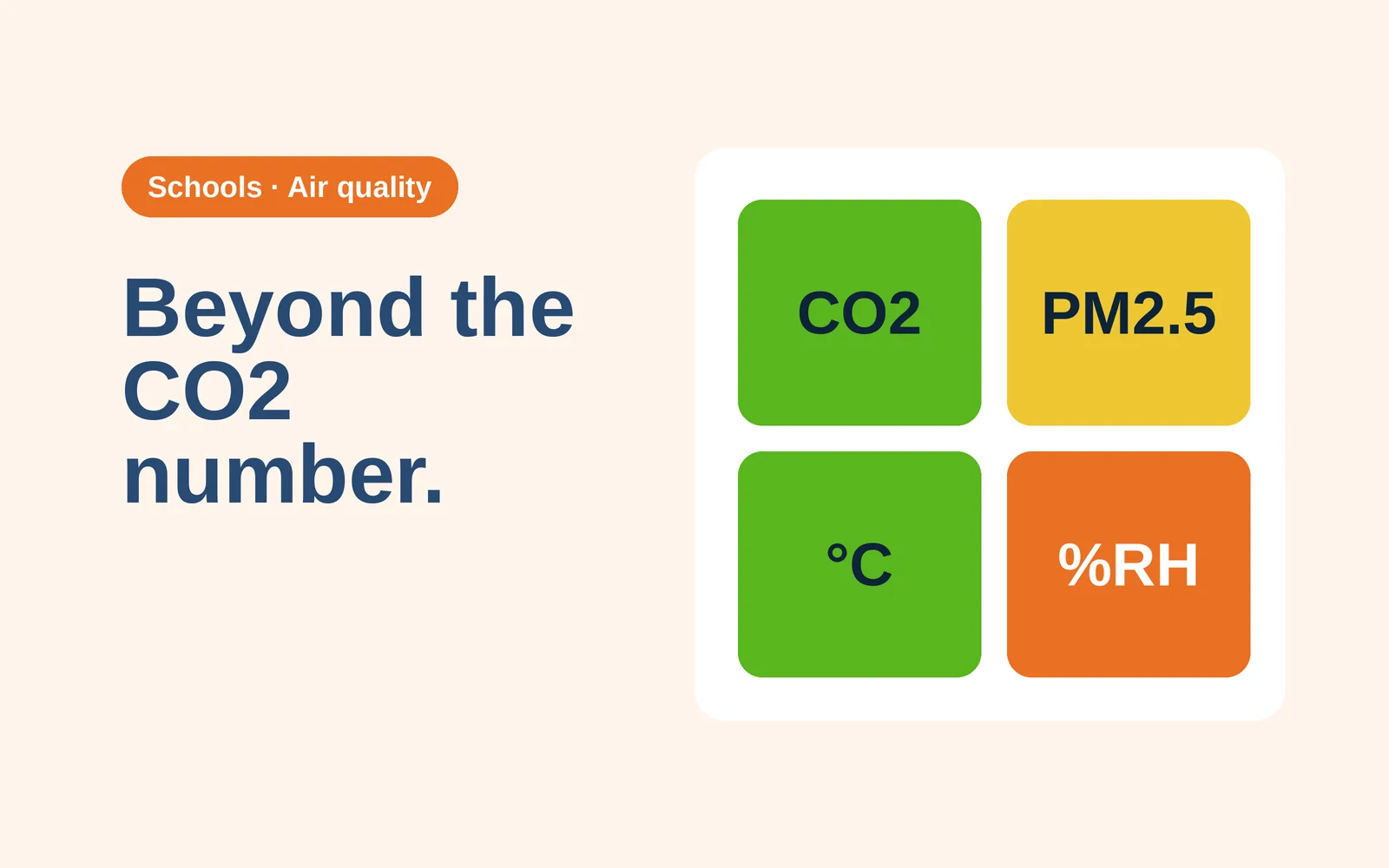
Indoor air quality in schools covers more than CO2. CO2 indicates whether a classroom has enough outdoor air for the people in it. It says nothing directly about particles from the street, damp walls, radon from the ground or chemicals from materials and cleaning products. One European study of those other pollutants is SINPHONIE, a project run under contract with the European Commission that measured chemical, biological and physical parameters in 114 primary schools in 23 countries and assessed 5,175 schoolchildren.
What was found in 114 European schools
- 13 percent of the children were exposed to PM2.5 above 25 µg/m³, and more than 85 percent above 10 µg/m³.
- More than 60 percent were exposed to formaldehyde above 10 µg/m³, and about 25 percent to benzene above 5 µg/m³.
- Visible mold was found in 7 percent of the schools.
- 67 percent of the schools were near traffic routes, and those showed higher NO2, PM and benzene exposure.
- 86 percent of the ventilation rate values were below the desirable 4 l/s per child, and mean CO2 was above 1,000 ppm in primary schools and kindergartens.
The executive summary recommends, among other things, radon prevention and mitigation, low-emission materials, removing moisture and mold sources, periodic monitoring of indoor air quality and harmonized assessment protocols.
What a school can track continuously
Temperature and relative humidity are cheap to log and say a lot about comfort and damp. The US EPA's school guidance gives 30 to 60 percent relative humidity as the range. Its problem-solving tool asks about humidity above 60 percent, condensation and damp areas, says excess moisture can let mold, dust mites and bacteria flourish, and says wet materials should be dried within 24 to 48 hours.
CO2 is still the first sensor to install (general reasoning). Under outdoor air supply, EPA's problem-solving tool asks whether CO2 is more than 700 ppm above outdoor concentrations. Limits and rules are covered in Ventilation in schools: CO2 limits, rules and monitoring, and airflow per person is covered in Ventilation rates in offices and classrooms: what the numbers mean.
Particles are the next candidate. WHO's 2021 guidelines recommend 5 µg/m³ as an annual mean and 15 µg/m³ as a 24-hour mean for PM2.5, and 15 µg/m³ (annual) and 45 µg/m³ (24-hour) for PM10. WHO states that they apply to outdoor and indoor environments and cover all settings where people spend time, with occupational settings excluded. They are non-binding, and the 24-hour level is a daily mean, so a day's average is what to compare. WHO also says outdoor air is the main cause of indoor pollution where there are no indoor sources, which matches SINPHONIE's finding for schools near traffic.
TVOC works as a flag. Germany's indoor air committee (AIR) says the TVOC value does not allow a health assessment but is a relevant indicator, and sets a reference value of 950 µg/m³, the 95th percentile in the German Environmental Survey GerES V (2014 to 2017). Above it, the AIR guide suggests more ventilation, possibly a changed cleaning routine, and a search for visible sources. EPA's tool asks about recent painting or remodeling, recent pesticide use and cleaning products when tracing a complaint, so a TVOC rise after such work is a reason to look (general reasoning). WHO's formaldehyde guideline of 0.1 mg/m³ over 30 minutes needs a specific measurement, since a TVOC reading cannot confirm it (general reasoning).
Radon needs its own test. A CO2, particle or TVOC monitor does not measure it (general reasoning). WHO proposes a reference level of 100 Bq/m³ and says it should not exceed 300 Bq/m³ if 100 cannot be reached. EPA tells schools to test all frequently used rooms on and below ground level, in the cooler months, with an action level of 4 pCi/L (150 Bq/m³). Check which radon rules apply to schools in your country.
Mold has no numeric limit. WHO's 2009 guidelines say no quantitative health-based guideline values or thresholds can be recommended for microbial contamination and that dampness and mold problems should be prevented and, where they occur, remediated. EPA's guidance relies on looking for water stains, discoloration, moldy odors and standing water. A humidity log can show which rooms to check first (general reasoning).
What official guidance says about measuring indoor air quality in schools
EPA's IAQ Tools for Schools action kit includes 11 checklists, among them a ventilation checklist and a walkthrough inspection checklist, which EPA designed to engage school staff in school inspections. Its reference guide names four basic measurements (temperature, relative humidity, air movement and airflow volume) with CO2 as a useful addition, and says sampling for pollutants is not recommended because results are difficult to interpret.
A workable plan for indoor air quality in schools, built from the sources above (general reasoning, no rule sets it), is to use continuous sensors for CO2, temperature and humidity, plus PM where outdoor air is a problem; to inspect for damp, odors and sources; and to treat radon tests and any chemical measurement as planned one-offs by a qualified laboratory, as set out in Testing air quality in an office: one-off test or continuous monitoring.
What school sensors can and cannot tell you
A February 2024 report for the US Department of Energy's Building America program found low bias and strong correlation for CO2 systems. PM2.5 sensors read higher above 20 °C and 60 percent relative humidity and underestimated PM2.5 in the presence of interferent dust. A classroom can reach those conditions (general reasoning). In a 2024 test of seven consumer monitors, Peters and Zhen found that only one brand met their PM2.5 accuracy threshold, and they did not evaluate TVOC, calling it complicated to measure. Moreno-Rangel and colleagues (2018) found that the CO2 equivalent a Foobot monitor derives from its TVOC reading was misleading as an indicator of ventilation. That monitor has no CO2 sensor.
Nomestic measures indoor climate room by room (CO2, temperature, humidity and more), and the schools page shows how that applies to classrooms. It works with or without a building management system, and nothing in the existing HVAC gets replaced. Operators can override automatic adjustments at any time.