Technology
Testing air quality in an office: one-off test or continuous monitoring
A one-off test can name a substance or a source. Continuous monitoring shows how air changes with people, weather and season. What each can and cannot tell you, with the sources.

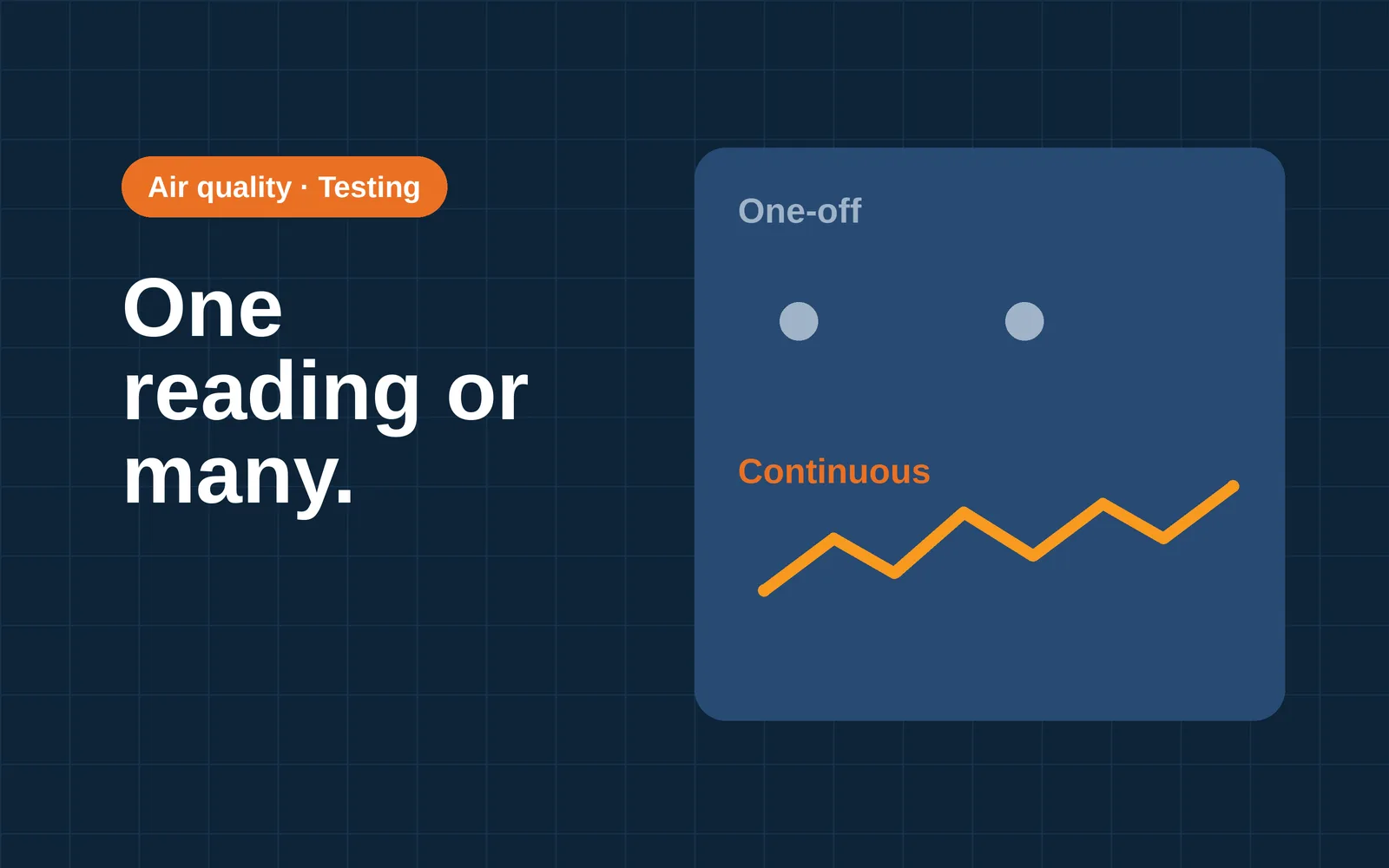
If you want to test air quality in office spaces, you can measure once or you can keep measuring. A one-off test answers a narrow question: what was in the air of this room, during these hours, under these conditions. Continuous monitoring answers how the air changes with people, weather, seasons and the ventilation system. Which one you need depends on whether you are chasing a specific complaint or running the building.
A one-off test with laboratory analysis is the right tool for naming a substance or finding its source. Continuous monitoring is the right tool for ventilation, comfort and anything that moves with occupancy or season. That split is general reasoning from the sources below, not a rule from any standard.
What a one-off test can show
ISO 16000-5:2007 is a guide to planning indoor measurements of volatile organic compounds. Its abstract says an inappropriate measurement strategy may add to the uncertainty of a result to a larger extent than the measurement procedure itself. ISO 16000-26:2012 does the same for CO2 and names two purposes: checking compliance with a guide value and evaluating how well a room is ventilated.
The German indoor air committee (AIR) published a 2025 guide on assessing chemical contamination from measurements. It describes discrete sampling, normally done while occupants are present (for office workplaces its table allows sampling with or without them). For offices it says to ventilate as the German workplace rule ASR A3.6 describes and keep windows and doors closed for one hour before sampling, with any mechanical ventilation system running under the room's usual operating conditions for at least three hours beforehand. Active short-term sampling takes minutes to a few hours and passive long-term sampling takes several days. The guide does not cover continuous measurement.
An earlier Umweltbundesamt article (UMID 2/2016) separates two set-ups. Measuring after at least eight hours without ventilation suits finding problem substances and their sources, and is not meant for health assessment of workplace air. Measuring under conditions of use is the set-up for assessment against guide values, and the article says German workplace rules allow only that for workplaces.
Why a single test can mislead
The US EPA's reference guide for schools says that concentrations of indoor air pollutants typically vary greatly over time and that the contaminant measured may not be the one causing the problem. It recommends against sampling for pollutants because results are difficult to interpret, and points to a CO2 monitor as a useful indicator of inadequate ventilation. The guide is written for schools, and the point about variation applies to offices too (general reasoning).
Season matters. In a study of 162 homes in southeast Michigan, Jia, Batterman and Relyea (2012) found that season and residence accounted for 50 and 31 percent of the variance in indoor VOC concentrations, and concluded that measurements in multiple seasons are needed for representative estimates. Homes are not offices, so read that as an indication.
Occupancy and weather matter as well. CO2 follows the number of people in a room, so a test in a half-empty room on a quiet day will look fine (general reasoning). WHO notes that where there are no indoor sources, outdoor air is the main cause of indoor air pollution, so tests on a polluted day and a clean day can differ for reasons the building does not control (general reasoning).
Reference values also carry an averaging time. WHO's PM2.5 guideline level of 15 µg/m³ is a 24-hour mean, and its formaldehyde guideline of 0.1 mg/m³ is a 30-minute average. Both are non-binding, and WHO excludes occupational settings from the 2021 PM guidelines and the workplace from the 2010 indoor guidelines, so for an office they are reference points. A spot reading cannot be compared with a 24-hour mean (general reasoning). A single test also gives a single result, and without a repeat you cannot tell whether a value is typical for the room or a one-day event (general reasoning).
What continuous monitoring adds
A logged series shows the daily profile of a room: when CO2 climbs, whether temperature swings with the sun or the HVAC schedule, whether humidity stays above 60 percent. With the same sensor in the same place, a change to the system shows up as a before and after comparison (general reasoning). A proposed model regulation from REHVA, Eurovent and the Nordic Ventilation Group suggests keeping hourly data for the last 12 months and making monitored air quality parameters visible in rooms.
The EU text points the same way. Article 13(10)(d) of Directive (EU) 2024/1275 says building automation and control systems must be capable of monitoring indoor environmental quality by 29 May 2026. The word continuously appears in point (a), which is about energy use, and point (d) says monitoring. Article 13(5) tells member states to require measuring and control devices for monitoring and regulating indoor air quality in new non-residential zero-emission buildings, and in existing non-residential buildings on major renovation where technically and economically feasible. National law applies these rules, so check what your country has adopted. See EPBD indoor environmental quality monitoring: what the May 2026 date means.
Continuous monitoring has limits of its own. It relies on low-cost sensors, and evaluations show they differ by parameter. A February 2024 report for the US Department of Energy's Building America program found low bias and strong correlation for CO2 systems, but PM2.5 sensors read higher above 20 °C and 60 percent relative humidity and underestimated PM2.5 in the presence of interferent dust. Peters and Zhen (2024) found that only one of seven consumer brands met their PM2.5 accuracy threshold and did not evaluate TVOC, calling it complicated to measure. Sensors do not name substances and do not detect mold (general reasoning). The detail is in Indoor air quality in offices, how to measure it, and CO2 monitor or air quality monitor covers the choice of device.
How to test air quality in office spaces with both methods
To test air quality in office spaces with both methods, a sequence that follows from the above (general reasoning, not a standard procedure) is to log CO2, temperature and humidity in a few representative rooms for long enough to include different occupancy patterns. If complaints point to an odor or a chemical source, commission a laboratory measurement planned to ISO 16000 and take it during normal use. Then keep the sensors running to see whether the fix held.
Nomestic measures indoor climate room by room (CO2, temperature, humidity and more). Savings are verified by comparing measured data before and after a change, and the platform works with or without a building management system.