Technology
CO2 monitor or air quality monitor: what a commercial building needs
A CO2 monitor shows whether a room gets enough fresh air for the people in it. An air quality monitor adds particles, chemicals, comfort and noise. Which one fits which question.

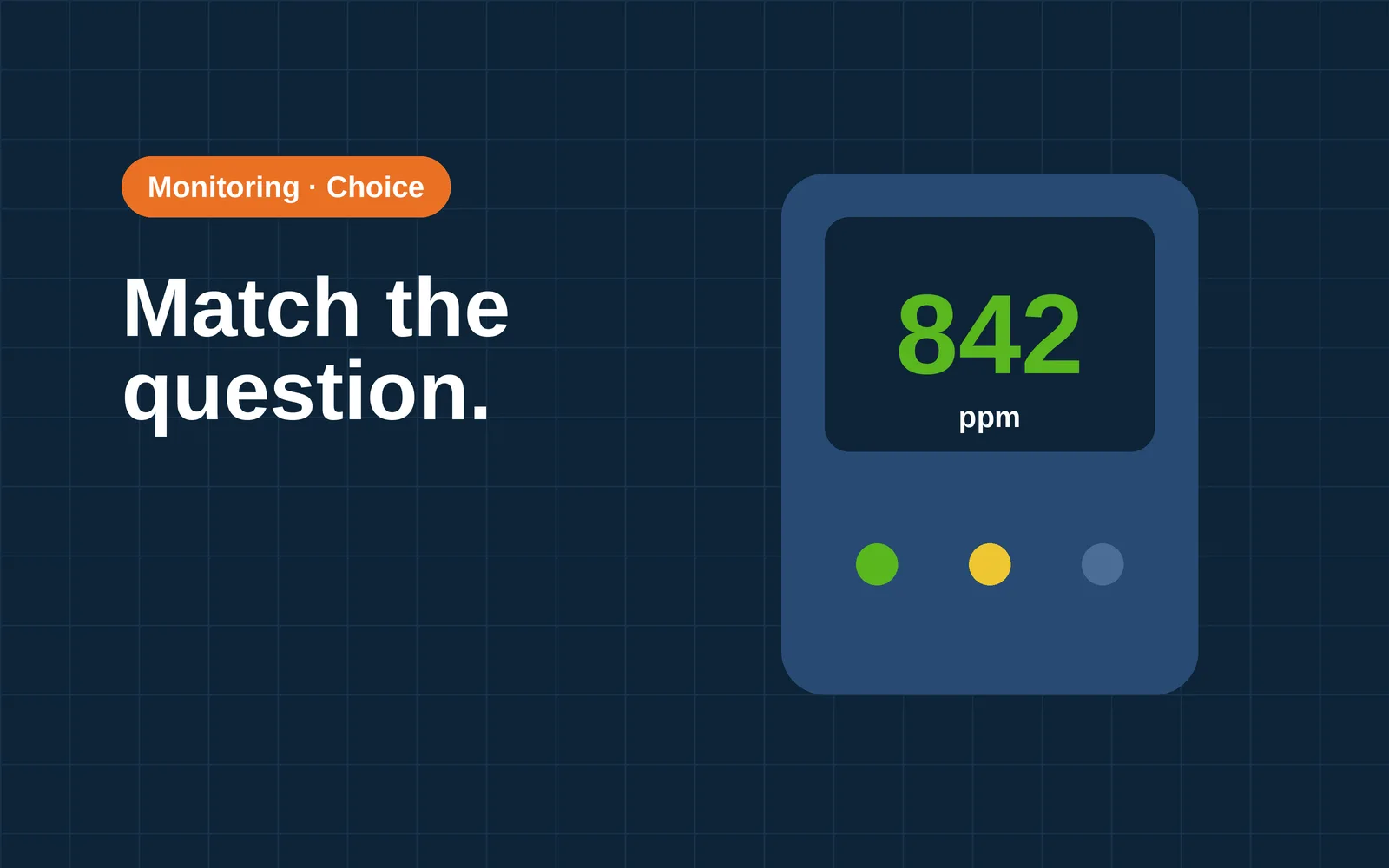
A CO2 monitor is enough when the question is whether a room gets enough fresh air for the people in it. An air quality monitor that also measures particles, chemicals, temperature, humidity and noise fits a wider question. A practical order is CO2 with temperature and humidity in each room first, and particles or chemicals added where a specific source or complaint calls for them.
What a CO2 monitor tells you
A CO2 monitor measures carbon dioxide, usually with temperature and humidity, and shows or signals the result: a number on a display, a status indicator, sometimes a buzzer. The UK Health and Safety Executive (HSE) names non-dispersive infrared (NDIR) monitors as the most appropriate portable devices for workplaces. In an NDIR sensor, infrared light passes through a chamber of room air, CO2 molecules absorb it at a wavelength of 4.26 micrometers, and a filtered detector measures how much gets through.
What the reading means is narrower than it looks. CO2 in a room comes mainly from people, so it shows how much outdoor air each person gets, which is the question behind a good CO2 level in an office. ASHRAE's technical FAQ says CO2 concentration is not a reliable indicator of building air quality as a whole, and the HSE calls readings a broad guide to ventilation that do not show a room is safe.
The HSE also lists places where a CO2 monitor tells you little:
- rooms with air cleaning units, which remove contaminants but not CO2 and do not improve ventilation
- spaces where a process produces CO2
- rooms with few or inconsistent occupants
- large open spaces with high ceilings, such as warehouses, where air may not be fully mixed
What an air quality monitor adds
A multi-parameter monitor puts several sensors in one housing. The UK Department for Education notes that environmental sensors can also measure temperature, humidity, pollutants such as volatile organic compounds, and particulate matter (PM2.5 or PM10). The product page for the Airsight Pro Monitor lists CO2, PM2.5, PM10, TVOC, temperature, humidity, noise, light and air pressure among its parameters. It has swappable sensor capsules, so a parameter can be added later, and it has no display.
Each extra sensor has its own limits. Particle sensors based on light scattering and chemical sensors measure different things than CO2 does, and their outputs are read differently. On the Airsight Pro page the TVOC reading is an index from 0 to 500, and it is not given as a concentration. A room can also read normal on CO2 and still have particles or chemicals from sources other than people, which is the point of ASHRAE's statement about air quality as a whole.
Who acts on the reading
A display and a buzzer matter most in rooms where people control the ventilation by opening windows. The UK guidance for education settings says to consider opening windows or doors between 800 and 1,500 ppm and to open them over 1,500 ppm. In a mechanically ventilated office the control system does the acting. The Airsight CO2 Monitor has a 3.7-inch display, a buzzer alarm and a status indicator. The Airsight Pro Monitor has the buzzer alarm and status indicator, and no display.
A single reading is weak evidence. Singapore's National Environment Agency says snapshot readings can be misleading and advises several measurements across the day, at peak occupancy or representative times. The HSE likewise advises several measurements while the room is occupied, and says to record each reading with occupant numbers and the ventilation in use. A monitor that logs and reports gives that history without someone walking round with a handheld meter.
Which one a building needs
Choose CO2 monitors when the aim is to check or control ventilation room by room, when the people in the room should see the value, and when the number of rooms makes cost per room matter. Placement then decides most of the quality of the data, as covered in where to place CO2 sensors for ventilation control. A mixed approach also works, with CO2 monitors in most rooms and multi-parameter monitors in a few reference spaces, for example a lobby near a busy road.
Choose a multi-parameter monitor when there are complaints about odor, dust or comfort, when the building sits next to heavy traffic or an industrial source, or when a tenant requirement or certification scheme names particles or chemicals. Read what the scheme asks for before choosing, because the requirement decides the sensor list.
Whichever type you pick, ask for the CO2 accuracy figure and what it covers. The Singapore advisory lists NDIR, a range of 300 to 3,000 ppm or more, accuracy within ±50 ppm or ±5%, resolution of 10 ppm or less, logging at least once a minute and the ability to be calibrated. The Airsight product pages list the CO2 sensor as NDIR with an accuracy of ±40 ppm ±3% of reading. In field tests, LBNL found that at 1,010 ppm 40% of installed building sensors were off by more than 75 ppm, so check how a supplier handles calibration too.
Where Nomestic fits
Nomestic measures indoor climate room by room, with CO2, temperature, humidity and more, and works with or without a building management system (BMS). The Airsight CO2 Monitor covers CO2, temperature and humidity with a display. The Airsight Pro Monitor takes swappable sensor capsules for more parameters.