Technology
Five questions to ask before installing a CO2 monitor
What the reading is for, where the monitor goes, how accurate it is, how it is powered and who acts on it. Five questions for a CO2 monitor, with published guidance where it exists.

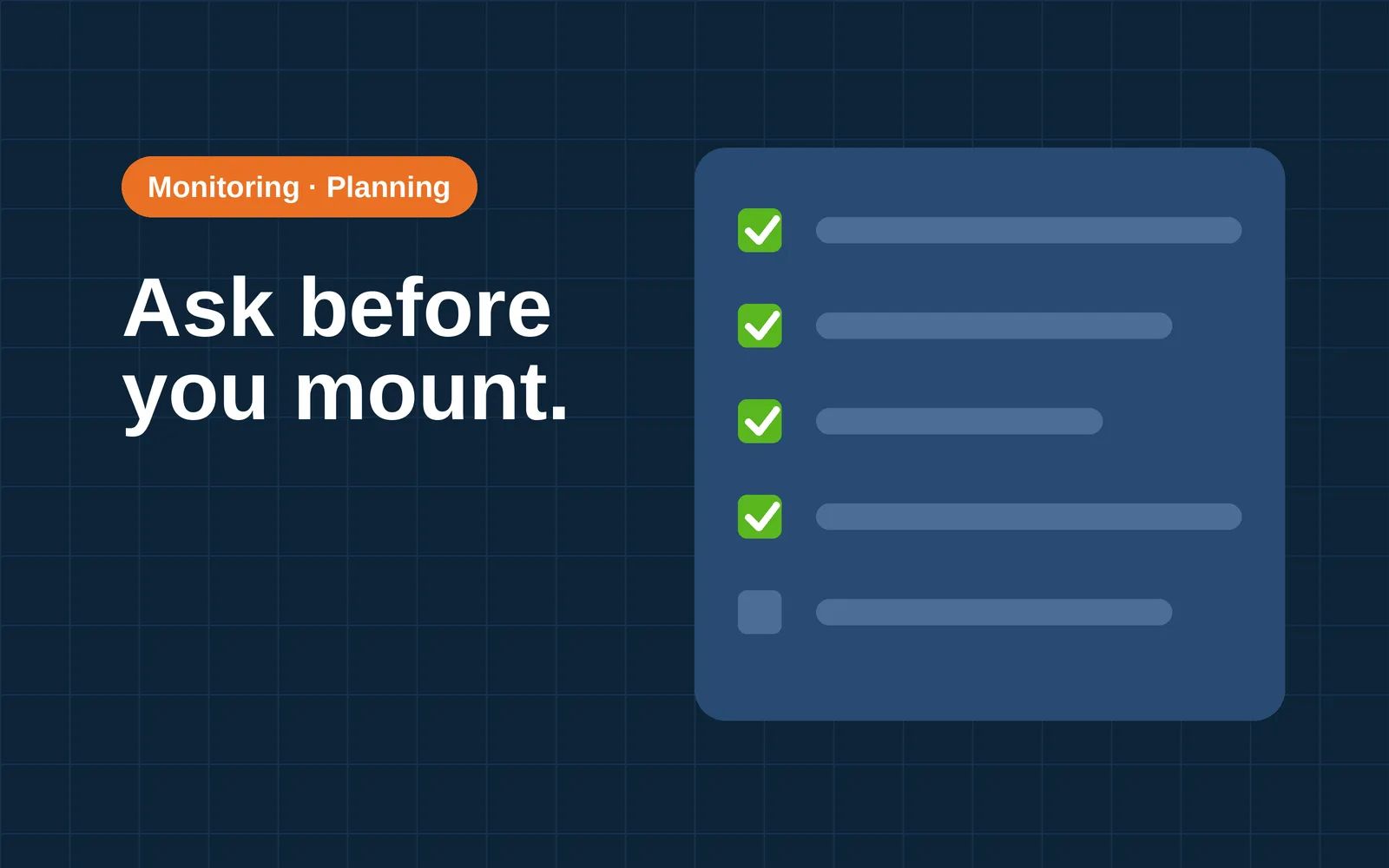
Five questions decide whether a CO2 monitor produces data anyone can use: what the reading is for, where the monitor goes, how accurate it is and how that is kept up, how it is powered and where its data goes, and who acts when the number is high. Each can be settled before the first device is mounted. The answers differ for a display in a meeting room and for a sensor that controls ventilation.
What will the CO2 monitor reading be used for?
A reading can do three jobs: show people in a room when the air is stale, record ventilation over time, or drive the ventilation controls. The UK Health and Safety Executive (HSE) and the Department for Education (DfE) both present CO2 monitoring as a way to find poorly ventilated spaces, and the HSE calls readings only a broad guide to ventilation that does not demonstrate safe levels. ASHRAE's issue brief on indoor carbon dioxide says the CO2 setpoints in Standard 62.1 are for demand control ventilation and should not be used as indicators of indoor air quality.
When the reading controls ventilation, the demands are higher. Addendum al to ANSI/ASHRAE Standard 62.1-2016 requires CO2 sensors used for demand control ventilation to be certified by the manufacturer as accurate within ±75 ppm at 600 and 1,000 ppm, and requires a signal on sensor failure that resets the ventilation system to supply the required minimum outdoor air.
The purpose also decides whether CO2 is the right measure. The HSE lists places where a CO2 monitor says little: rooms with air cleaning units, which do not remove CO2, spaces where a process produces CO2, rooms with few or inconsistent occupants, and large open spaces such as warehouses. The choice between a CO2 monitor and a multi-parameter device is covered in CO2 monitor or air quality monitor.
Where will the monitor go, and how many are needed?
The HSE advises head height, away from windows, doors and air supply openings, and more than 50 cm from people because exhaled breath contains CO2. Singapore's National Environment Agency (NEA) gives 75 cm to 120 cm from the floor and advises measuring in the spaces with the highest occupant density. Mounting detail is in where to place CO2 sensors for ventilation control.
The count depends on the space. The HSE says monitors can be used in spaces up to 50 m² when the same number of people use them for over an hour, and that they are unlikely to give reliable measurements where the number of people changes over short periods. For spaces over 320 m² it says multiple monitors may be needed. The TU Delft classroom study (Zhang, Ding and Bluyssen, 2022) recommends at least two measurement points in naturally or hybrid ventilated classrooms and says one point seemed enough in its mechanically balanced classroom, where CO2 was well mixed. How many CO2 sensors a building needs gives the wider picture.
How accurate is the CO2 monitor, and how does it stay accurate?
Ask for the accuracy figure and the range it covers. The NEA's recommended specification for ventilation checks is a non-dispersive infrared (NDIR) sensor measuring 300 to 3,000 ppm or more, accuracy within ±50 ppm or ±5%, resolution of 10 ppm or less, logging at least once every minute, and the ability to be calibrated. A component data sheet shows what the sensing element alone does: Sensirion's SCD41 lists ±(50 ppm + 2.5% of reading) from 400 to 1,000 ppm at 25 °C and 50% relative humidity. That describes the sensing element, not a finished monitor. ASTM D8624-25 (2025 edition) is, according to the ASTM store page, a test method that evaluates stationary indoor CO2 sensors against a CO2 reference monitor in a chamber under steady-state CO2, temperature and relative humidity conditions; the standard itself is paywalled. Asking a supplier whether a device has been tested to it is a practical question.
Then ask how accuracy is kept. Some NDIR sensors correct drift automatically, on the assumption that they see outdoor air regularly. Sensirion's data sheet (version 1.5, July 2023) says its algorithm assumes exposure to 400 ppm at least once per week. Amphenol's note on its version says it suits spaces unoccupied for 4 hours per day or more, advises deactivating it in spaces such as those occupied around the clock, and says calibration may then be required every 2 to 3 years. In the Lawrence Berkeley National Laboratory field study (LBNL-3279E, 2010) of 208 installed sensors, 40% were off by more than 75 ppm at 1,010 ppm, and when asked, no facility manager indicated that they had calibrated sensors since installation. The HSE says to follow the manufacturer's instructions on calibration. So the questions are whether self-calibration is on, what it assumes about the room, how the sensor is checked and who does the check.
How is the CO2 monitor powered, and where does the data go?
A wireless CO2 sensor still needs power from somewhere. Battery life depends on how often the device measures and reports. Sensirion's data sheet shows the pattern: its SCD41 figure of 0.45 mA typical at 3.3 V applies to one measurement every 5 minutes, and the data sheet's self-calibration timing assumes that interval. Ask for battery life at the interval you intend to use, and who replaces the batteries. Wireless CO2 sensors for retrofit buildings covers radio options and signal range.
A display shows the present value only. The HSE advises several readings across the day, recorded with occupant numbers and the ventilation in use, and repeated as the weather changes, which needs a record. The DfE notes that sensors can connect to a wireless network for remote data access or run standalone and show readings on screen. Before buying, find out where the history is stored, who can see it and whether it can be exported. The HSE and DfE pages do not cover those points, so they are practical questions and not published findings.
Who acts when the number is high?
A monitor does nothing by itself. For classrooms, the DfE reads under 800 ppm as good ventilation, 800 to 1,500 ppm as adequate with a suggestion to consider opening windows or doors, and over 1,500 ppm as poor, with advice to increase ventilation. The page does not say who reads the monitor. The HSE treats levels consistently above 1,500 ppm in an occupied room as a sign of poor ventilation.
In a mechanically ventilated building the controller acts, and someone still has to check the sensor. Table 8.2 of ANSI/ASHRAE Standard 62.1-2016 as amended by addendum al lists verifying the accuracy of permanently mounted sensors, including CO2 sensors used for demand control, and says a sensor that fails the accuracy stated in the O&M manual shall be recalibrated or replaced. A practical suggestion, not a published finding: before installation, write down who reads the data, what number triggers what action, and who checks the sensors and how often.
Where Nomestic fits
Nomestic measures indoor climate room by room, with CO2, temperature, humidity and more. The Airsight CO2 Monitor uses an NDIR CO2 sensor, and the devices are wireless and battery-powered, so a room takes minutes to equip.