Technology
Wireless CO2 sensors for retrofit buildings
A wireless CO2 sensor goes into an existing room without new cabling. What to check on radio options, battery life and the reporting interval, signal range in old buildings and security.

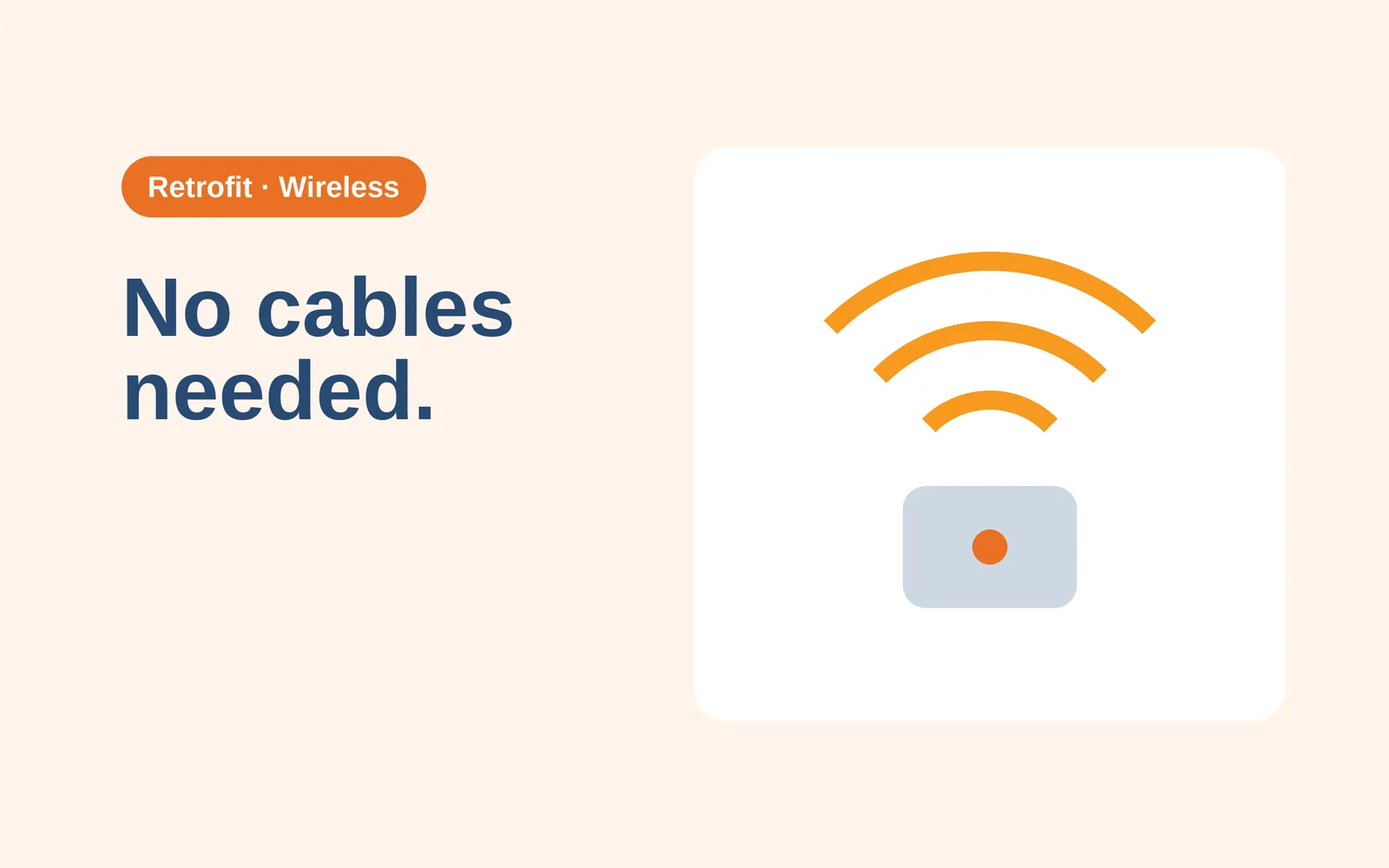
A wireless CO2 sensor sends its readings over a radio link instead of a cable, and many also run on batteries, so it can go into an existing room without pulling wire through ceilings and walls. A 2015 engineering article notes that renovation projects pose difficulties for wired networks. The trade-offs are battery life, signal range through the building and keeping the radio network secure.
What counts as a wireless CO2 sensor
The word can describe the data link, the power supply or both. A sensor can send data by radio and still be plugged into the mains, so the radio says nothing about power. Check the data link and the power supply separately in the data sheet.
Four radio options, as described in a 2015 article in Consulting-Specifying Engineer by Don Horkey of DLR Group and in the LoRa Alliance's own technical overview:
- Wi-Fi is widely used in IT systems and is easily managed by most IT staff. Horkey also calls it a more expensive technology to deploy and notes that power is typically wired for Wi-Fi.
- Zigbee has low data rates, which the article says give long battery life. It shares the 2.4 GHz band with Wi-Fi and can coexist with it when properly configured.
- EnOcean works at 315 or 868 MHz, is described as less susceptible to interference, and needs no batteries.
- LoRaWAN is a long-range, low-power protocol that uses unlicensed bands such as EU 868 MHz, with devices talking to gateways in a star layout. A 2022 report by DEOS lists long range, deep building penetration, long battery life and low infrastructure cost as its benefits.
Network layout differs. Horkey says mesh networks can be considerably less susceptible to interference and environmental conditions than a single access point. The LoRa Alliance, which promotes the star layout, says mesh networks reduce capacity and battery life. The two sources point in opposite directions, so ask the supplier what happens when one device or one gateway fails.
Radio rules also limit sub-GHz devices. In the European 868 MHz band that LoRaWAN uses, ETSI rules set duty cycles per sub-band. At a 1% duty cycle a device may transmit for 864 seconds per day in total, and in the 0.1% sub-bands only 86 seconds (The Things Network documentation). The limit is on a device's transmit time, so it caps how often a device can report.
Battery life depends on the interval
No battery life figure means anything without the measurement and reporting interval next to it. A wireless CO2 sensor that reports every minute uses more energy than one that reports every 15 minutes. Sensirion's data sheet for its SCD41 sensor shows the pattern: it gives a supply current of 0.45 mA typical at 3.3 V, but only for one measurement every 5 minutes, and its self-calibration is tuned to that same interval.
Horkey's 2015 article says most battery-operated wireless sensors have a battery life of up to 5 years, though this may vary widely with use in the building, and that battery replacement and labor belong in the lifecycle cost. The article also says that in existing buildings reduced battery life is a concern, because construction materials cannot easily be changed. Across hundreds of rooms, battery replacement becomes a scheduled maintenance task. Where changing batteries is awkward, a mains-powered option, or one that needs no batteries, may be the better choice for that room.
The interval also sets how quickly a controller sees a room fill up. A longer interval saves battery and gives the controller a slower picture. For monitoring and reports that is usually fine. For ventilation control, check what interval the control logic needs before setting one.
Old buildings are hard on radio signals
Existing buildings are the hard case for radio. Horkey notes that drywall and wood are excellent media for wireless signals, while signal loss through concrete depends on thickness and rebar spacing. He calls interference a significant risk to wireless networks, and says wireless systems need the same reliability as wired ones. A short walk-through test with a gateway or access point in the planned position finds weak spots before sensors are ordered.
On security the article describes trusted-sender authentication and 128-bit AES encryption, and mentions a building automation system that is firewalled and on its own virtual network. A Wi-Fi sensor joins the building's network, so involve the IT team early. A sub-GHz gateway needs power and a network connection in a central spot. Settle both before ordering.
What a wireless CO2 sensor does not change
A wireless CO2 sensor still has to sit in the right place and read correctly. Mounting height, distance from people and doors, and the outdoor reference apply exactly as in where to place CO2 sensors for ventilation control, and the room count question is in how many CO2 sensors a building needs.
Accuracy and drift come from the sensor element, and the radio has no say. Sensirion's SCD41 data sheet lists accuracy of ±(50 ppm + 2.5% of reading) for 400 to 1,000 ppm and a typical drift of ±(5 ppm + 0.5% of reading) after five years with self-calibration on. Self-calibration needs fresh air: the sensor assumes it sees 400 ppm at least once a week. A unit in a room that is occupied around the clock never gets that chance, and Amphenol's note on its ABCLogic function says to deactivate it in such spaces, after which calibration may be required every 2 to 3 years.
Where Nomestic fits
Nomestic measures indoor climate room by room with wireless, battery-powered devices, so a room takes minutes to equip and nothing in the existing HVAC gets replaced. The Airsight CO2 Monitor uses an NDIR CO2 sensor, and its product page says the measurement and data upload interval can be changed to maximize battery life, which can go up to 3 years. Operators can override automatic adjustments at any time.