Technology
Design for operations: how developers hand over better buildings
Soft Landings, commissioning and seasonal checks ask developers to involve operators early and stay on after handover. What each guide asks for, and how strong the evidence is.

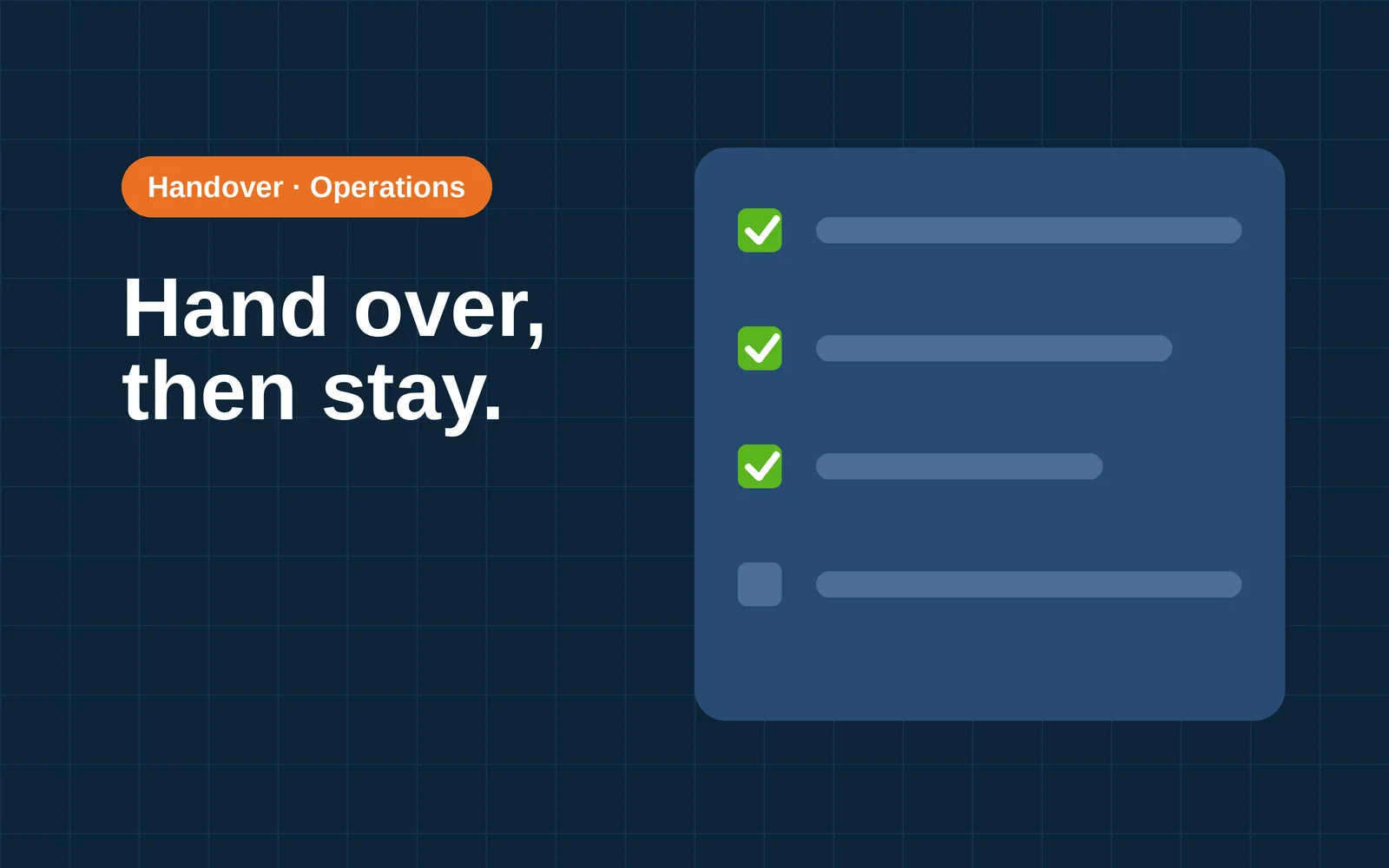
Published handover guidance asks developers to involve the people responsible for building operations in the brief and the design review, and to stay involved after completion. One published method is the Soft Landings framework from BSRIA, written with the Usable Buildings Trust, which treats handover as a process that starts at briefing and continues into aftercare of up to three years. Government Soft Landings, CIBSE commissioning guidance and a BREEAM seasonal commissioning credit each ask something specific of a developer.
Where building operations problems first show up at handover
CIBSE's 2017 Carbon Bite on Soft Landings, written by Richard Tetlow of AECOM and stating that it does not necessarily reflect CIBSE's views, calls the handover period critical and says many problems with performance can first develop then. It says buildings can "crash land" on their new occupants at completion. Bunn and Burman (CIBSE Technical Symposium, 2015) drew on two educational buildings studied under the Innovate UK building performance evaluation programme, with up to three years of energy data. They report that under-performance against targets is usually first noticed in the 12-month defects period, and in one building the fan inverters were not set up correctly and supplied 100% fresh air regardless of actual demand.
The evidence for the size of the problem is limited. The Soft Landings Framework (BSRIA BG 54/2014) says energy use found in post-occupancy evaluations can be higher by a factor of two or three, but names no study. Bunn and Burman give "between a factor of two and three" for energy performance shortfalls against design forecasts and cite Bunn (ed.), Design of Sustainable Schools: Case Studies (TSO, 2006). Their own analysis covers two buildings, and neither document gives a sample size for the factor.
What the Soft Landings phases ask for
The 2014 edition (BG 54/2014) was written by Mark Way and Bill Bordass, with help from Adrian Leaman and Roderic Bunn, and has minor amendments over a version published in 2009. BSRIA relaunched the framework in 2018 as BG 54/2018 with six phases instead of five stages, giving construction its own phase and using "phase" in place of "stage" so the framework is not tied to one plan of work. The detail below comes from the 2014 edition; for 2018 only the phase names are available.
- Inception and briefing Appoint a Soft Landings champion who stays with the project, spell out roles and limits of responsibility from the start, and set targets that are unambiguous and measurable.
- Design Hold peer design reviews with independent experts at key stages, designing for buildability, usability and manageability and reviewing likely performance against the original expectations.
- Construction This became a separate phase in 2018, with the construction content strengthened. The sources read do not list its activities.
- Pre-handover Review who records energy and environmental data, set up the energy meters, have trained operation and maintenance staff in place before handover, demonstrate the building management system (BMS) to operators, and have the facilities manager sign off the O&M manual. Write an occupant guide and a technical guide.
- Initial aftercare Typically four to six weeks after handover. One or more members of the design and building team are on site, with at least two meetings with occupants and two with facilities management.
- Extended aftercare and post-occupancy evaluation Years 1 to 3. Review meetings every three to four months may suit year 1, then every six months. The facilities manager leads energy monitoring, with monthly readings as a minimum on the framework's worksheet. Fine-tuning follows seasonal changes and emerging issues, and changes to control settings and operating schedules are recorded in the O&M manuals and logbook. Independent occupant surveys are held not less than 12 months apart, the first after one full heating and cooling season.
The Usable Buildings Trust describes Soft Landings as a way of thinking that can be attached to any building project. In a 2011 interview, Bill Bordass said it is "more a question of organisation than more time and money, at least until Stage 5", and that somebody must pay for longer-term aftercare and post-occupancy evaluation, usually the client directly. That is one practitioner's account, with no cost data behind it.
The UK government version
Government Soft Landings (GSL) applies the same ideas to UK central government work. The executive summary hosted by the Centre for Digital Built Britain (April 2013) says the policy was approved by the Government Construction Board in September 2012, will apply to all new central government projects and major refurbishments, and was working towards a mandate in alignment with BIM in 2016. CIBSE's 2017 Carbon Bite says that from 2016 all Government construction projects will require GSL. Cabinet Office guidance on commissioning, training and handover (Section 7, April 2013) asks for the asset register and O&M manuals to be planned, user guides including a CIBSE TM31 log book, asset data logged through COBie data drops where BIM is used, a commissioning report before practical completion or occupancy, a training and handover programme, and an aftercare plan that covers any seasonal commissioning. The summary has outcomes monitored three years after completion. A Ministry of Justice GSL framework (v4.1, May 2017) adds that the constructor submits a handover training plan with its tender, and that a post-occupancy evaluation is normally completed no sooner than 12 months after occupation. None of these documents says whether the policy is still current.
Commissioning and seasonal checks
The Better Buildings Partnership's fit-out toolkit describes commissioning as checking that building systems work as designed and are fit for occupation, and says pressure to complete and hand over can result in commissioning being rushed. It reports one case, TH Real Estate's Steward Building (4,500 m2), where analysis of 25,000 data points flagged 70 actions, 45 of them resolved before practical completion, and found specific issues on 20% of 136 chilled beams. It is a single case on one page, with no commissioning method given beyond the data analysis.
Some commissioning tasks cannot be finished within the normal contract period. BSRIA's guide BG 44/2013 on seasonal commissioning (March 2013) was written because, in the words of a trade news item, not all aspects of commissioning can be carried out in that period. CIBSE Commissioning Code M (July 2022, replacing the 2003 edition) covers commissioning management, handing over commissioning documentation, training users and operators, and fine tuning and seasonal testing. CIBSE's Code C on automatic controls (October 2001) has chapters on design for commissionability, system handover and post-occupancy checks. The Designing Buildings wiki, which is not a BREEAM document, summarizes BREEAM UK New Construction 2014 and Refurbishment and Fit-Out 2014 as saying seasonal commissioning should start in the first 12 months after occupation and test full-load and part-load conditions. In England, requirement L1(b)(iii) in Schedule 1 to the Building Regulations 2010, quoted in Approved Document L Volume 2 (2021 edition incorporating 2023 amendments), says fixed building services must be commissioned by testing and adjusting as necessary so that they use no more fuel and power than is reasonable in the circumstances.
Estimating operating energy at design stage
CIBSE TM54:2022 (January 2022) gives engineers a method, in steps 0 to 17, for evaluating operational energy use at the design stage. It covers operating hours and occupancy factors, modelling HVAC systems and their controls, management considerations and sensitivity analysis. CIBSE says the document aims to demonstrate that energy performance depends on how the building is run and maintained. An estimate like this needs assumptions about operation, which is a reason to put the operator's view into the brief (general reasoning, not a CIBSE statement).
What to put in a developer's brief
This list is a practical synthesis of the documents above, not a published checklist.
- A named champion from briefing to the end of aftercare.
- Operator review of the design, with the comments recorded.
- Measurable targets written into the brief.
- A commissioning plan that includes seasonal testing in the first 12 months of occupation.
- Operator training and a BMS demonstration before handover.
- Handover information specified at the start, as set out in [handover data: what operators wish developers provided](/blog/handover-data-operators-wish-for/).
- Aftercare funded for up to three years, with a review rhythm that operators can keep up, such as [a simple weekly routine for reviewing building data](/blog/weekly-routine-for-reviewing-building-data/).
The 2014 framework warns that comparison of actual and expected performance will be impossible unless the facilities manager records changes to systems and settings routinely. For why a calculated rating differs from running performance, see why a good energy label does not tell you how a building runs.