Technology
Wireless sensors vs cabled systems in fit-outs and retrofits
Wireless sensors and cabled systems trade batteries, radio range, interference and security against cable runs. What named sources say, and where they give no cost figures.

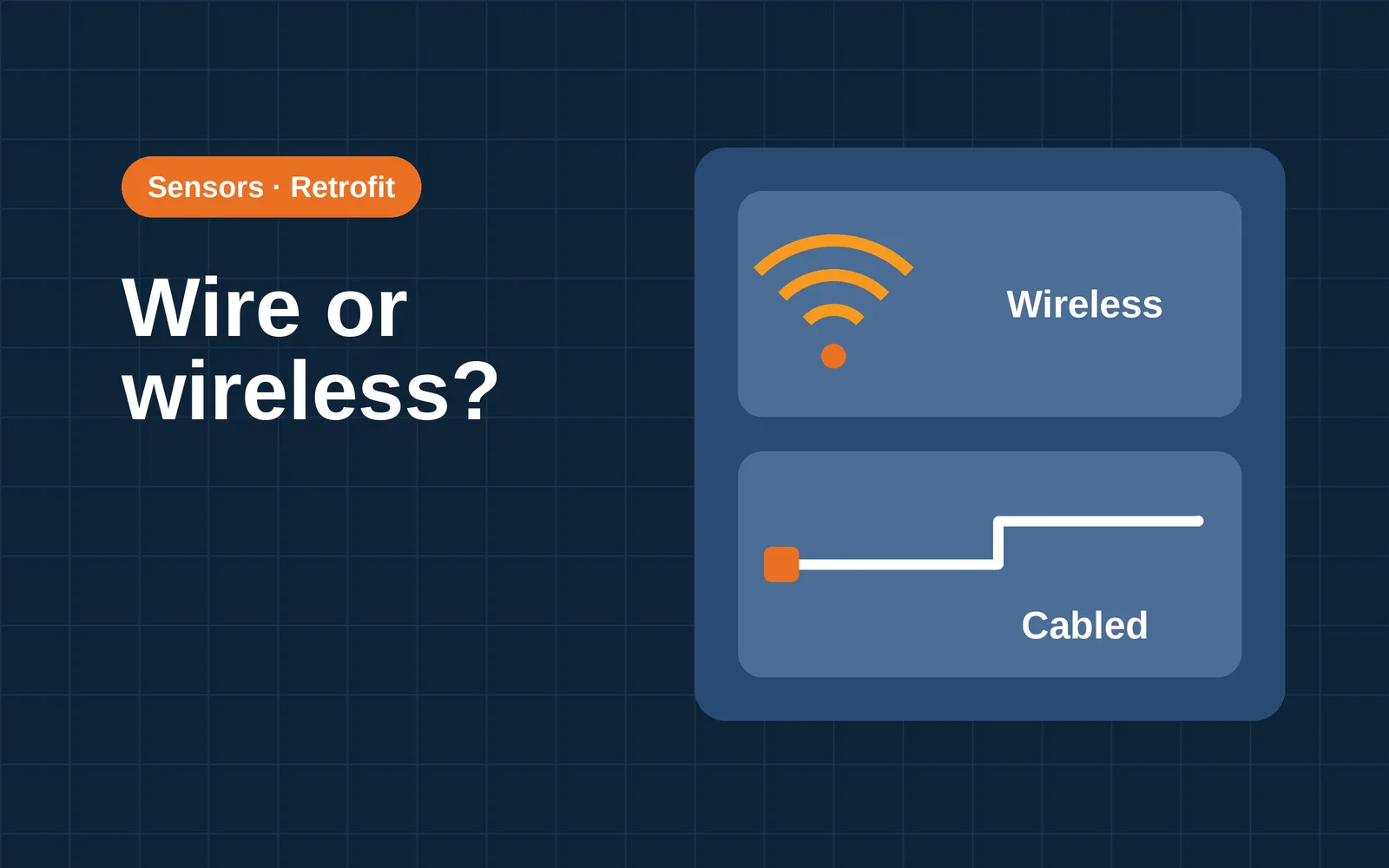
Wireless sensors suit a retrofit where pulling cable would mean opening ceilings and walls in rooms people are using, and cabled systems suit a fit-out where ceilings are open and a power and data run is cheap to add. That is general reasoning, not a published finding. The sources named below give no installed-cost, installation-time or reliability comparison of wireless against cabled in either case. What they do give are technical trade-offs: batteries, radio range and interference, security, and the rules each radio standard operates under.
What the sources say about wireless sensors and cabled systems
In a 2015 article in Consulting-Specifying Engineer, Don Horkey of DLR Group describes wired building automation as the standard way a system is installed and expects wireless use to grow, partly because renovation projects pose difficulties for wired networks. Most wireless installations are hybrids, with wireless most common at the field level (sensors and room devices) and wired networks using BACnet/IP, BACnet/MSTP or LonTalk above it. He cites ease of installation, flexibility and ease of relocation as the reasons for wireless at field level and gives no cost or time figures.
A 2025 ACEEE brief on controls for small and medium commercial buildings (Steven Nadel) has one number that touches installation. A controller costs on the order of $5,000, but with thermostats, sensors, wiring and installation the installed cost can reach $20,000 or more, according to a personal communication with a staff scientist at Pacific Northwest National Laboratory in May 2025. The brief does not split out wiring or compare wireless with cabled, so the number does not show what wireless would save.
Batteries and power
Battery life depends on how far the information must travel, the amount of data and how often a device reports, according to Horkey. He says battery-operated sensors have a battery life of up to 5 years, varying with building use, that battery replacement and labor belong in the lifecycle cost, and that energy-harvesting devices such as EnOcean's can potentially cost less than battery-operated systems over their lifecycle. He also notes that Wi-Fi consumes considerably more power than other systems. The detail for CO2 sensors is in wireless CO2 sensors for retrofit buildings. As general reasoning, wireless sensors that run on batteries add a recurring maintenance task, and a cabled supply removes it and adds the cable run.
Radio range, interference and network layout
Horkey writes that drywall and wood are excellent media for wireless signals, that signal loss through concrete depends on its thickness and rebar spacing, and that steel framing, elevator shafts and other metals significantly affect performance. Zigbee (802.15.4) and Wi-Fi share the 2.4 GHz band, and microwave ovens, cordless phones, Bluetooth and mobile phones can degrade performance. EnOcean works at 315 or 868 MHz, which he says makes it less susceptible to interference. He adds that wireless systems are required to have the same level of reliability as wired ones.
On layout, Horkey says a mesh network, where devices relay data through each other, can help avoid single points of failure, though the design must account for building construction and the number of repeaters needed. The LoRa Alliance, in a November 2015 technical whitepaper sponsored by its members, says a long-range star layout makes the most sense for preserving battery lifetime and that mesh adds complexity and reduces battery life. The sources weigh redundancy against battery life, and the Alliance promotes the star layout, so ask each supplier what happens when a hub or relay device fails.
Radios in the 868 MHz band in Europe also work under legal limits. The Things Network summarizes the ETSI sub-band rules for the EU868 band: a 1% duty cycle allows about 864 seconds of transmit time per day, and a 0.1% duty cycle about 86 seconds. Because the limit is on total transmit time, it caps how often a device can report, although the source does not state a reporting rate. The summary page of a DEOS AG report on LoRaWAN in building automation (dated 1 May 2022 on the ASHB site) lists long range, deep building penetration, long battery life and low infrastructure cost as benefits, and it mentions no limitations.
Security
Horkey says protocols add 128-bit AES encryption, mutually authenticated communications and key management, and recommends firewalling the building automation system and placing it on its own virtual network. He also says these advances "have made wireless networks inherently secure", which is a strong claim from a practitioner in 2015, stated without supporting evidence. The LoRa Alliance whitepaper says LoRaWAN uses two layers of security, one for the network and one for the application, with AES encryption. The INCIBE-CERT blog wrote in August 2025 that BACnet had to evolve to improve cybersecurity because of rising cyberattacks on the electricity sector, and that BACnet/SC is based on TLS 1.3 and is compatible with BACnet/IP and MS/TP networks. The ACEEE brief lists owners' cybersecurity concerns about making HVAC systems and data available through the Internet as an adoption challenge. Any device that joins a building network, wired or wireless, is a question for the IT team.
Questions to settle before choosing
These questions are a practical suggestion, not a published checklist. For a retrofit in a building without a BMS, see also adding demand-controlled ventilation to a building without a BMS. For what operators ask for at handover, see handover data: what operators wish developers provided.
- Power: is a mains or power-over-Ethernet supply near each position, or does each device need a battery plan with a named person to change the batteries?
- Interval: does the control or reporting task need readings every minute or every 15 minutes?
- Walls: has a test unit been placed in the worst rooms, behind concrete or near lift shafts?
- Network: who owns the hub or access point, and where does it connect?
- IT: who approves a device joining the building network?
- Failure: what raises an alarm when a device stops reporting?
Nomestic measures indoor climate room by room with wireless, battery-powered devices, so a room takes minutes to equip and nothing in the existing HVAC gets replaced. Where a cabled supply suits a room better, the Airsight Pro Monitor can be powered over PoE, a 24 V AC supply, 10 to 30 V DC wiring or USB-C, according to its product page.