Technology
Connecting new sensors to an existing BMS: what to ask your vendor
Adding sensors to a BMS can involve licenses, labor and responsibility as well as hardware. Questions on protocols, points, data ownership, commissioning and cybersecurity.

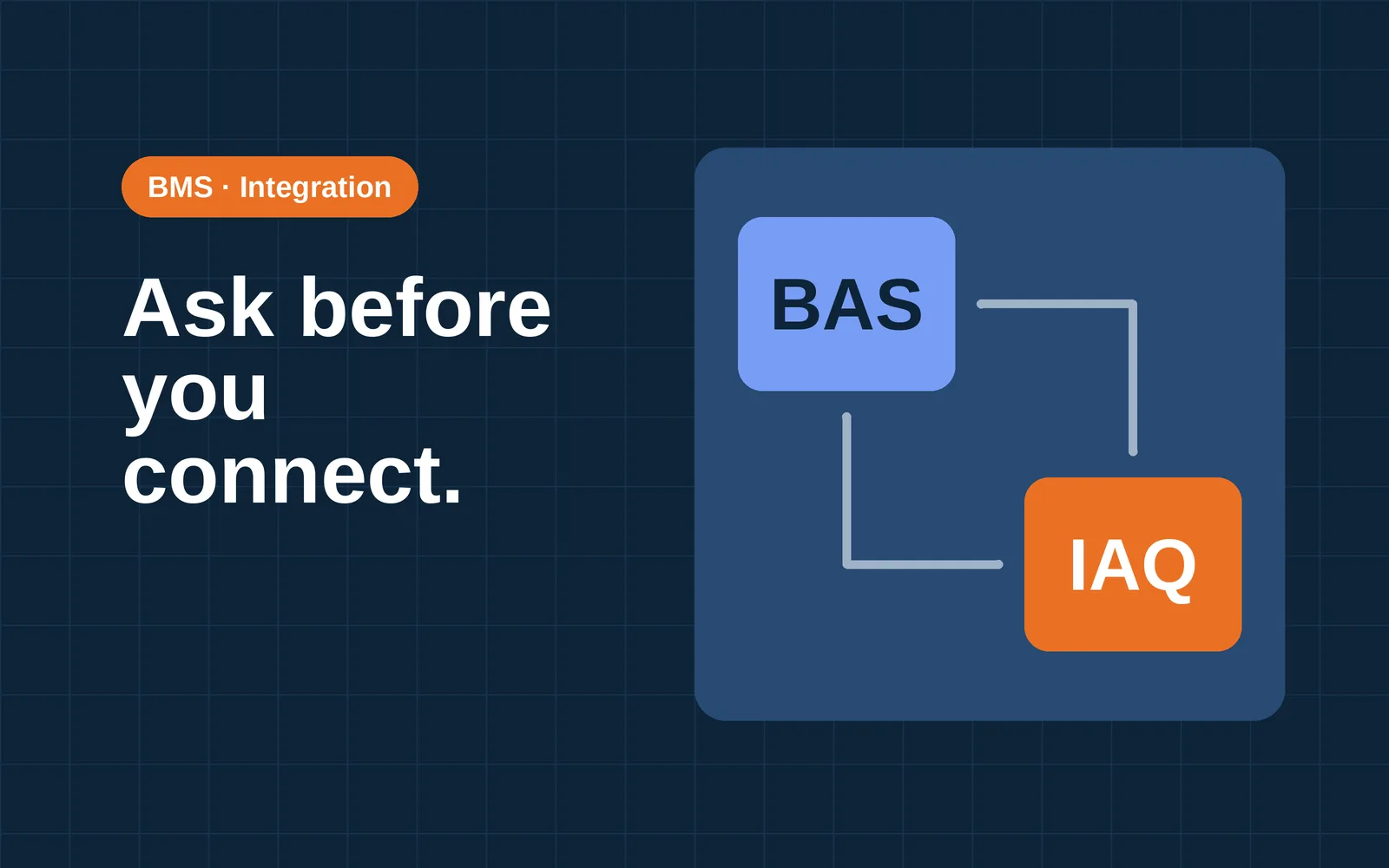
Adding sensors to an existing building management system (BMS) can involve vendor time, software licenses and responsibility as well as hardware. The questions below on BMS integration are for the BMS vendor or integrator, before any work is quoted. This article gives no prices for the work, so cost has to come from the quote.
BMS integration starts with protocol support
Ask which protocols the BMS can read and write, over which network, and in which version. BACnet is defined by ANSI/ASHRAE Standard 135, which carries the ISO designation 16484-5 and is maintained by an ASHRAE standing committee, SSPC 135. BACnet and Modbus explained for building owners covers both BACnet and Modbus. If the answer is a proprietary protocol, ask what the vendor charges to connect an outside device and whether it will publish the interface. These are practical questions, not published findings.
Then ask for documents. Every BACnet device is required to have a PICS (protocol implementation conformance statement), a manufacturer-written document that lists the device's BACnet capabilities, including object types and which properties can be written. Control system designers can use it to find out what BACnet interoperability capabilities a product has. BACnet International, which runs the BACnet Testing Laboratories (BTL), notes that a listed product's PICS is supplied by the manufacturer and not validated by BTL, while the product itself is independently tested. Ask for the PICS of the new sensor and of the BMS controller it will talk to, and whether both are BTL listed. A 2010 FacilitiesNet article quoted one controls vendor representative who said BTL listing covers interoperability but not interchangeability, and another who suggested a live demonstration between local integrators, with a BTL-listed product on a simple network.
Points, licenses and who can change what
A point is one data value in the BMS, such as a temperature reading. For a BMS integration quote, ask whether adding sensors adds points, whether each point or device carries a license or an annual fee, whether graphics, trends and alarms for the new sensors are included, and what each later change costs. An engineer at HDR (Lisowski, 2023) notes in a review of control platforms that licensing and maintenance fees on some open software platforms can grow with the number of controllers, and says first cost and total cost of ownership should both be shown to the client when open and proprietary systems are compared.
Ask who holds the access. Clemson University's building automation standard is an owner's specification for its own campus and a useful example of what an owner can require. In its March 2025 revision it asks the contractor to supply licensed programming, configuration and graphics tools, to match the point naming conventions of the existing BMS database, and to give the university unrestricted access to all documentation, including passwords and programming tools.
Who owns the data
Article 16 of Directive (EU) 2024/1275 is titled data exchange. Its first paragraph asks Member States to ensure that building owners, tenants and managers can have direct access to their building systems' data, including data from building automation and control systems, meters and measuring and control devices. Paragraph 3 says no additional costs are to be charged to them for that access or for a request to make the data available to a third party. Member States set the details, so national law applies.
Contracts matter as well. A May 2026 article by a Calgary law firm (Alberta, Canada, so only an illustration here) says data ownership is mainly set by contract and that many vendor agreements give the vendor broad rights to collect, aggregate and use building data. It recommends terms that state the performance data is the owner's property, give portability when switching vendors, and require the vendor to delete or return the data when the contract ends. Put the same three points to the BMS vendor, and ask whether data from the new sensors leaves the building and where it is stored.
Commissioning and accuracy
Ask who commissions the new points: who tests that each reading arrives in the BMS correctly, and what record is delivered at acceptance. For CO2 sensors that feed ventilation, a REHVA Journal paper on commissioning demand-controlled ventilation (Mysen and co-authors, 02/2015) suggests checking on site that all CO2 sensors show the same ppm reading when the building is empty in the evening or at night. It also suggests overriding each room signal to force maximum and minimum airflow and recording the result, testing in both summer and winter, and reviewing the system after about one year of normal operation.
Sensor accuracy deserves its own question. A Berkeley Lab study (LBNL-3279E) checked 208 single-location CO2 sensors in 34 commercial buildings. In a subset of 90 sensors tested against calibration gas, 40% had errors greater than 75 ppm at 1,010 ppm. Ask the sensor maker how the sensor is calibrated and how drift is handled, and ask who is responsible when a reading proves wrong. Where to place CO2 sensors for ventilation control covers placement.
Cybersecurity of the new connection
A new sensor is a new device on the building network. A NIST blog post from August 2026 says that as building automation and control system networks are integrated with corporate networks and the cloud, their risk of cyberattack increases significantly, and it links to a NIST quick-start infographic of security steps. NIST SP 800-82 Revision 3 (September 2023) names building automation systems as an example of operational technology. SmithGroup engineers writing in Consulting-Specifying Engineer (2020) say cybersecurity should be continuously checked. The questions below are practical suggestions, not published findings: which network the sensor sits on, whether it needs an internet connection, who patches it, and what happens to default passwords.
Put the answers in the BMS integration quote or contract so they can be checked at acceptance. If the BMS is old, adding demand-controlled ventilation to a building without a BMS and what a building management system is cover the alternatives.