Technology
Facility management companies: how to prove HVAC performance to clients
Task lists show that work was done. Measurements show whether rooms were comfortable and ventilated. What evidence a client can accept, which standards help, and how to report it.

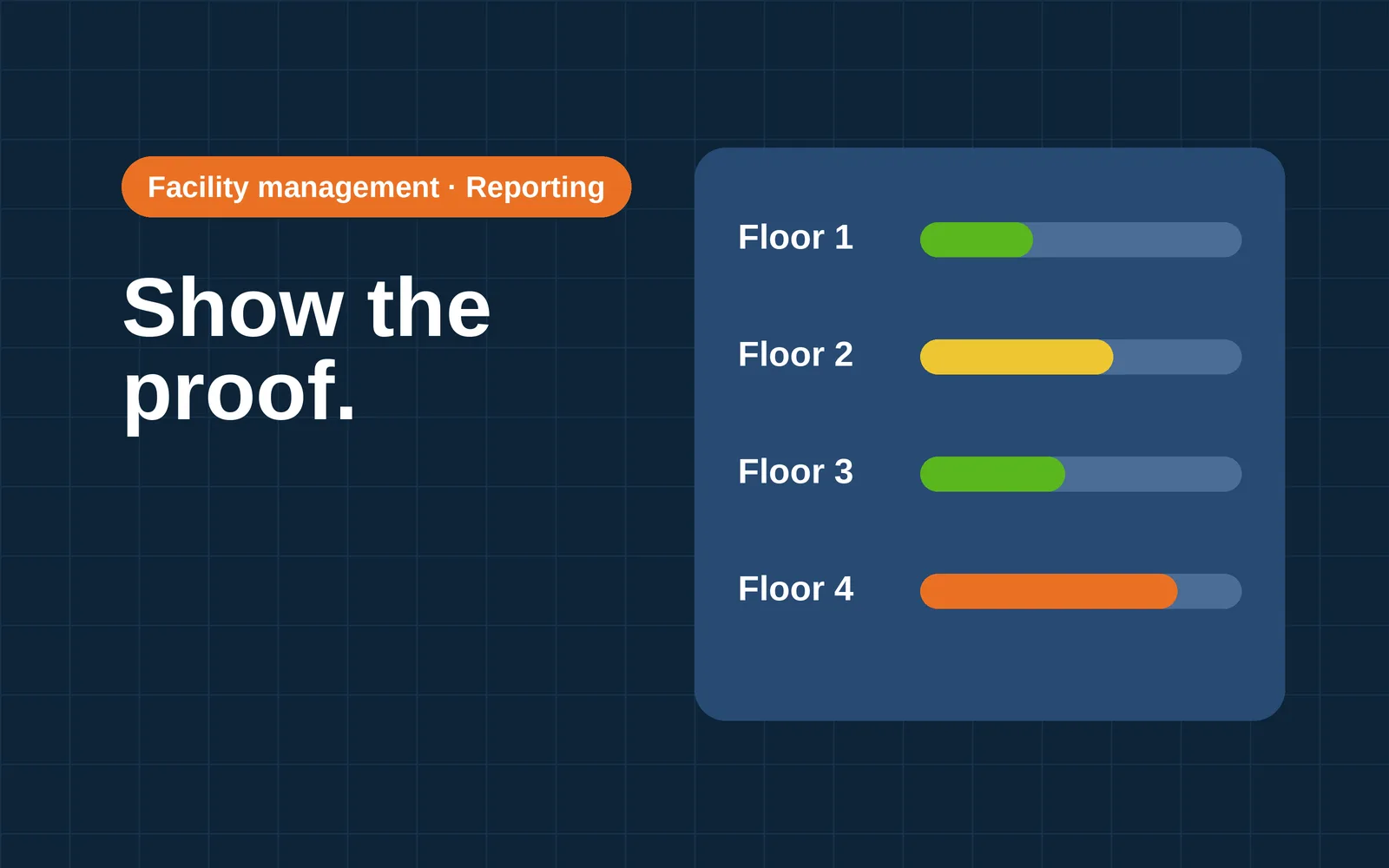
For facility management companies, a record of work (tickets closed, planned maintenance completed, contractor visits) shows activity. A client who asks whether the rooms were comfortable and ventilated last month needs measurements. Most of what follows is practice, and the text says so where no standard or study backs a point.
Agree what performance means before the first report
As practice, a report can only prove what the contract defines. EN 15221-2:2006, European guidance on preparing facility management agreements, includes a section on the structure and content of service level agreements (SLAs) and applies to services that are recurring (more than one year) and performance oriented. BSI lists it as withdrawn on 6 July 2018, so it is a reference for the idea only.
A European reference for indoor conditions is EN 16798-1:2019, which followed EN 15251:2007 (EVS lists EN 15251 as withdrawn from 15 October 2019). A 2024 REHVA Journal summary by Bjarne Olesen describes four categories of indoor environment: Category I is a high level of expectation, II is normal, III is an acceptable, moderate level, and IV is a low level that should only be accepted for a limited part of the year. The standard is paywalled, so this is the summary's wording. A contract that names a category and a measured parameter, such as operative temperature, gives both sides something to check. This is a practical suggestion: EVS describes EN 16798-1 as input parameters for design and assessment of energy performance. For CO2 values by category, see what is a good CO2 level in an office.
The companion technical report, CEN/TR 16798-2:2019, specifies methods for long-term evaluation of the indoor environment, criteria for measurements that can be used to check compliance by inspection, and parameters for monitoring and displaying the indoor environment in existing buildings (as described by the Estonian standards body EVS). Its predecessor, EN 15251, described one long-term evaluation method (Annex F) as the calculated number or share of hours in the occupied period when the operative temperature or PMV is outside a specified range (REHVA Journal, August 2012). As practice, a report can carry the same measure: the share of occupied hours each room or zone stayed inside the agreed range. None of these descriptions gives a pass mark, so the contract has to state one, for example how large a share of occupied hours may fall outside the range.
Evidence a client can accept
Five kinds of evidence are worth collecting. The order is practice: it follows how directly each one answers a client's question.
- Measured room data for occupied hours: temperature, humidity and CO2, shown as the share of occupied hours inside the agreed range, by room or zone.
- Before and after records for every change to settings or equipment, with the same sensors and the same type of period. The method is covered in [how to verify ventilation savings with before and after sensor data](/blog/verify-ventilation-savings-before-after/).
- A fault log with the date a problem was found, the likely cause, the date it was fixed and how the fix was checked. ASHRAE Guideline 1.2-2019, on commissioning existing HVAC&R systems, lists verification of completed recommendations and ongoing commissioning activities among the phases of its process.
- Maintenance and test records. ASHRAE Guideline 4-2019 covers the format, content, delivery and updating of O&M documentation for HVAC&R systems, can be used as a guide for existing building documentation, and has an appendix on HVAC maintenance and test reports.
- Energy data in context. The 2002 DOE O&M Best Practices guide (section 3.3) suggests comparing monthly energy use against the same month of the prior year.
Work records and measurements answer different questions. A fully completed maintenance plan can sit next to rooms that were stuffy all winter.
How facility management companies can report HVAC performance
The format below is a suggestion, not a standard. One page per building per month, with the same five parts every time, is a workable starting point.
- The agreed measure and its result, for example the share of occupied hours inside the agreed range, for the whole building and for the five worst rooms. A building average hides bad rooms.
- Open issues, with how long each has been open and who owns the next step.
- Closed issues, with the date found, the cause, the date fixed and the check that showed the fix worked.
- Changes made to schedules, setpoints or equipment, each with before and after data.
- Anything outside the facility manager's control: design limits, tenant requests, a client decision not to replace a part. Written down, it protects both sides.
Keep definitions identical from month to month. A report that changes its range, its rooms or its sensors makes trends hard to read. As practice, offer the raw data on request: a summary is easier to believe when it can be checked.
For buildings in the EU, Directive (EU) 2024/1275, Article 13(10), lists what building automation and control systems must be capable of, including benchmarking the building's energy efficiency, detecting losses in efficiency of technical building systems and informing the person responsible for the facilities or technical building management about efficiency improvement opportunities. The same paragraph adds, by 29 May 2026, monitoring of indoor environmental quality. It applies where national rules require such systems, and national law sets which buildings and when (see EPBD for non-residential buildings). Room-level reporting does not by itself show that a building meets a legal requirement.
Limits of the data
Measurements show conditions. They do not identify causes. A room that runs warm can reflect an HVAC fault, a design limit, a blocked vent or a heater placed next to the sensor. The report should say which cause is suspected and how it was checked.
Sensors need the same scrutiny as the equipment. In an LBNL analysis of fault reports (Crowe et al., 2023), faulty zone temperature sensors were reported on 46% of air terminal units at some point in time. The data came from fault detection software, not site-level observation, so the figure counts flagged sensor problems and does not count sensors confirmed to be wrong. As practice, agree in the contract where sensors sit and how they are checked, because a bad reading that goes into a client report is hard to withdraw. See also reactive vs predictive HVAC maintenance for what room data changes.
Nomestic measures indoor climate room by room (CO2, temperature, humidity and more) and works with or without a building management system. Savings are verified by comparing measured data before and after a change. Nothing in the existing HVAC gets replaced (see the ClimateIQ platform).