Technology
Ten questions building owners ask about ventilation control
Sensors, energy, air quality, cost, setup time, overrides and the law: ten questions about ventilation control, each answered from a named standard or study, or marked as practice.


Ventilation control sets how much outdoor air a system delivers and when. The ten questions below are a practical selection, not the result of a survey of owners. Where an answer is practical judgment instead of a published finding, it says so.
What is ventilation control?
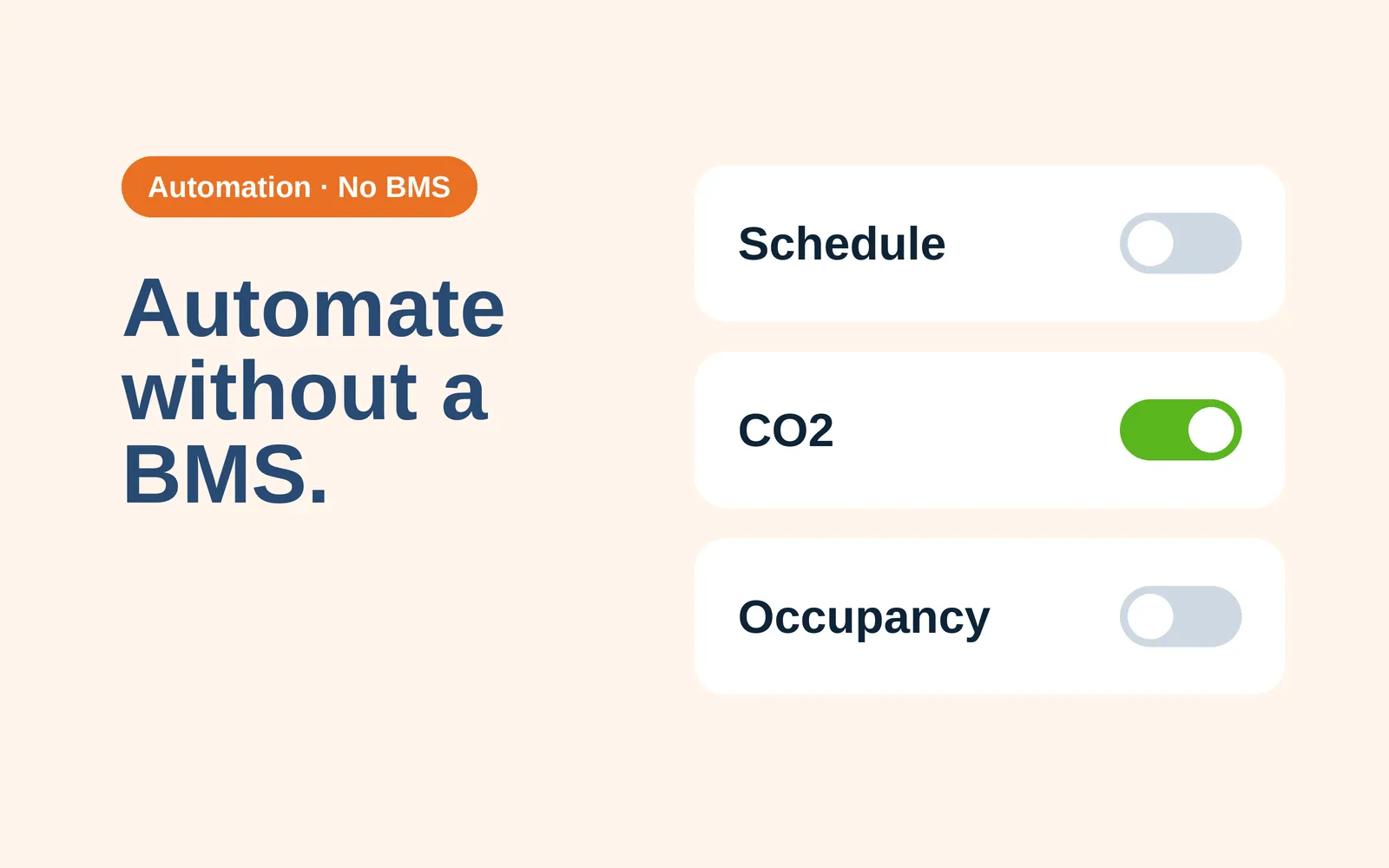
It is the logic that decides airflow. An HPAC Engineering article by Murphy and Bradley (2008) lists three ways to assess ventilation demand: occupancy schedules, in which the building automation system predicts the population by time of day; occupancy sensors; and CO2 sensors. A REHVA Journal article (Mysen and colleagues, 2015) uses the narrower term demand-controlled ventilation for airflow that is controlled automatically according to a measured demand at room level. The article on ventilation control compares the three signals, and demand-controlled ventilation covers the measured ones.
Do I need sensors?
A schedule needs none. CO2 control needs CO2 sensors, and occupancy control needs presence detectors or people counters. All of them also need something to control. The US Department of Energy federal technology alert on CO2-based demand-controlled ventilation (DOE/EE-0293, March 2004) says outdoor air intake must be adjustable automatically, for example with variable-speed fans or modulating dampers.
ASHRAE Standard 62.1-2022 addendum ab, approved on 31 October 2023, asks for at least one CO2 sensor per ventilation zone and one per 5,000 ft² (460 m²) of net occupiable floor area, mounted 3 to 6 ft (0.9 to 1.8 m) above the floor. That is a US standard, and other countries set their own rules.
Will it save energy?
Sometimes, and the size depends on the building. A REHVA Journal article (Mysen and colleagues, 2015) cites Maripuu (2009) for ventilation energy cuts of more than 50% when demand control is correctly implemented, and Mysen and colleagues (2010) for measured energy use showing that the potential is seldom met. ASHRAE research project RP-1747 reports 7% to 44% HVAC energy savings against non-DCV baselines and 10% to 30% in office simulations with realistic occupancy schedules, says the savings depend on each building's occupancy profile, and, as of ASHRAE's August 2019 report, had been tested in the lab and in simulation but not in the field.
The DOE alert says case studies generally show larger savings for heating than for cooling, that demand control may not reduce energy use in buildings with heat exchangers, and that a building that was under-ventilated before may use more energy afterward. Berkeley Lab (LBNL) found in 2010 that demand control would generally not be cost effective in California general offices if the existing ventilation rate was 28 cfm per person, and would often be at 80 cfm per person. A savings figure for one building needs that building's own data (practical judgment).
Is it safe for air quality?
It can be, if the design keeps a floor under the airflow. Addendum ab does not let outdoor airflow fall below the area-based part of the required rate while a zone is occupied, and on sensor failure the system must supply the design minimum. It does not allow CO2 control in zones with CO2 sources other than people, and it lists occupancies, such as laboratories and health care-related uses, where CO2 control is not allowed.
The DOE alert says CO2 sensors suit only occupant-related ventilation, often recommends a base rate of 20 to 30% of the original design ventilation rate, and says systems should be able to purge before occupancy. Murphy and Bradley warn that controlling to a fixed CO2 difference based on design occupancy underventilates a zone at partial occupancy.
What does it cost?
The sources give no price that holds across buildings. The DOE alert of March 2004 prints per-zone installed costs, which are out of date, and LBNL's 2010 work for California's Title 24 ties cost effectiveness to how much air the building delivers today. When comparing quotes, ask for sensor count, what changes in the existing controls, who commissions the system and what ongoing checks it assumes. That advice is a practical suggestion, not a published finding.
Can my existing system do it?
Only if its airflow can change. Alberta Infrastructure's Design and Technology Series #20 on demand control ventilation (2025) notes that fans and VAV boxes have a limited turn-down ratio, and that minimum fan speed is often what limits how low the outdoor air rate can go in 100% outdoor air systems. For a building without a BMS, the ebm-papst CN1090 data sheet shows the kind of standalone demand ventilation controller on the market: it takes 0 to 10 V sensor inputs, with CO2 among the examples, and in its proportional band mode sets fan speed between minimum and maximum limits. Adding demand control to such a building is covered in adding demand-controlled ventilation without a BMS.
How accurate are the sensors?
Accuracy can be a problem. LBNL checked 208 single-location CO2 sensors in 34 commercial buildings in 2010. At about 1,010 ppm, 40% were off by more than 75 ppm and 13% by more than 300 ppm, and sensor age did not reliably predict the error. In LBNL's field studies for Title 24, no facility manager reported calibrating the sensors after installation.
Addendum ab asks for sensors certified by the manufacturer to be accurate within 75 ppm at 600, 1,000 and 2,500 ppm and to need calibration no more than once every five years. Addendum d, approved on 31 March 2025, changes that tolerance, so the current text of the standard is the one to check. The DOE alert suggests comparing indoor readings with outdoor readings over several unoccupied hours, and the REHVA commissioning article suggests checking that all sensors agree when the building is empty.
How long does it take?
No source gives one duration. The DOE alert describes a sequence: monitor outdoor CO2 for at least a week, monitor indoor CO2 in all zones for several days, check CO2 readings with a handheld monitor for a few days after startup, and, in its case study, log concentrations every 15 minutes for a week. The REHVA article adds a test of each unit at forced maximum and minimum airflow, tuning for summer and winter conditions, and a review after a period of normal operation, for example one year. A practical reading, not a published finding: weeks of data before and after a change, and a season or more before the result is settled.
Can staff override ventilation control?
They should be able to. ASHRAE addendum f to 62.1-2022, approved on 30 September 2025, adds emergency control modes that, according to its foreword, may be started manually or by a sensed value. In the outdoor air intake increase mode, demand-controlled ventilation is disabled and outdoor air intake and exhaust go to the designer's maximum. Each mode must reset automatically, with a user-adjustable timer of no more than 72 hours, and starting a mode must trigger a notification. A documented manual override and a log of when it was used are a practical suggestion, not a published finding.
Does the law require it?
Article 13 of Directive (EU) 2024/1275, as given in unofficial English and German copies (the EUR-Lex version prevails), asks for building automation and control systems in non-residential buildings, where technically and economically feasible, with heating, air-conditioning or combined heating or air-conditioning and ventilation systems of more than 290 kW by 31 December 2024 and more than 70 kW by 31 December 2029. The listed functions are energy monitoring, benchmarking and loss detection, interoperability, and monitoring of indoor environmental quality by 29 May 2026. The listed functions do not mention ventilation control. Member states must also require non-residential zero-emission buildings to have measuring and control devices for monitoring and regulating indoor air quality. Member states set these requirements in national law, so dates and scope can differ by country.
In the US, a 2012 review by the Pacific Northwest National Laboratory (PNNL-21281) summarizes ASHRAE Standard 90.1-2010 as requiring demand control for spaces over 500 ft² with a design occupancy above 40 people per 1,000 ft², on systems with an air-side economizer, a modulating outdoor-air damper or a design outdoor airflow above 3,000 cfm. The edition and the local code decide what applies.
Nomestic measures indoor climate room by room, including CO2, temperature and humidity, and works with or without a building management system. Operators can override automatic adjustments at any time. Savings are verified by comparing measured data before and after a change.