Regulation
Belgium and Austria: why the building automation rules depend on the region
BACS in Belgium differs across Flanders, Wallonia and Brussels, and BACS in Austria across states. What four Austrian states and the three Belgian regions say, and what is unchecked.

BACS rules in Belgium and Austria depend on where the building stands. Belgium has three regional texts, for Flanders, Wallonia and Brussels-Capital. In Austria the rules sit in state law, and this article covers four of the nine states. BACS means building automation and control system. In every text cited below, the trigger is the rated output of heating or air-conditioning systems in kW. Floor area enters only as a share test in Brussels and Wallonia, which ask how much of the building is non-residential. Dates, tiers and listed functions differ. This is general information, not legal advice.
BACS in Belgium: three regions, three legal texts
The BACS rule sits in a different text in each region. Flanders cites article 11.1/1.2 of the Energiedecreet and article 9.4.1 of the Energiebesluit. In Wallonia, article 19/3 was inserted by the Walloon Government's arrêté of 11 January 2023 into its arrêté of 15 May 2014 on the energy performance of buildings. Brussels-Capital's information sheet refers to the Brussels government's arrêté of 21 June 2018 on energy performance requirements.
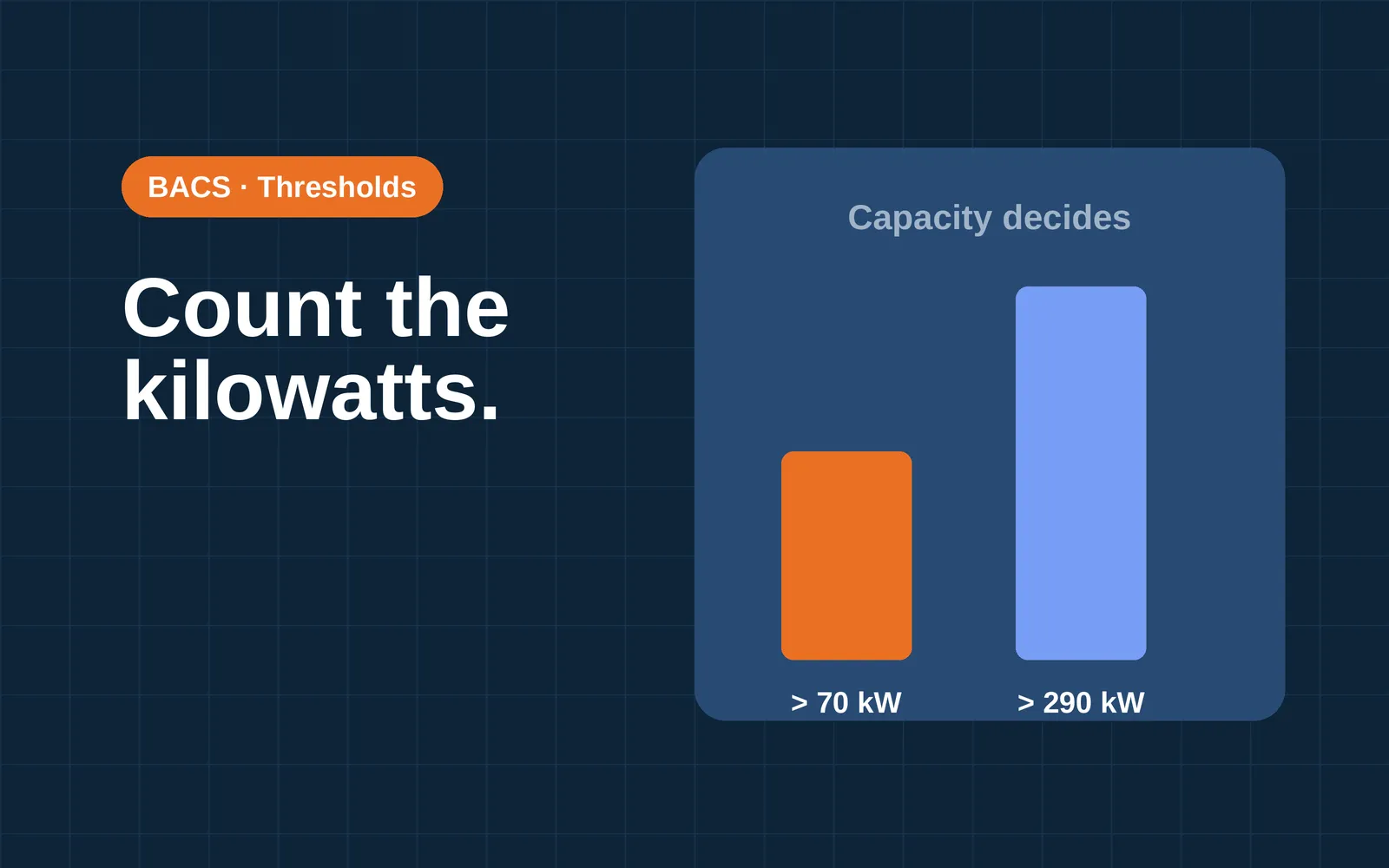
In Flanders, vlaanderen.be says new and existing non-residential buildings need a BACS if they have a heating or combined heating and ventilation system, or a cooling or combined air-conditioning and ventilation system, above 290 kW. The page gives 31 December 2025 for the 290 kW tier and 31 December 2029 at the latest for 70 kW. It says heating and cooling are each judged against their own limit, and within one of them it adds up generators or installations that are linked hydraulically or by refrigerant.
The page says the duty sits with the owner or the holder of a real right (zakelijk recht) over the systems. In casco leases the tenant is often the one who installs the systems, and in that case the page says the BACS duty also rests with the tenant. The required functions include monitoring the indoor environment (het binnenmilieu monitoren). Buildings where the duty is technically, functionally or economically unfeasible are exempt, which in practice means buildings with only one of space heating, cooling or ventilation. The page mentions no enforcement or sanctions and shows no modification date.
Brussels-Capital works from the Bruxelles Environnement information sheet on BACS, dated 1 January 2025. It gives 1 January 2025 for new or existing heating or cooling systems above 290 kW where non-residential energy performance (PEB) units make up more than 50 percent of the area served. The agency's web page of 7 October 2025 says at least 50 percent. For heating, the sheet adds up the useful nominal power of boilers and the thermal power of heat pumps. It lists three functions: energy monitoring, benchmarking and interoperability. It lists no indoor environment function and no exemption, and neither the sheet nor the web page mentions a 70 kW tier.
Wallonia has conflicting sources. Article 19/3 of the arrêté of 11 January 2023 says that by 31 December 2025 non-residential buildings served by heating systems (paragraph 1) or cooling systems (paragraph 2) totaling more than 290 kW of useful nominal power need a BACS with the functions of annex C4. A second sub-paragraph in each deals with mixed buildings and refers to non-residential or collective-housing parts amounting to at least 50 percent of the total useful area. Annex C4 (point 1.8.6.1) asks for class B of NBN EN 15232-1 and applies when a heat generator is installed or replaced, and the text does not say how that trigger fits the 2025 date. The Wallex page is the amending arrêté itself, not a consolidated text, and it contains no 70 kW tier.
A presentation by the Walloon energy administration (SPW Énergie, 8 October 2025) gives 1 January 2025 for systems above 290 kW and 1 January 2030 for systems above 70 kW. Its slide cites no Walloon arrêté, and the deck is titled "Nouvelle Directive PEB". A planning slide in the deck lists a Walloon décret PEB for the first half of 2026, an executive order (AGW) for the second half of 2026 and a probable entry into force on 1 January 2027. An SPW Énergie presentation of 1 December 2025 gives the passage of the décret to a second reading in the Walloon Government in December and the drafting of the AGW as the current stage; it does not mention BACS. The documents cited contain no adopted Walloon text with a 70 kW tier. Which date applies in Wallonia is therefore unconfirmed, and the region (SPW Énergie) is the place to ask.
BACS in Austria: nine states, four covered here
The four Austrian texts cited here are state law, and each sits in a different place: an ordinance on technical building rules in Tyrol (Technische Bauvorschriften 2026, section 38), the building code in Lower Austria (Bauordnung 2014, section 44a), a heating and air-conditioning act in Vienna (Heizungs- und Klimaanlagengesetz 2015, section 14b) and a building ordinance in Burgenland (Bauverordnung 2008, section 34c). They are not identical:
- Tyrol (in force since 16 July 2026): non-residential buildings with systems above 290 kW, and above 70 kW from 31 December 2029, where technically and economically feasible. The systems must be able to monitor indoor climate quality (Raumklimaqualität).
- Lower Austria (version in force from 29 May 2026): above 290 kW a BACS where feasible, with no date for it (31 December 2027 applies to automatic lighting controls). Above 70 kW a BACS and lighting controls by 31 December 2029, where feasible. The listed functions include Raumklimaqualität. The paragraphs name no obliged party.
- Vienna (version in force from 15 July 2026): the building owner is the obliged party. Above 290 kW a BACS with no BACS date shown (31 December 2027 for lighting controls), and above 70 kW by 31 December 2029. The listed functions include Raumklimaqualität. Section 14b(3) defines economic feasibility as equipment costs lower than the expected monetary savings over the expected service life.
- Burgenland (version in force since 10 May 2025): above 290 kW a BACS "bis zum Jahr 2025", where feasible. The text cited has no 70 kW tier, no indoor climate function and no obliged party.
Lower Austria (section 44a(2)) and Vienna (section 14b(1c)) also have a separate paragraph for zero-emission non-residential buildings, which need measuring and control devices for monitoring and regulating indoor air quality (Raumluftqualität). Section 38(2) of the Tyrol ordinance refers to OIB-Richtlinie 6 (Ausgabe September 2025), points 4.9.1 and 8, where the requirements are technically, functionally and economically feasible. This article does not state what that guideline requires.
The other five states (Salzburg, Styria, Carinthia, Upper Austria and Vorarlberg) are not covered here, and nothing in this article describes their rules. The excerpt of Vorarlberg's building act (Baugesetz) cited here has no BACS threshold. Its section 15(3) provides for detailed rules by ordinance of the state government, including on energy performance (Gesamtenergieeffizienz), and that ordinance was not located.
Checking a building in Belgium or Austria
Two buildings with the same boiler can face different dates, tiers and functions depending on the region or state. For each building, a practical order is to find the regional or state text in force on the day of the check, count system power the way that text counts it, and note the date, the obliged party and whether indoor climate monitoring is listed. This is a practical suggestion drawn from the differences above, not a legal finding.
The EU rules behind all of this are in Article 13 of Directive (EU) 2024/1275 (what its 29 May 2026 date means), and EPBD for non-residential buildings: what applies in NL, DE, FR, BE, AT and IE compares six countries. For how kW tiers are counted at EU level, see Does the 290 kW or 70 kW threshold apply to your building?, and Where to start with building automation compliance lists the order of checks.