Regulation
France's décret BACS: who is covered and when
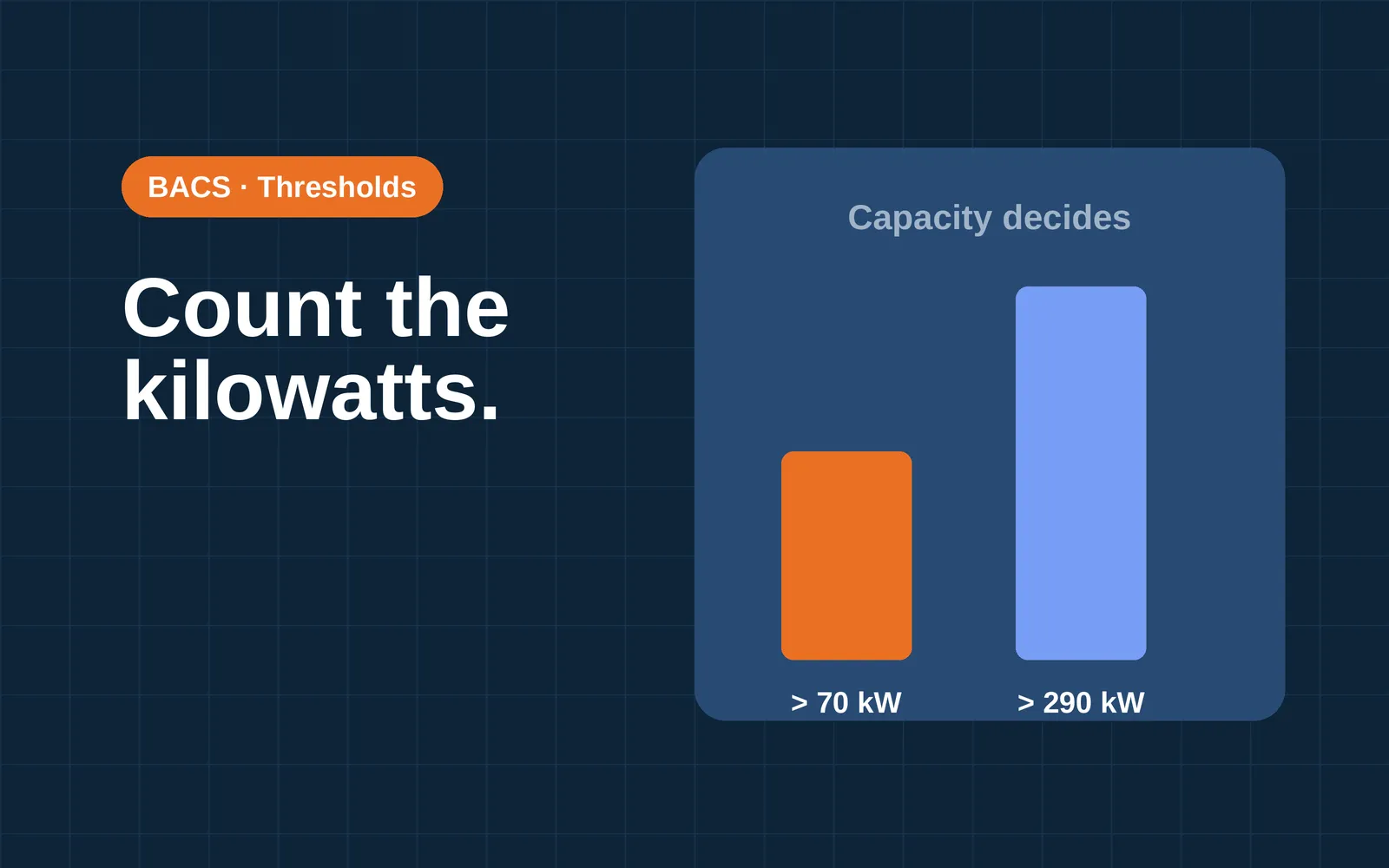
France's décret BACS sets 290 kW and 70 kW tiers for tertiary buildings. Who is covered, which dates apply, who carries the duty, the exemption study and what the sources leave open.


The décret BACS is the French rule that requires a building automation and control system (BACS, often called a GTB in French) in tertiary buildings, meaning buildings where commercial or non-commercial tertiary activities take place. It was set by décret n° 2020-887 of 20 July 2020 and extended to a lower power threshold by décret n° 2023-259 of 7 April 2023. According to Banque des Territoires, décret n° 2025-1343 of 26 December 2025 then moved the date for existing buildings in the lower tier to 1 January 2030. Scope depends on the power of the heating or air-conditioning system, so floor area alone does not tell whether a building is covered. This is general information, not legal advice.
Who is covered by the décret BACS
The government's application guide (version 2, January 2026) says the decree covers buildings where tertiary activities take place and that have a heating or air-conditioning system, alone or combined with ventilation, with a useful nominal power above 70 kW or above 290 kW. Useful nominal power is the maximum thermal power stated by the manufacturer. For heat pumps the guide takes the higher of the heating and cooling output. Several heat pump machines count as one system with their power added up, and boilers networked in one room count as one boiler. Other systems count one by one. For a building on district heating or cooling, the substation's power counts.
For the EU-level logic of the two tiers, see Does the 290 kW or 70 kW threshold apply to your building?. A March 2026 presentation by DREAL Nouvelle-Aquitaine, a regional state office, has a slide headed "Assujettissement BACS ≠ Assujettissement DEET", which separates the BACS decree from the décret tertiaire (DEET).
Dates for new and existing buildings
The dates in the décret BACS depend on the power tier and on whether the building is new or existing. For new buildings the application guide takes the date of the building permit application as the reference.
For existing buildings the guide says "avant le 1er janvier 2025 ou 2030, selon la puissance installée". The 2025 date for the 290 kW tier comes from an INERIS-hosted copy of a 2022 order on boilers and thermodynamic systems, which quotes article R. 175-2 as making a BACS mandatory "à partir du 1er janvier 2025" for systems above 290 kW. The 2030 date for the 70 kW tier rests on Banque des Territoires and the ministry's note.
The text of décret n° 2023-259 on Légifrance also applies the duty to other existing buildings above 70 kW when the heating or cooling system is renewed and, at the latest, on the stated date. The guide of January 2026 still gives the 70 kW threshold "lors du renouvellement de ce système" and does not define renewal.
The owner carries the duty
According to the guide, the owner of a system whose power exceeds the threshold has to install the BACS. For a building on a heat or cold network that is the owner of the substation, or the owner of the installation inside the building when the substation belongs to the network operator. The owner has to see that the operator (exploitant) is trained. The inspection is done at the owner's initiative, and for a BACS shared by several co-owners the syndicat de copropriété is responsible. The guide also asks the owner to pass consumption data to the tenant (preneur à bail), where there is one.
The exemption study
According to the guide, an existing building can be exempt if the owner produces a study showing that installing a BACS has a payback time (temps de retour sur investissement, TRI) of more than 10 years, after deducting aid and energy-saving certificates (CEE). Article 3 of décret n° 2023-259 on Légifrance changed the period in the rules for buildings above 290 kW from six to ten years and gives new buildings above 70 kW the same study route. The guide's payback formula divides the installation cost, net of aid, by the energy gain multiplied by energy cost, and sets the gain at 15 percent or at the result of an energy audit.
What the system must do
The guide lists five functions that a BACS must have under article R. 175-3:
- Monitor, log and analyze energy production and consumption data continuously, by functional zone and at an hourly time step, and adjust them accordingly.
- Compare the building's energy efficiency with reference values.
- Detect efficiency losses and inform the operator.
- Communicate and interact with other equipment and systems, within security requirements. The guide says only technical interoperability is required.
- Allow the supervision to be shut down manually while the connected systems keep running on their own.
The guide names the systems concerned as heating, air-conditioning, ventilation, domestic hot water, integrated lighting and on-site electricity generation, alone or in combination. A periodic inspection (article R. 175-5-1) is due at most every five years, and within two years after the BACS or a connected system is installed or replaced. The report goes to the owner within a month of the site visit.
Indoor air quality monitoring is not among the five functions. The guide names occupant comfort and health as an aim and suggests linking ventilation to particle detectors, but the term air quality does not appear in it. The ministry's presentation note on the draft decree does not mention air quality either, so neither document ties a duty to 29 May 2026, the date from which Article 13 of the EU directive lists monitoring of indoor environmental quality (what that date means). How the same EU article reads in other countries is in EPBD for non-residential buildings: what applies in NL, DE, FR, BE, AT and IE.
What could not be confirmed
The text of décret n° 2025-1343 was not checked. The move of the 70 kW date for existing buildings to 1 January 2030 comes from Banque des Territoires (6 January 2026), which reports publication in the Journal officiel on 27 December 2025, and from the ministry's presentation note on the draft decree, which ties the new date to Article 13 of Directive (EU) 2024/1275. A law firm's blog (Landot Avocats, 5 January 2026) also describes a postponement to 2030 of the 2027 date in article R. 175-2, without reproducing the new wording. The wording of R. 175-2 after the amendment was not checked, so it is open whether the renewal route above survives and with which latest date.
The exact days for new buildings differ by one day between two official documents. The guide gives 22 July 2021 and 9 April 2024. A November 2023 presentation by DREAL Occitanie gives 21 July 2021 and 8 April 2024. The guide mentions no penalties, and this article does not cover them.
Before relying on a date for a specific building, check the current articles R. 175-2, R. 175-3 and R. 175-5-1 of the Code de la construction et de l'habitation on Légifrance, or ask an adviser. Where to start with building automation compliance: a checklist for owners sets out the order of checks.