Technology
Too warm, too stuffy: how to find the cause room by room
Temperature, humidity and CO2 point to different causes. Published guidance and fault data point to where to look for each, and room readings narrow the search.

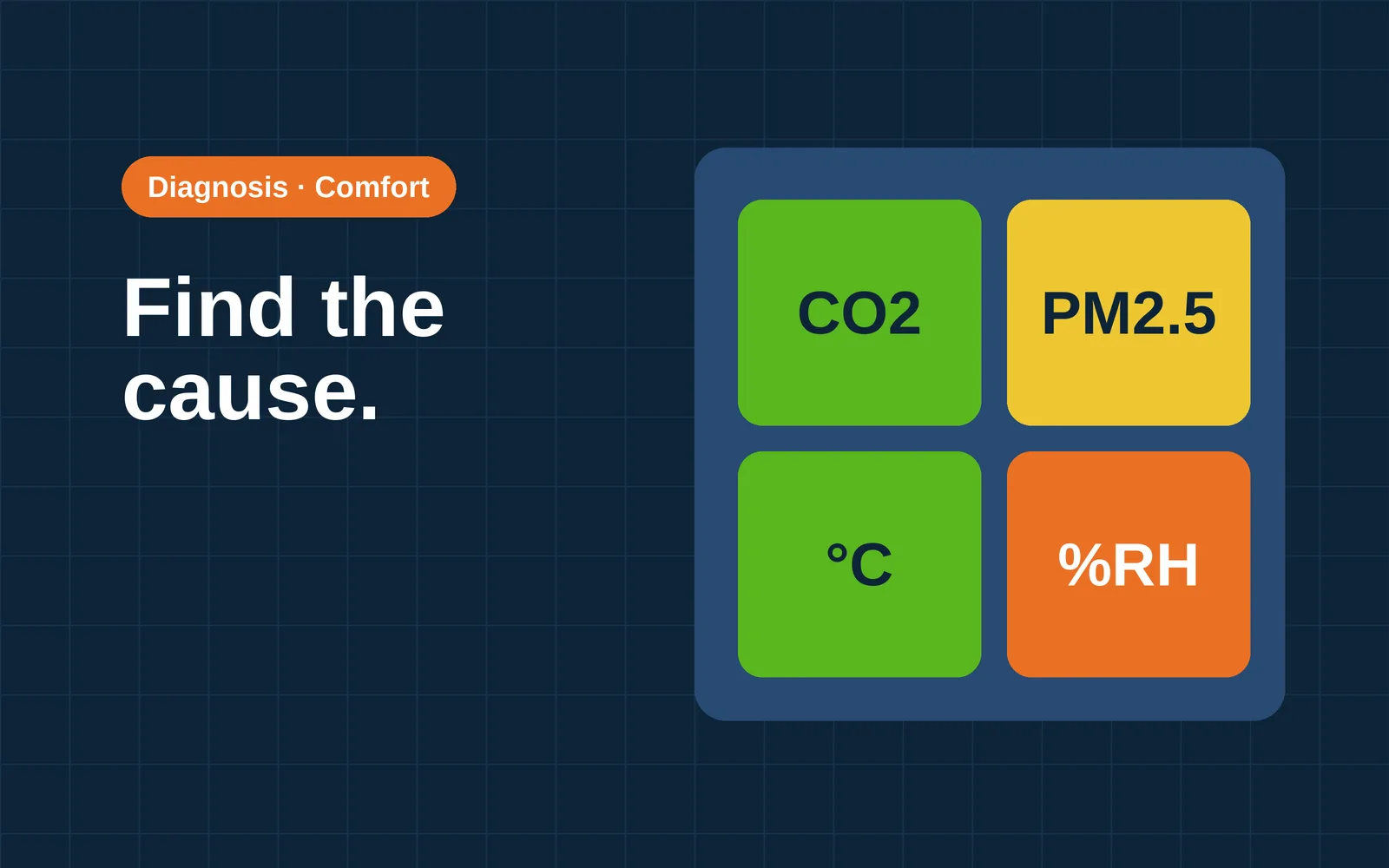
Too warm and too stuffy are different problems. Temperature, humidity and CO2 each point to different causes, so the first job in tracing an indoor climate complaint is to say which of the three is out of range in that room. Ventilation faults, meaning equipment or control problems that leave a room with less outdoor air than intended, explain one branch. Others sit in thermostats, zone controls and the room itself.
What counts as out of range
For temperature, EN 16798-1:2019, as summarized in REHVA Journal (Boerstra, April 2019), gives office operative temperatures for Category II of 20 to 24°C in winter and 23 to 26°C in summer. Category I is narrower (21 to 23°C and 23.5 to 25.5°C) and Category III wider (19 to 25°C and 22 to 27°C). Operative temperature also depends on surface temperatures, so a sensor that reads air temperature only approximates it (general reasoning).
For CO2, the same table allows 550 ppm above the outdoor level in Category I, 800 ppm in Category II and 1,350 ppm in Category III. Two screening values come from guidance. The EPA and NIOSH guide Building Air Quality (1991) calls peak CO2 over 1,000 ppm an indicator of underventilation, and the UK Health and Safety Executive says CO2 consistently above 1,500 ppm in an occupied room indicates poor ventilation. The HSE adds that single readings can mislead and that CO2 is only a broad guide to ventilation. What is a good CO2 level in an office covers the numbers.
For humidity, the EPA and NIOSH guide gives a recommended range of roughly 30% to 60% relative humidity and says high relative humidity can promote the growth of mold and mildew. ASHRAE Standard 55-2017, in addendum d (approved 31 July 2020), states that no lower humidity limit has been established for thermal comfort.
Too warm: check what the controls see
Rooms on one thermostat can sit at different temperatures (EPA and NIOSH, 1991). A DOE retrocommissioning case study lists relocating thermostats to improve comfort and avoid simultaneous heating and cooling, and DOE's list of trend-data problems asks whether zone heating and cooling setpoints are too close together. The EPA and NIOSH guide adds that temperature stratification is common and that air near the ceiling can be several degrees warmer than at floor level. ASHRAE Standard 55-2017 (as changed by addendum d) says the head-to-ankle air temperature difference shall not exceed 3°C for seated occupants. A sensor mounted at a different height than the occupants therefore reads a different room (reasoning).
Then check whether the controls read the room correctly. Fault reports from monitoring software on over 60,000 pieces of equipment (Crowe et al., LBNL and partners, 2023) list faulty zone temperature sensors and abnormal zone temperature each on 46% of air terminal units at some point. These are software-reported faults, and the authors name limits: false positives and negatives, and a sample not shown to be representative. A DOE field check still in progress compared the building automation reading with a separate logger at a 2°F (about 1 K) threshold and flagged 3 of 11 rooftop units (27%) for zone temperature sensor drift. A logger placed beside the thermostat is the same test on a small scale (practical suggestion).
Too stuffy: separate the air from the heat
Warmth and humidity alone can make air seem less acceptable. In a laboratory study at 18 to 28°C and 30 to 70% relative humidity, Fang, Clausen and Fanger (Indoor Air, 1998) found air was judged less acceptable as temperature and humidity rose, with the effect weakening as pollution increased. The 1991 EPA and NIOSH guide reports research that judged indoor air quality worse above 76°F (about 24°C). A room that is warm and stuffy may therefore improve once the temperature is fixed (reasoning).
If CO2 in the occupied room stays high, the question is outdoor air per person. The EPA and NIOSH guide says IAQ complaints often arise because the quantity or distribution of outdoor air is inadequate. It gives an example of underventilation after the minimum outdoor air setting was lowered, and it notes that most early variable-air-volume systems did not allow control of the outdoor air quantity. In a multiple-zone system the critical zone sets the system's outdoor air intake (Stanke, ASHRAE Journal, 2005), so a stuffy room that is the critical zone is where an intake shortfall would show first (reasoning).
If CO2 is normal and the room is still stuffy, CO2 may be the wrong measure. An ASHRAE Technical Committee 4.3 FAQ states that CO2 is not a good indicator of the concentration and occupant acceptance of other indoor contaminants, such as volatile organic compounds from furnishings and building materials. In an experiment with 25 people, each exposed for 255 minutes to five conditions (Zhang, Wargocki, Lian and Thyregod, Indoor Air, 2017), pure CO2 added to reach 1,000 and 3,000 ppm had no significant effect on perceived air quality, while bioeffluents at 3,000 ppm lowered it. CO2 is therefore best read as a signal for ventilation per person (reasoning).
Humidity that is too high or too low can produce discomfort (EPA and NIOSH, 1991), and OSHA's Technical Manual recommends keeping indoor relative humidity below 60% (50% where cold surfaces are in contact with room air) as a microbial control. The sources cited here do not link a room's humidity problem to a specific equipment fault, so that step needs an engineer's inspection.
What room readings can and cannot show about ventilation faults
Room readings narrow the search for a fault. They cannot name it. The patterns below are reasoning from the sources above, not a published procedure.
- Warm room, CO2 normal while occupied: outdoor air per person looks adequate, so look at the thermostat, the zone setpoints and the heating or cooling supply to that room.
- Warm room, CO2 high: look at ventilation and cooling together, and at how many people use the room compared with what it was designed for.
- CO2 high, temperature in range: look at the outdoor air supply and the minimum outdoor air setting for that room's air handler or terminal.
- Humidity out of range, temperature in range: the sources cited here do not tie this to a particular equipment fault, so the cause needs an engineer's inspection.
Room data carries its own error. In the LBNL study of 208 CO2 sensors, 40% were off by more than 75 ppm at 1,010 ppm (Fisk et al., 2010), so a surprising reading deserves a check of the sensor first. A room sensor also measures only the room. A damper, a valve, a sensor or a setting elsewhere may hold the cause, and only someone at the equipment can check it. How to spot HVAC faults without a BMS covers what loggers can show. On why complaints are better treated as data, see building complaints are a data problem.
A practical order for indoor climate problems
The order below is a practical suggestion, not a published procedure.
- Name the symptom and the room Record which room, what time, and whether it is warm, stuffy, damp or dry. The EPA and NIOSH guide uses the location of complaints to define the complaint area and looks at timing, including whether symptoms are worst at the start of the occupied period.
- Log the room for several days Record the room's indoor climate (CO2, temperature and humidity) through occupied and unoccupied hours, with the number of people noted. The HSE advises several measurements through the day while the room is occupied, with occupant numbers and the type of ventilation recorded.
- Compare with the thermostat Put a separate logger beside the thermostat and compare it with the control system's reading, the method DOE used in its field check.
- Inspect the equipment behind rooms still out of range Check dampers, valves, sensors and minimum outdoor air settings for the air handler or terminal that serves the room. A fault such as a minimum outdoor air setting that is too low can only be confirmed at the equipment (practice).
- Change one thing and watch the same readings The EPA and NIOSH guide treats a change that reduces complaints as support for a hypothesis, says such changes may be only temporary measures, and notes that a problem may have more than one cause.