Technology
Why one building is enough to start
Start with one building and let its measured results decide the rollout. How to choose it, what to measure and when to scale, with DOE and REHVA guidance cited and the practice labeled.

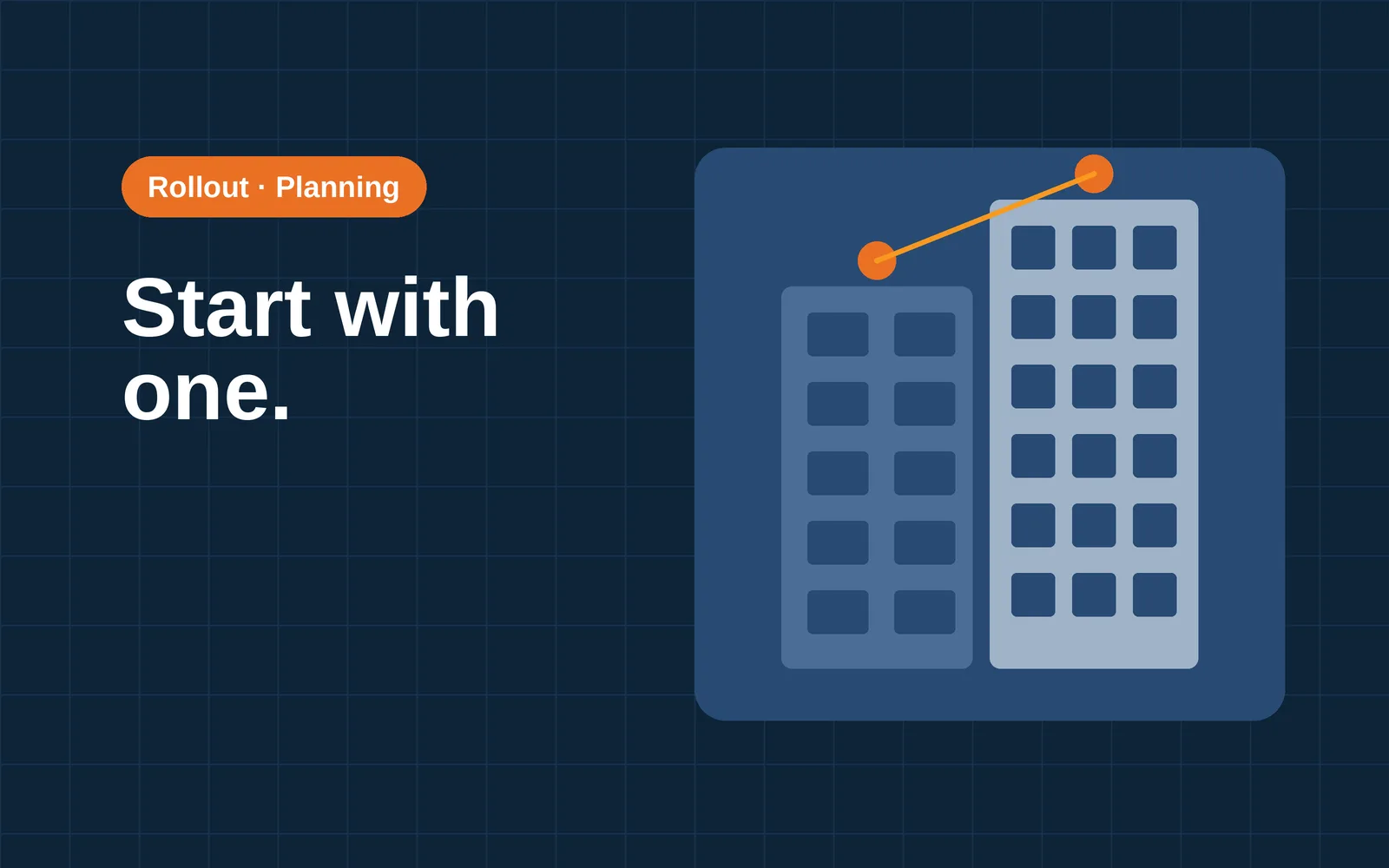
Start with one building and let its measured results decide what happens next. That is a practical judgment, not a published finding: the DOE and REHVA documents cited below give no rule for how many buildings to begin with, so the steps here are practice built on that guidance, and each says so.
A US Department of Energy presentation on retro-commissioning in the public sector (an NREL webinar, 18 July 2013) says public agencies can start by conducting retro-commissioning in a sample group of their own buildings and then use the results to build broader policy. It defines retro-commissioning as a systematic process for identifying and improving less than optimal energy performance.
What you can settle if you start with one building
One building cannot prove what will happen across a portfolio. It can answer the questions that decide whether a wider rollout is worth planning. These questions are a practical list, and no published method is behind them.
- Does the measured pattern in the rooms match what the schedule and the drawings say?
- Is the data credible: do sensors read sensibly, and are gaps rare?
- Can the team act on what the data shows? The DOE's guidance on energy management and information systems (EMIS, February 2022) describes them as human-in-the-loop tools that will not generate results unless energy conservation measures are identified, acted upon and implemented.
- Does a change show up in the before and after record?
Which building to start with
The DOE retro-commissioning presentation names three moments when the work makes sense: at the time of sale, at HVAC replacement and at a major renovation. It also says the work is valuable when buildings change use or have operations and maintenance problems or comfort complaints. Those are sourced triggers. The rest of this section is practice.
To start with one building well, pick one that looks like most of the portfolio, so that the results transfer to the others. The best and the worst building in the portfolio would teach the least. It should have meter data for at least a year, HVAC that can be adjusted, and one named person who owns the outcome. A building with an unusual system teaches less about the next building than an ordinary one does.
What to measure first
This sequence is practice, assembled from the DOE and REHVA material cited here. No published method is behind it.
- Record the baseline Pull metered energy for the building covering both a heating and a cooling season, and note the occupied hours. REHVA's commissioning guidance for demand-controlled ventilation calls for tuning in both summer and winter, so the baseline should cover both.
- Check the sensors Place sensors in a few representative rooms. REHVA's guidance includes a check that CO2 sensors read the same ppm in an empty building in the evening or at night.
- Compare hours Set the hours rooms are occupied against the hours the equipment runs, and list the rooms where the two do not match.
- Fix, then verify The DOE's EMIS guidance describes a five-step cycle: identify and prioritize, validate, diagnose and triage, implement corrective actions, verify improvement, then monitor, update and maintain. Log each change with its date.
- Compare before and after Use the same meters and sensors for both periods, and account for weather and occupancy. The method is covered in How to verify ventilation savings with before and after sensor data.
Deciding on a rollout
Write the decision criteria down before the work starts on the first building. This is a practical suggestion, not a published rule. Examples are the number of faults found and fixed, the hours of equipment run time removed, and whether comfort and CO2 stayed within the limits the building team agreed. Setting them in advance keeps the decision from bending to whatever the data happens to show.
Check again after a season, not after a week. The DOE retro-commissioning presentation states that many measures addressed during retro-commissioning do not persist for a long time, which it puts at more than 6 months. Its example is a day shelter where, after the controls contractor's service agreement ended, several controllers lost communication and a rooftop unit defaulted to running 24/7. REHVA's commissioning guidance for demand-controlled ventilation recommends an inspection, function test and review after a period of normal operation, for example one year. The routine for that review is in A simple weekly routine for reviewing building data.
The DOE's EMIS guidance lists implementation of like improvements across multiple properties as one consideration when findings are sorted into implementation categories. As general reasoning from that listing, a fix found once in a first building can be repeated elsewhere. One building has its own climate, equipment and occupants, though, so the second and third buildings need their own baseline. When several buildings are running, One view for many buildings: what portfolio owners need covers what to look for.
Nomestic measures indoor climate room by room, works with or without a building management system (BMS), and nothing in the existing HVAC gets replaced. Devices are wireless and battery-powered, so a room takes minutes to equip. Owners can start with one building and start without upfront investment.