Technology
A simple weekly routine for reviewing building data
A 30-minute weekly routine for facility management teams: what to open, what to compare, what to log and when to escalate. A practical suggestion, not a published standard.

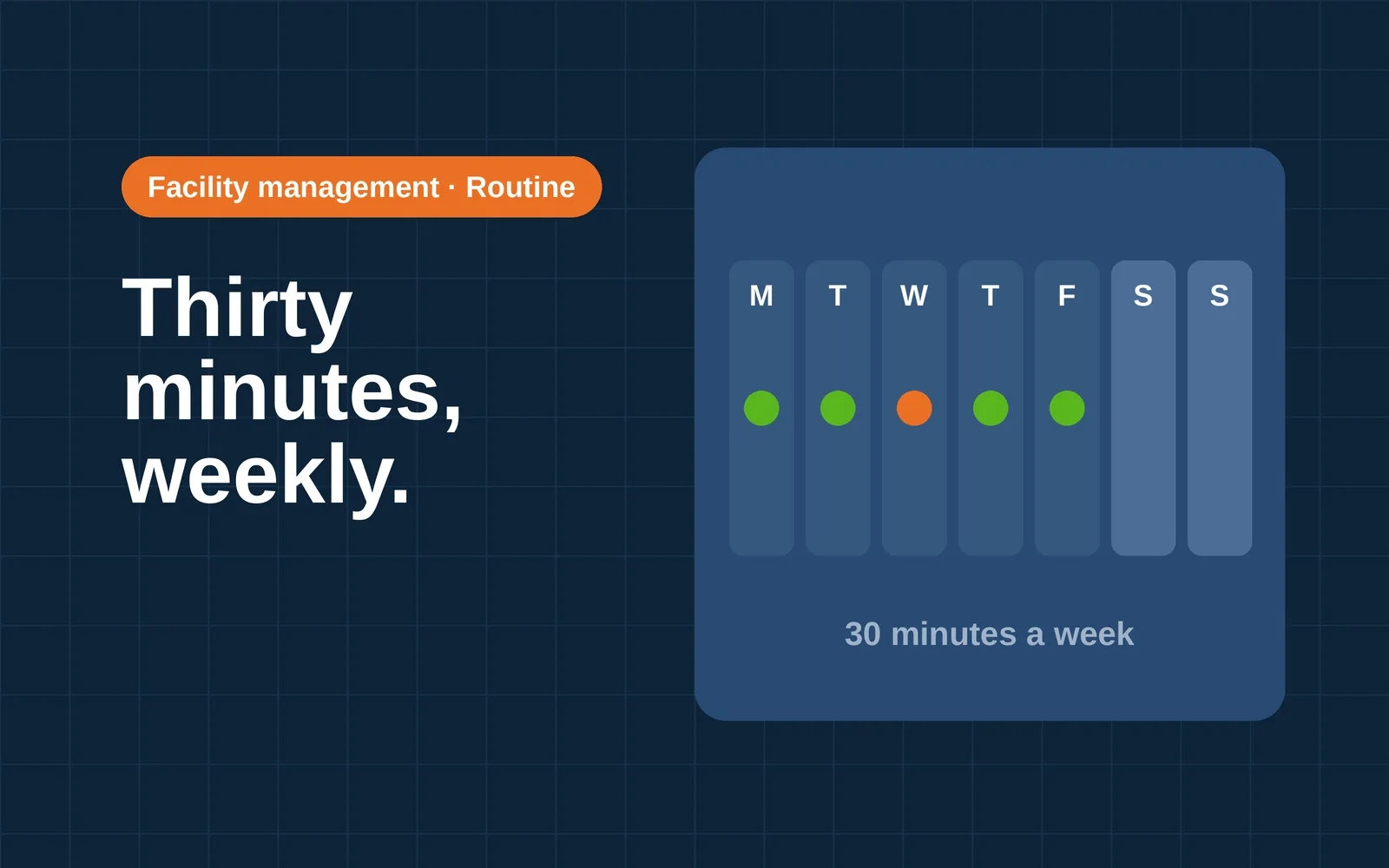
A short review at a fixed time every week is one way for a facility management team to keep up with building data. The routine below takes 30 minutes. It is a practical suggestion and not a published standard, and the weekly interval is a choice: a weekly look is short enough to catch a problem within days and long enough to show a pattern. What the guidance supports is the activity itself: looking at building data to tell normal operation from abnormal, then fixing and checking.
What a weekly review of building data builds on
Reported faults are common enough to justify a regular look for them. A 2009 LBNL report by Evan Mills, compiling commissioning case studies for 643 existing and new buildings, found a median whole-building energy saving of 16% in existing buildings. Commissioning is a larger exercise than a weekly review, so the figure says nothing about what a weekly review saves. PNNL's building re-tuning is a process of detecting, diagnosing and correcting operational problems, mostly through the building automation system. Its re-tuning guides each give a list of points to trend, charts to generate and suggested actions, and explain how to detect normal and abnormal operation.
ASHRAE Guideline 1.2-2019, on commissioning existing HVAC&R systems, lists verification of completed recommendations among the phases of its process, and ongoing commissioning activities as the last. The routine here borrows the same loop in small form: look, log, fix, check. That adaptation is a practical suggestion. Katipamula and Rice (PNNL, 2012) say re-tuning can be repeated every 3 to 4 months, so the weekly review sits between those larger passes.
The 30-minute facility management routine
- Open exceptions first (5 minutes) Start with whatever was flagged since the last review: alarms, rooms outside their agreed range, devices that stopped reporting. Count them before reading any. If nothing was flagged, check that every sensor is still reporting, because a sensor that went silent can look the same as a room with no problem.
- Compare the week with the week before (10 minutes) Open the same views every time. Look at occupied hours first: peak CO2 and temperature by room, and which rooms spent time outside the agreed range. Then look at nights and weekends for fans, heating or cooling running in empty rooms. Compare each room with a similar one, and with the same period a year ago if the history exists. The DOE O&M Best Practices guide (2002 edition, section 3.3) suggests comparing monthly energy use against the same month of the prior year.
- Check the oddest rooms against reality (5 minutes) Pick the one to three rooms that look most unusual. Ask whether a complaint, a walk-through or a person in the room matches the data, and check the sensor before blaming the equipment. In the LBNL fault analysis (Crowe et al., 2023), faulty zone temperature sensors were reported on 46% of air terminal units at some point in time, so a strange reading can be the sensor.
- Log what was seen (5 minutes) One line per finding: date, room or equipment, what was seen, suspected cause, who owns the next step, status. The DOE O&M Best Practices guide (2002 edition, section 3.4) says tracking work orders over time helps managers understand workloads and schedule staff, and lists the backlog of corrective maintenance as an indicator of workload issues and of the effectiveness of preventive and predictive maintenance programs. A findings log kept next to the work orders gives a similar history.
- Decide what to escalate (5 minutes) Escalate when the same finding appears two weeks running, when it affects several rooms served by the same equipment, when the fix is outside the team's access or budget, or when a contractor is involved. State what was seen, since when, and what has been tried. These criteria are practice, and each team should set its own.
What to look for in the first month
Early reviews are slow because nothing is normal yet. In the first weeks, the aim is to learn what a normal week looks like for each room type and to note which rooms differ from the rest. After a month, deviations stand out against that baseline, and the log shows which problems repeat. For a quick read of a day of CO2 data, see how to read ventilation data in five minutes. The night and weekend check is covered in three signs your ventilation runs when nobody is there. Both the baseline idea and the order of checks here are practice.
Keep the operations manual to hand. ASHRAE Guideline 4-2019 covers the format and content of operations and maintenance documentation, and its appendices include an operations manual and a maintenance manual. As practice, compare an odd pattern with the documented schedules and setpoints, where they exist, to see whether the building is doing what it was told to do.
When to move from weekly review to re-tuning
A weekly review finds symptoms. As practice, problems in control logic often need a structured pass. PNNL's building re-tuning material has nine guides, each for a commonly occurring operational problem, among them air-side economizer operation, occupancy scheduling (night and weekend temperature setback and supply fan cycling during unoccupied hours) and minimum outdoor-air operation. If the log keeps pointing at one of these, that is a reasonable time to schedule a re-tuning pass or call in the controls contractor.
What the routine cannot do
Thirty minutes of review does not replace inspections, and data shows conditions without proving causes. The same room symptom can come from several faults, so a finding is a prompt to look and not a diagnosis. See spotting ventilation problems before tenants complain for early indicators that come before complaints, and fault detection and diagnostics for HVAC for the faults found most often in the LBNL data.