Technology
What facility managers get wrong about CO2 sensors
Five documented problems with CO2 sensors in buildings: unchecked accuracy, self-calibration limits, placement, single-number thresholds and treating CO2 as air quality.

Five problems with CO2 sensors in buildings are documented in named sources: installed sensors that are far off, self-calibration that depends on the room, placement that changes the reading, one number judged against one threshold, and CO2 read as a measure of air quality as a whole. Of the sources cited here, only a Lawrence Berkeley National Laboratory field study reports on facility managers: when asked, no facility manager indicated that they had calibrated sensors since installation. For the other four, the sources describe the problem and say nothing about how often facility management teams meet it.
Installed CO2 sensors can be far off
Lawrence Berkeley National Laboratory checked 208 single-location CO2 sensors in 34 commercial buildings (LBNL-3279E, 2010). The mean error was small, -9 ppm at 1,010 ppm, but individual errors were not. At 1,010 ppm the mean absolute error was 138 ppm, 40% of sensors were off by more than 75 ppm and 19% by more than 200 ppm. Sensor age was not consistently a statistically significant predictor of error, and when asked, no facility manager indicated that they had calibrated sensors since installation.
The report concludes that many CO2-based demand controlled ventilation systems will, because of poor sensor accuracy, fail to meet the design goals of saving energy while assuring that ventilation rates meet code requirements. It lists calibration immediately after installation and periodically after that as an option, and says research is needed to determine whether that gives acceptable accuracy at acceptable cost.
Addendum al to ANSI/ASHRAE Standard 62.1-2016, approved in 2019, states in its foreword that the standard had no requirements for the accuracy of CO2 sensors used for demand control ventilation, and adds language from the 2013 California Title 24. It requires manufacturer certification to within ±75 ppm at 600 and 1,000 ppm and factory calibration. Table 8.2 adds a maintenance task to verify the accuracy of permanently mounted sensors, including CO2 sensors used for demand control, with recalibration or replacement for any sensor that misses the accuracy stated in the O&M manual.
Self-calibration depends on regular outdoor-level air
Some NDIR sensors correct their own drift, and the method assumes the sensor regularly sees outdoor-level air. Sensirion's SCD4x data sheet (version 1.5, July 2023) states that the algorithm assumes exposure to 400 ppm at least once per week. LBNL describes the same logic as assuming that the lowest CO2 concentration the sensor encounters is approximately 400 ppm. Amphenol's note on its ABCLogic function says it is designed for spaces unoccupied for 4 hours per day or more, advises deactivating it where regular background levels are unlikely, such as spaces occupied around the clock, and says calibration may then be required every 2 to 3 years.
Two points follow, both reasoning from those descriptions and not measured results. A room that never empties gives the algorithm no true baseline. And 400 ppm is below current outdoor levels: NOAA reports a Mauna Loa monthly mean of 426.07 ppm for September 2026 (preliminary), and LBNL found a building where the outdoor CO2 reading averaged approximately 510 ppm. Mauna Loa is a remote background site, so air at a given building can differ.
Placement changes the reading
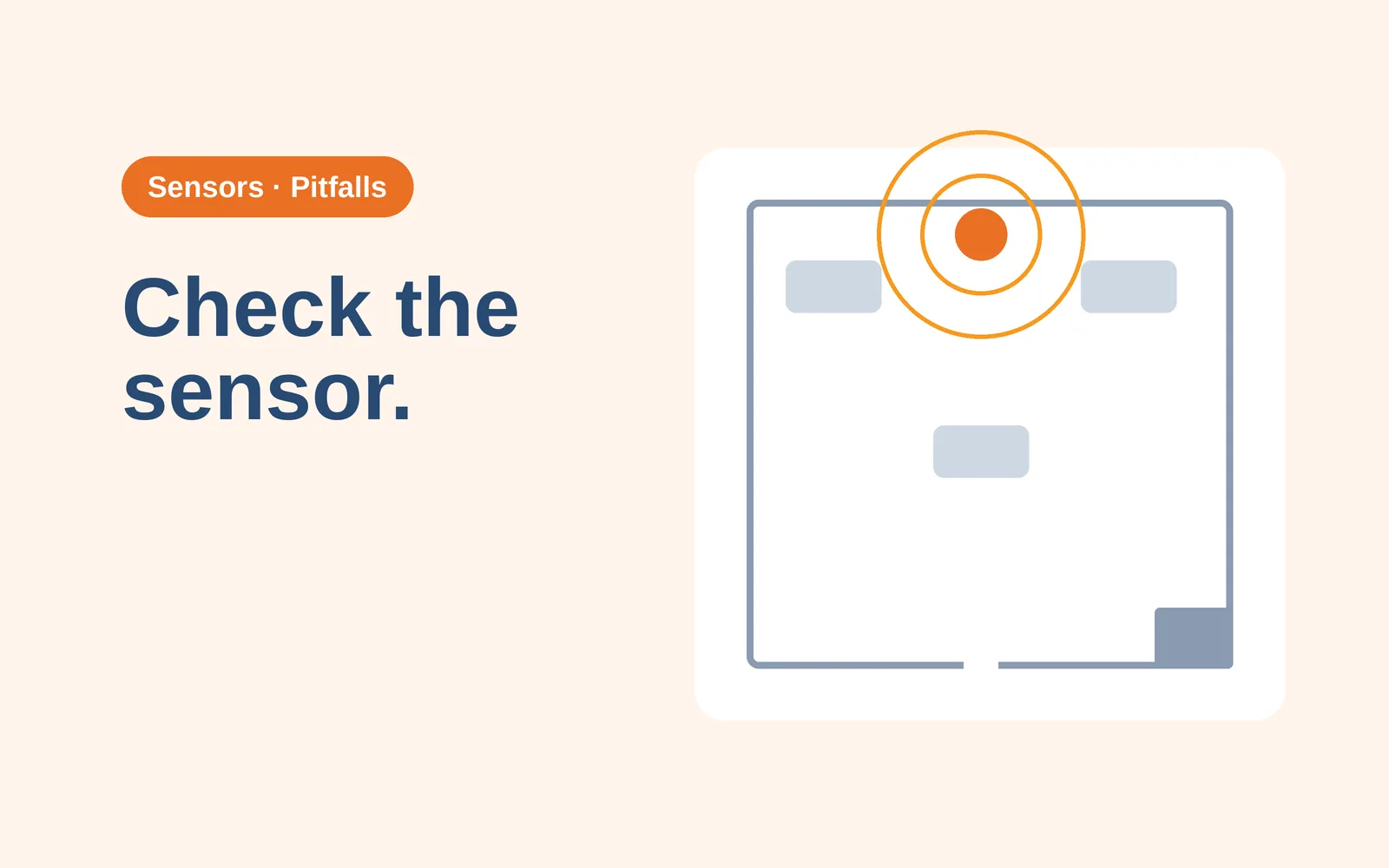
The UK Health and Safety Executive (HSE) advises head height, away from windows, doors and air supply openings, more than 50 cm from people, and testing several spots to find the most representative one. LBNL's meeting-room data show how much position can matter: in some instances, concentrations at different wall-mounted sample points in the same room varied by more than 200 ppm. Ventilation type changes the answer too. In a computational fluid dynamics study (Pei, Rim, Schiavon and Vannucci, Energy and Buildings, 2019), sensors at the room exhaust could meet the accuracy requirements of ASTM E741 and California Title 24 with mixing ventilation, but with displacement ventilation exhaust sensors could overestimate the breathing-zone concentration.
The count matters as well. One sensor per floor describes an average, as explained in why one CO2 sensor per floor misses the problem rooms, and mounting details are in where to place CO2 sensors for ventilation control.
One reading against one threshold
A widely used yardstick is 1,000 ppm. NIST Technical Note 2213 says ASHRAE Standard 62-1981 contained an indoor CO2 limit of 2,500 ppm that was changed without explanation to 1,000 ppm in the 1989 version, and that the value has been viewed by many as a de facto indoor air quality standard without a sound understanding of its basis. ASHRAE's issue brief on indoor carbon dioxide says claims that Standard 62.1 requires indoor CO2 below a certain threshold are incorrect. The HSE adds that single or snapshot readings can be misleading and that CO2 measurements are only a broad guide to ventilation.
Reading the number also takes context. The ASHRAE document lists the number and activity of occupants relative to design capacity, the time since occupancy began, and the absence of combustion or other CO2 sources. A publication by Rich Prill of the Washington State University Extension Energy Program (revised 2000) says that interpretation of CO2 data is often a more significant source of error than instrument accuracy. Which threshold applies to which room is covered in what is a good CO2 level in an office.
CO2 does not measure air quality as a whole
ASHRAE's issue brief on indoor carbon dioxide says indoor CO2 concentrations do not indicate the air quality of a building as a whole, and its technical FAQ calls CO2 a poor indicator of other contaminants such as VOCs from furnishings and building materials. The same document says CO2 readings far above expected ranges may indicate that the ventilation system is not functioning properly, and that CO2 can be used to verify ventilation performance against existing standards. A low reading is therefore consistent with ventilation keeping up with the people in the room and says little about sources that are not people (reasoning from the ASHRAE statements).
The HSE adds cases where a CO2 monitor is of limited use: rooms with air cleaning units, spaces where a process produces CO2, rooms with few or inconsistent occupants, and large open spaces where the air may not be fully mixed. CO2 monitor or air quality monitor covers when to add particles and chemicals to the measurement.