Technology
What changes when ventilation follows occupancy
When airflow follows occupancy, fans slow down and rooms differ. What changes in airflow, energy, comfort and upkeep, with the evidence and its limits.

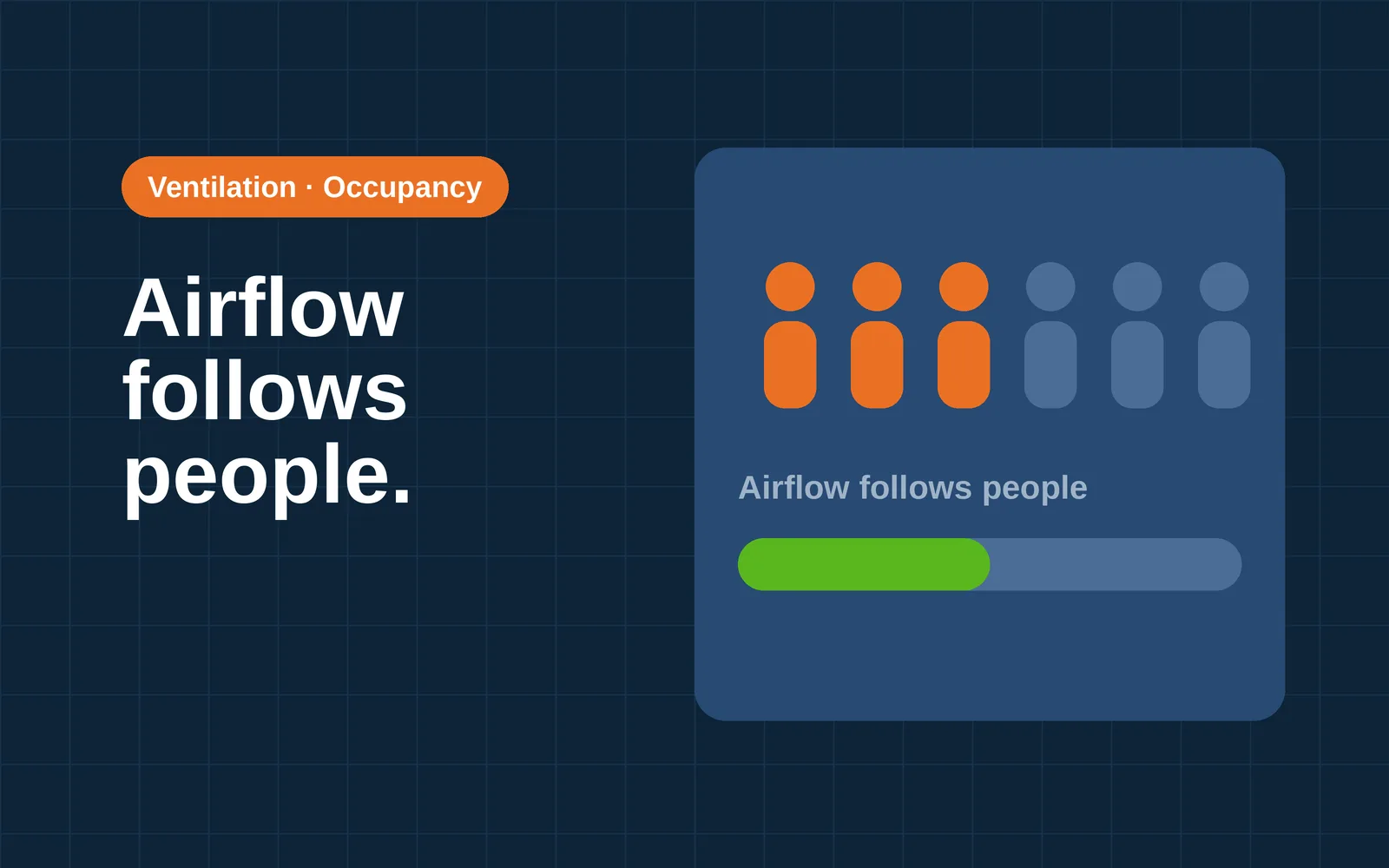
When ventilation follows occupancy, the airflow in a room stops being a fixed number and becomes a range that moves with the people in it. That is the idea behind demand controlled ventilation (DCV). A REHVA Journal paper on commissioning DCV (Mysen and colleagues, 2015) says a DCV system will typically run at 30% to 80% of maximum airflow. What that does to energy, comfort and upkeep depends on the baseline, the climate and the sensor, and every figure below comes with its conditions.
Airflow: the people part follows occupancy, the area part stays
Standard 62.1 splits outdoor air into a part per person and a part per unit of floor area, and only the people part follows occupancy. Take a 1,000 ft² meeting room at the Table 6-1 values in addendum w to Standard 62.1-2022: 5 cfm per person, 0.06 cfm per ft² and a default density of 50 people per 1,000 ft². At full design occupancy the breathing-zone outdoor airflow is 310 cfm. With 10 people it is 110 cfm, about 65% lower. With the room empty and still treated as occupied it is 60 cfm, under a fifth of the design figure. These are table values worked out by arithmetic, and the full procedure adds corrections.
Research goes further. ASHRAE's 2019 report on research project RP-1747 says its control sequence accounts for occupancy presence sensing and for the occupied-standby mode in Standard 62.1, which allows zone ventilation to be reduced to zero when a zone is detected to be empty. The report does not name the edition. The sequence was tested in simulations and lab-scale tests, and the researchers said they hoped to do field-scale testing in a separate project.
The starting point decides how large the change is. The Pacific Northwest National Laboratory (PNNL) literature review of March 2012 says installers often set the minimum airflow of a terminal box at 30% to 50% of maximum, and that conference rooms often receive the airflow designed for full occupancy even when they are empty. As general reasoning, those are the rooms where airflow moves most when it follows occupancy.
Energy: large estimates, small measurements
The PNNL review quotes an estimate of energy cost savings of 20% to 30% for open-space offices with average occupancy of 40%, attributed to Mansson (1994) and Meier (1998). It also cites the Advanced Energy Retrofit Guide for Office Buildings (Liu and colleagues, 2011) on a 4% reduction in whole-building energy use from occupancy-based control in conference rooms alone. The first is an estimate by the original authors, and the second is a guide figure for one measure in one building type.
Measurements are smaller and narrower. At the University of Coimbra, Chenari, Saadatian and Gameiro da Silva (Air, 2025) compared two occupancy strategies in one 25 m² test room over two days. Fan energy was 0.034 kWh per day when airflow followed the number of occupants, against 0.081 kWh per day when the fan ran at full power throughout the occupied period. Average occupancy was 1.8 and 1.9 people on the two days, and the authors say a definite comparison cannot be made because occupancy was not the same. They list a single-site lab, CO2 as the only pollutant considered and unassessed occupant behavior as limits.
Whole-building figures carry conditions as well. ASHRAE reports 7% to 44% HVAC energy savings against non-DCV baselines for the RP-1747 work, and 10% to 30% in simulations of an office building with realistic occupancy schedules, and notes that actual savings depend on the building's occupancy profile.
Lawrence Berkeley National Laboratory (LBNL) is more cautious. Its April 2010 report on California's Title 24 says DCV would generally not be cost effective for general office spaces in California if existing offices have 28 cfm per person of ventilation, and would often be cost effective at 80 cfm per person. The savings studies for demand controlled ventilation are set out in more detail in the article on demand-controlled ventilation.
Comfort: CO2 settles higher, with a delay
Less air in a lightly used room lets CO2 settle higher. In the Coimbra test the average CO2 was 948 ppm with occupancy-level control against 822 ppm with the constant-volume strategy. CO2-based control works to a limit. Addendum ab to Standard 62.1-2022 (approved 31 October 2023) states the limit as a difference above ambient, 600 ppm for office space, and lets designers assume ambient is 400 ppm, which makes 1,000 ppm. The addendum does not allow CO2-based DCV in zones with indoor CO2 sources other than occupants.
Timing changes too. The PNNL review states that the delay in CO2 concentration after occupancy rises is at least 10 to 20 minutes. In a meeting room that fills within a few minutes, the first part of the meeting is ventilated for the empty room (general reasoning). On the comfort side, the same review says a constant minimum airflow results in comfort issues and wasted energy, and that excess minimum flow causes reheat and fan energy waste. Lower airflow in empty rooms would cut that waste (general reasoning).
Upkeep: demand controlled ventilation adds equipment to maintain
Demand controlled ventilation that runs on CO2 depends on the sensor. LBNL checked 208 CO2 sensors in 34 commercial buildings. At about 1,010 ppm, 40% had errors above 75 ppm and 13% above 300 ppm, and sensor age did not reliably predict error. Its Title 24 report adds that many deployed sensors cannot practically be calibrated because they lack an inlet port or a calibration protocol. Addendum ab set sensor accuracy within 75 ppm at 600, 1,000 and 2,500 ppm and required sensors to be certified to need calibration no more often than every five years. Addendum d (approved 31 March 2025) modifies the accuracy range, so the current text of the standard governs. How to place the sensors is covered in where to place CO2 sensors for ventilation control.
Counting people has limits too. LBNL found that optical people counters work well much of the time and have large counting errors in some situations. The PNNL review concluded in 2012 that several technologies show promise but none fully met the need with adequate accuracy and sufficiently low cost.
Development shows how things go wrong. ASHRAE reports that early RP-1747 equations that worked on paper caused problems in the real system because of sensor error, transients and network delays. The REHVA paper lists commissioning checks: confirm that all CO2 sensors give the same reading when the building is empty, and override each unit's room signal to force maximum and minimum airflow while recording the result.
Addendum f to Standard 62.1-2022 (approved 30 September 2025) adds emergency control modes. One disables DCV and sets outdoor air intake and exhaust to the designer's maximum, for example during a temporary period of unusual indoor contaminant source. The addendum's foreword says the method of initiation is not a requirement and gives manual start or a sensed value as examples. Keeping a way for staff to override normal automatic control is a practical suggestion. The article on ventilation control compares schedule, CO2 and occupancy signals.
Nomestic measures indoor climate room by room, including CO2, temperature and humidity, and works with or without a building management system (BMS). Operators can override automatic adjustments at any time, and savings are verified by comparing measured data before and after a change. What makes that comparison fair is covered in how to verify ventilation savings.